
Print on demand lets you sell custom-designed products, like t-shirts, mugs, or wall art, without buying inventory upfront. A production partner prints and ships each item only after a customer orders it, so you pay for production after the sale happens, not before. That structure makes it one of the lower-risk ways for creators, side-hustlers, and small ecommerce sellers to launch a product line.
TL;DR:
- Order a physical sample before launch to check print quality, color accuracy, and fit; you still handle customer inquiries, refunds, and returns.
- A $28 shirt leaves about $13.76 in gross profit after roughly $2.24 in fees and other order costs, before ad spend or occasional reprints.
- Production takes 1 to 7 business days; quote customers delivery times that include transit, and favor local production for international orders.
- Start with two or three product types in one niche, then test demand with a small promotion before expanding your catalog or increasing ad spend.
- Sell only original, licensed, or public domain designs; unauthorized characters, logos, or trademarked phrases can trigger takedowns or legal claims.
Table of Contents
- How print on demand works: end-to-end process
- What you can sell with POD and how to pick product types
- How to start a POD store: a step-by-step checklist
- How to choose a POD provider: evaluation criteria
- Pricing and margins: example math and the levers that move profit
- Fulfillment and shipping realities
- Monetization and bookkeeping tips from Win Personal Finance
- Legal considerations: copyright, trademarks, and liability
- Marketing and customer acquisition for POD sellers
- Tools and software for design and automation
- Tax implications and financial management for POD income
- Who benefits most from print on demand
- Win Personal Finance resources for side-hustle sellers
- FAQ
- Sources
How print on demand works: end-to-end process
Print on demand follows a predictable sequence, and understanding each stage helps you spot where your time, money, and control actually sit.
It starts with design. You create or license artwork, then prepare it in the file format and resolution your provider requires, usually a high-resolution PNG or vector file sized to the product’s print area. Most providers offer a mockup generator so you can preview how the design looks on a shirt, tote bag, or canvas before it ever reaches a customer.
Next comes store integration. You connect your online store to a POD provider through a plugin or API, which syncs your product listings, inventory status, and order data automatically. This is the layer that turns a design file into a sellable product without manual work on your end.
When a customer places an order, it routes to your print provider, who produces, packages, and ships the item directly to the buyer. You never touch the physical product.
Throughout this process, you retain control over:
- Pricing: you set the retail price and keep the margin above production cost.
- Branding: packaging inserts, labels, and store presentation stay yours to design.
- Customer service: you handle inquiries, refunds, and returns even though a third party fulfills the order.
That last point matters. Customers see your brand, not your provider’s, so service quality still rests on you.
What you can sell with POD and how to pick product types
Print on demand catalogs span a wide range of categories, and your choice affects both your margin and your shipping cost. Common categories include:
- Apparel: t-shirts, hoodies, and hats, usually the highest-demand category with moderate margins.
- Home decor: mugs, blankets, and pillows, often priced higher but with bulkier, pricier shipping.
- Wall art: canvas prints and posters, which carry strong margins but are more fragile to ship.
- Accessories: phone cases, tote bags, and jewelry, typically lightweight with lower shipping costs.
Lightweight, flat items like posters and phone cases tend to ship cheaper and faster, protecting your margin on lower-priced orders. Bulkier items like blankets or framed art can carry higher retail prices, but shipping costs eat into that advantage, especially internationally.
Design constraints also shape your product mix. A detailed illustration that looks sharp on a large canvas may lose clarity on a small accessory, so match your artwork’s complexity to the product’s print area before committing to a full catalog.
Pro Tip: Start with two or three product types in one niche rather than spreading one design across ten categories. It’s easier to track margin and demand per SKU when your catalog is focused.
How to start a POD store: a step-by-step checklist
Launching a print-on-demand store is less about technical skill and more about sequencing the right decisions before you spend money on marketing.
- Pick a niche and product mix. Choose a theme and two or three product categories that fit it, rather than trying to cover every option at once.
- Create or license your designs. Use your own artwork or a licensed design, keeping print area and resolution requirements in mind.
- Build mockups and order a physical sample. A sample lets you check print quality, color accuracy, and garment fit before a customer ever sees the product.
- Set up your store. Shopify, Etsy, and WooCommerce are the most common platforms for POD sellers, each with direct integrations to major providers.
- Connect your POD provider. Link your store through the provider’s app or plugin so orders route automatically once you publish listings.
- Set pricing and publish listings. Price to cover production cost, shipping, and marketplace fees, with room left for profit.
- Launch a small test promotion. A modest ad budget or an organic social push helps you validate demand before scaling inventory of designs or expanding your catalog.
If you’re also considering digital products alongside physical ones, our guide to protecting your profit selling Etsy digital products covers pricing and platform fees worth factoring into your overall plan. For a broader look at where to list and sell once your store is live, see our roundup of websites to make money online.
How to choose a POD provider: evaluation criteria
Not all print-on-demand providers operate the same way, and the model behind each one affects your base cost, print quality, and how fast orders reach your customers. Provider models generally fall into three types: vertically integrated companies that run their own production facilities, marketplace platforms that route orders to a network of third-party providers, and local-partner networks that print closer to the buyer.
When comparing providers, weigh these factors:
- Catalog breadth: how many product types and variants the provider actually offers.
- Base production cost: what you pay per unit before shipping and fees.
- Fulfillment time: how quickly an order moves from placed to shipped.
- Store integrations: whether the provider connects cleanly to Shopify, Etsy, or WooCommerce.
- Sample policy: whether you can order discounted samples to check quality before listing.
- White-label options: whether packaging can carry your branding instead of the provider’s.
Before committing to one provider, order a sample, inspect the print quality in hand, and track how long it actually takes to arrive. That real-world test tells you more than any catalog description.
As your store grows, many experienced sellers route different SKUs to different providers, sending each order to whichever supplier offers the best combination of cost, quality, and delivery speed for that specific product and destination. This kind of per-SKU routing is a meaningful operational upgrade once you’re running paid ads, since it protects margin order by order rather than relying on a single provider’s pricing across your whole catalog.
Pricing and margins: example math and the levers that move profit
Your profit on any POD item comes down to five line items: production cost, shipping, marketplace fees, payment processing, and an allowance for returns or reprints. If you price the shirt at $28, your fees total roughly $2.24, leaving you with about $13.76 in gross profit before accounting for ad spend or occasional reprints.
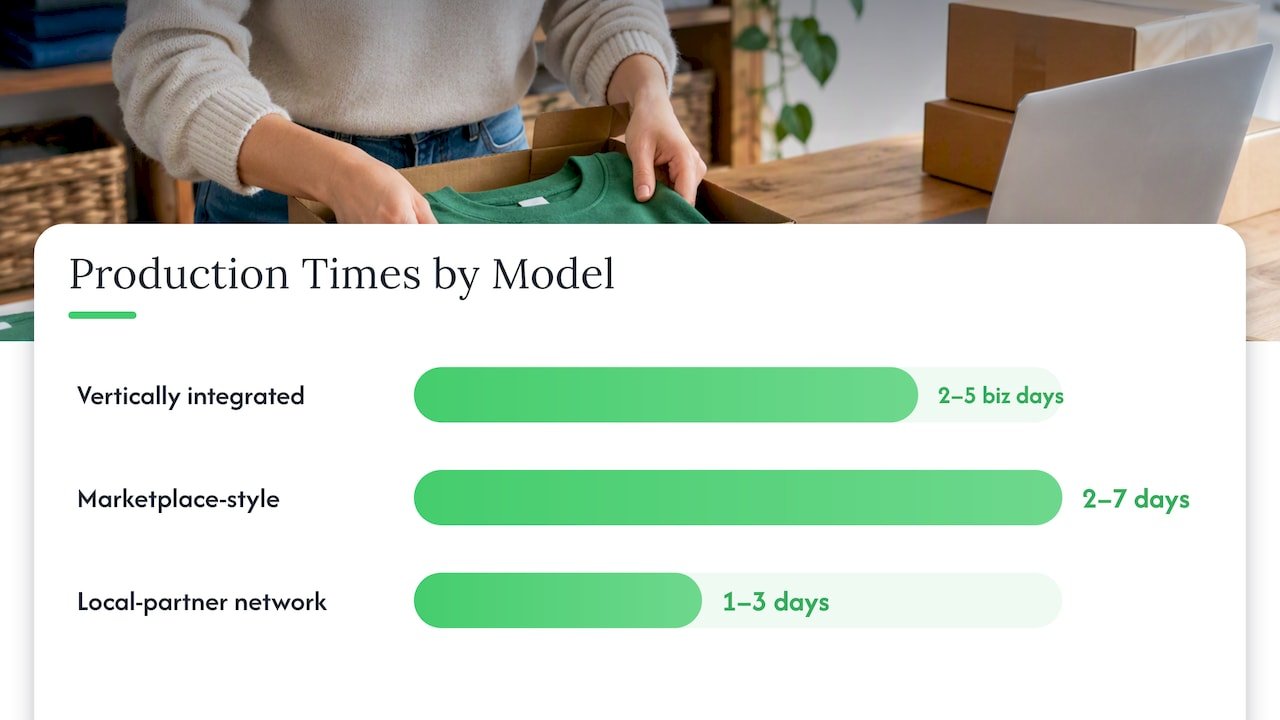
Production models directly affect that base cost. Vertically integrated providers typically deliver production in 2 to 5 business days, marketplace-style providers run 2 to 7 days depending on the individual supplier, and local-partner networks often complete production in 1 to 3 days, with total delivery time varying further by destination. Faster production doesn’t always mean lower cost, but it often reduces cart abandonment from buyers wary of long shipping windows.
Volume discounts and supplier routing are the other levers worth watching. Some providers lower per-unit costs once you cross certain order thresholds, and routing orders to whichever supplier offers the best landed cost for a given SKU and destination can shave real money off your per-order margin over time.
Fulfillment and shipping realities
Production time and total delivery time are two different numbers, and conflating them leads to frustrated customers. Production windows for most providers run 1 to 7 business days depending on the model, with transit time added on top once the item ships.
A few practices keep this realistic for both you and your customers:
- Set honest delivery estimates on your listings that reflect production plus shipping, not just shipping alone.
- Favor local production networks for international buyers when available, since printing inside the buyer’s country typically shortens delivery and reduces customs exposure compared with shipping from a single overseas facility.
- Build a clear returns policy that accounts for misprints versus buyer’s remorse, since POD items are custom-made and not always eligible for standard returns.
- Communicate proactively when an order is delayed, rather than waiting for the customer to ask.
Monetization and bookkeeping tips from Win Personal Finance
Treat your POD store like a small business from day one, even if it starts as a side project. Track cost of goods sold, ad spend, marketplace fees, and returns in a simple profit-and-loss sheet so you know your real margin, not just your revenue. Review ad return on spend by SKU, not just storewide, since one design can carry an entire campaign while others quietly lose money.
Pro Tip: Set a simple rule for yourself early: reinvest profit until you hit a consistent monthly baseline, then start taking a portion as a distribution rather than pouring everything back into ads.
Our guide to free financial wellness tools offers templates that work well for tracking income and expenses as a solo seller.
Legal considerations: copyright, trademarks, and liability
Every design you sell needs to be either your own original work, properly licensed, or in the public domain. Using a copyrighted character, logo, or trademarked phrase without permission can result in a takedown or legal claim, even if you only sold a handful of units.
If you use AI tools to generate or assist with designs, disclose that where relevant. The Federal Trade Commission expects transparency around AI involvement in product creation, and misleading claims about originality or authorship can raise consumer protection concerns. For a practical walkthrough of staying compliant while using AI-assisted art, this guide to selling AI art under U.S. copyright rules breaks down the key steps.
Product liability is worth a mention too. Most POD providers carry some manufacturing liability for defects in production, but you as the seller are still the face of the brand, so keeping clear records of your designs, licenses, and any permissions protects you if a dispute arises.
Marketing and customer acquisition for POD sellers
Organic social content tends to work especially well for POD because the products themselves are visual. Short videos showing a design on the product, styled photos, and behind-the-scenes posts about your creative process all give potential buyers a reason to stop scrolling.
Paid ads can accelerate testing once you have a design you believe in, but start small. A modest budget spent testing two or three designs against each other tells you more than a large budget spent on one unproven concept.
Email and SMS lists matter more as you scale, since repeat buyers typically cost less to re-engage than new customers acquired through ads. Building that list from day one, even with a simple discount offer, pays off later.
Tools and software for design and automation
A handful of tools cover most of what a new POD seller needs. Canva and Adobe Express work well for simple graphic designs, while Adobe Illustrator suits sellers who need vector files for sharper print quality. Mockup generators built into most provider platforms let you preview products without a professional photoshoot.
As your catalog grows, automation tools that sync inventory, pricing, and order routing across multiple providers save meaningful time and reduce manual listing errors. If you’re building a store from scratch and want a structured approach to launch mechanics beyond the design side, this ecommerce launch checklist walks through technical and compliance basics worth checking before you go live.
For sellers exploring beyond flat printed goods, converting 2D artwork into print-ready 3D formats is an emerging option worth knowing about, and this guide on turning line art into print-ready 3D files explains the file conversion process.
Tax implications and financial management for POD income
Income from a print-on-demand store is taxable, whether you’re running it as a side hustle or a full business. Keep records of every sale, provider invoice, and marketplace fee statement throughout the year rather than scrambling at tax time. If your POD income grows alongside other earnings, our breakdown of 2026 tax brackets can help you understand how additional income affects your overall tax position.
Setting aside a percentage of every sale for taxes, rather than treating all revenue as spendable profit, prevents an unpleasant surprise later. Many sellers also find it worthwhile to open a separate account for their store’s income and expenses, which simplifies both tax prep and profit tracking. For a more structured approach to managing this alongside other financial goals, our financial management plan guide walks through the basics step by step.
Who benefits most from print on demand
Sellers with a clear niche, a consistent design style, and some comfort with basic marketing tend to see traction fastest. A first sale often comes within weeks of launch, but a consistent monthly profit usually takes longer, so treat the first few months as a testing period. Pair your product work with basic bookkeeping and marketing skills early, since those habits matter as much as the designs themselves.
— Win Personal Finance
Win Personal Finance resources for side-hustle sellers
Print on demand is a product business, but the financial side, tracking margin, planning ad spend, and knowing when to reinvest, is where many sellers lose money without realizing it. We focus on that side of the equation: practical guides that help you plan a side hustle, track real profit, and make informed decisions about your earnings.
A few resources worth exploring as you build out your store:
- Our side hustle ideas and 30-day plan for structuring your first month of sales.
- Our smart budgeting habits guide for managing income that fluctuates month to month.
- Our Roth vs. traditional IRA breakdown for deciding where to put profit once your store is consistently earning.

Start with our personal finance resources to build the financial foundation that keeps your POD profits working for you.
FAQ
Is print-on-demand still profitable?
Yes, though profitability depends heavily on niche selection, pricing, and controlling acquisition costs. Side-hustle sellers often earn modest monthly amounts, while sellers who scale with strong marketing and supplier routing can generate considerably more.
What is the best company to use for print-on-demand?
There’s no single best provider. The right choice depends on your priorities: vertically integrated providers offer consistent quality, marketplace platforms offer a wider catalog, and local-partner networks offer faster regional delivery, so compare based on your product type and customer base.
Is print-on-demand a good idea?
It’s a reasonable way to test a product idea with low upfront cost, since you only pay for production after a sale occurs. It suits creators and side-hustlers who want to build a brand without holding inventory, though it works best alongside realistic expectations about margin and timelines.
Do you need an LLC to sell print-on-demand?
An LLC isn’t required to start selling, and many sellers begin as sole proprietors. As your revenue grows, forming an LLC can offer liability protection and tax flexibility worth discussing with a tax professional.
Sources
- Print on Demand – start your online business
- Federal Trade Commission guidance and consumer protection resources
- Printify vs Printful vs Gelato: Which Is Best for POD? | PodVector AI