
For tax brackets 2026, the federal income tax system keeps its seven marginal rates: 10%, 12%, 22%, 24%, 32%, 35%, and 37%. The top rate kicks in above the highest taxable income cutoff for single filers and married couples filing jointly, according to the IRS inflation adjustments for 2026. The full tables live on IRS.gov, and we break them down below so you can see exactly where your income lands.
TL;DR:
- The inflation-adjusted income thresholds for the 10% and 12% tax brackets increased by about 4%, offering more benefit to lower and middle-income households.
- Higher income brackets, including the top 37% rate, grew only by roughly 2.3%, which means high earners see less of a benefit from inflation adjustments.
- Moving into a higher tax bracket does not mean all your income is taxed at that rate; only the income above each threshold is taxed marginally at the higher rate.
- Estimating your 2026 tax bracket requires subtracting deductions and contributions from gross income to find your taxable income, which determines your actual tax rate.
- Adjustments to other thresholds, like the standard deduction and retirement contribution limits, impact how much income remains taxable and can help plan year-end tax strategies.
Table of Contents
- 2026 Federal Tax Bracket Tables by Filing Status
- What Changed for 2026: Inflation Adjustments and What They Mean for You
- Marginal vs. Effective Tax Rate: A Worked Example
- How to Estimate Your 2026 Tax Bracket Step by Step
- Other 2026 Thresholds That Can Shift Your Bracket
- Smart Moves to Manage Your Taxable Income in 2026
- Win Personal Finance Checklist: Putting 2026 Brackets to Work
- Why Getting the Numbers Right Shapes Everyday Money Decisions
- A Practical Next Step With Win Personal Finance
- FAQ
- Sources
2026 Federal Tax Bracket Tables by Filing Status
The tax brackets 2026 apply only to the slice of income that falls within it, not your entire paycheck. Here are the 2026 taxable-income ranges for each rate, based on the IRS release and the Tax Foundation’s 2026 bracket table.
| Rate | Single | Married filing jointly | Head of household | Married filing separately |
|---|---|---|---|---|
| 10% | $0 to $12,400 | $0 to $24,800 | $0 to $17,700 | $0 to $12,400 |
| 12% | $12,400 to $50,400 | $24,800 to $100,800 | $17,700 to $67,450 | $12,400 to $50,400 |
| 22% | $50,400 to $105,700 | $100,800 to $211,400 | $67,450 to $105,700 | $50,400 to $105,700 |
| 24% | $105,700 to $201,775 | $211,400 to $403,550 | $105,700 to $201,775 | $105,700 to $201,775 |
| 32% | $201,775 to $256,225 | $403,550 to $512,450 | $201,775 to $256,200 | $201,775 to $256,225 |
| 35% | $256,225 to $640,600 | $512,450 to $768,700 | $256,200 to $640,600 | $256,225 to $384,350 |
| 37% | Over $640,600 | Over $768,700 | Over $640,600 | Over $384,350 |
For 2026, the standard deduction rises as well, which we cover in more detail further down. Knowing where your taxable income, not your gross salary, falls on this table is the first step toward estimating what you actually owe.
What Changed for 2026: Inflation Adjustments and What They Mean for You
The IRS adjusts bracket cutoffs every year to account for inflation, and 2026 brought a notable twist: the adjustments were not uniform across all brackets. According to the Tax Foundation, the bottom two brackets (10% and 12%) grew by about 4%, while the higher brackets grew by roughly 2.3%.
That gap matters for a few reasons:
- Lower and middle income households get a bigger inflation cushion, which helps protect their real purchasing power.
- Higher earners see their thresholds move up more slowly, meaning more of their income can migrate into a higher bracket over time.
- The top 37% threshold for joint filers moved to $768,700, a cutoff that affects fewer households but shapes planning for high earners and small business owners.
The 10% and 12% brackets expanded by about 4% for 2026, nearly double the 2.3% growth applied to the higher brackets, according to the Tax Foundation’s analysis. In practical terms, this means many workers with modest raises will keep more of their income taxed at the lower rates, while higher earners should watch their bracket placement more closely heading into year-end.
Marginal vs. Effective Tax Rate: A Worked Example
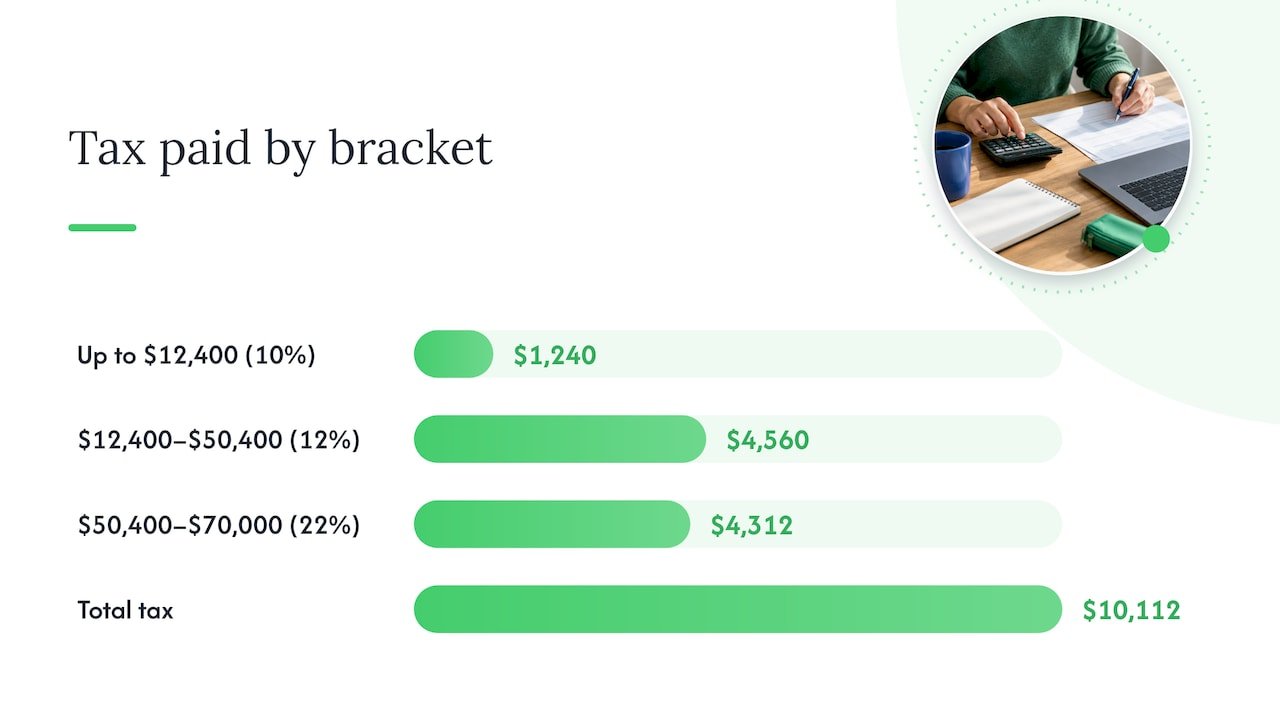
A lot of confusion around tax brackets 2026 comes from one mix-up: people assume their whole income gets taxed at their top bracket’s rate. It does not. Your marginal tax rate is the rate applied only to the last dollars you earn, the ones that fall into your highest bracket, while your effective tax rate is the average rate you pay across your entire taxable income, as explained by Investopedia and the Center on Budget and Policy Priorities.
Here is how that plays out for a single filer with $70,000 in taxable income in 2026:
- The first $12,400 is taxed at 10%, for $1,240.
- The next portion, from $12,400 to $50,400, is taxed at 12%, for $4,560.
- The remaining amount, from $50,400 to $70,000 ($19,600), is taxed at 22%, for $4,312.
- Total tax owed: $10,112.
- Effective tax rate: $10,112 divided by $70,000, or about 14.4%, well below the 22% marginal rate.
That gap between a 22% marginal rate and a 14.4% effective rate is the whole point: moving into a higher bracket never taxes income you already earned at a higher rate, it only applies to the next dollar in.
How to Estimate Your 2026 Tax Bracket Step by Step
Figuring out your bracket starts with your taxable income, not your salary. Here is the sequence we recommend walking through:
- Start with gross income from wages, self-employment, or other sources.
- Subtract pre-tax contributions like 401(k), 403(b), or HSA deposits, since these lower the income reported for tax purposes.
- Subtract your standard deduction (or itemized deductions if they’re larger).
- The result is your taxable income, the number you match against the bracket tables above.
- Find which bracket your taxable income falls into, then calculate tax owed using the marginal method shown earlier.
Say a single filer earns $85,000 in gross wages, contributes $6,000 to a 401(k), and takes the standard 2026 deduction for single filers.
Pro Tip: Use a paycheck calculator or the IRS withholding estimator early in the year, not in December, so you have time to adjust your W-4 or estimated payments before a surprise bill shows up.
Self-employed taxpayers face an extra layer: self-employment tax on top of income tax. A 1099 tax calculator built for 2026 rates can help estimate both pieces together, which matters when setting aside money for quarterly estimated payments.
Other 2026 Thresholds That Can Shift Your Bracket
Several other inflation-adjusted figures interact with your taxable income and are worth tracking alongside the brackets themselves, all published in the IRS 2026 adjustments release:
- The standard deduction for single filers and married filing separately rises for 2026, directly lowering taxable income before brackets apply.
- The standard deduction for married filing jointly and head of household also increased, following the same inflation formula.
- The annual gift tax exclusion and the Alternative Minimum Tax exemption amounts were adjusted as well, both worth checking if you make large gifts or have significant deductions.
- Retirement account contribution limits, including 401(k) and IRA caps, were updated for 2026 and directly affect how much income you can shield from current-year taxation.
Each of these numbers works alongside your bracket to determine your final bill, so a quick check of the full IRS release before year end can prevent surprises.
Smart Moves to Manage Your Taxable Income in 2026
Once you know where your income falls on the bracket table, you have real options for managing it, not avoiding tax, just being deliberate about timing and structure.
- Maxing out pre-tax retirement contributions (401(k), traditional IRA, SEP-IRA for the self-employed) reduces taxable income dollar for dollar up to the annual limit.
- HSA contributions work the same way if you have a qualifying high-deductible health plan, and the funds grow tax-free for future medical costs.
- Timing matters too: if you’re near a bracket edge, shifting a year-end bonus or deductible expense into a different tax year can change which rate applies to that income.
- Self-employed taxpayers should pay particular attention to estimated quarterly payments, since both income tax and self-employment tax accumulate without automatic withholding.
Pro Tip: Build a short year-end checklist: confirm your W-4 withholding matches your expected income, top off retirement and HSA contributions if you have room, and review whether any income or deductions can be shifted to the more favorable tax year.
For employees, a mid-year paycheck review often catches under-withholding before it becomes a April surprise. For self-employed readers, a 1099 tax calculator can help model quarterly payments against the 2026 brackets so you’re not guessing at what to set aside.
Win Personal Finance Checklist: Putting 2026 Brackets to Work
Here is a short checklist to help turn these numbers into action:
- Calculate your taxable income using the steps above, not just your salary.
- Set a target for pre-tax contributions you can realistically afford this year.
- Update your W-4 or estimated payments if your income or deductions changed.
- Put a reminder on your calendar for a mid-year check-in, since life changes (a raise, a new job, a side hustle) can shift your bracket fast.
If your situation involves multiple income streams, significant investments, or major life changes, a licensed tax professional can help you apply these numbers to your specific return.
Why Getting the Numbers Right Shapes Everyday Money Decisions
Tax brackets sound abstract until a bonus, a raise, or new freelance income shows up and you need to know what you’ll actually keep. The single most useful habit we can suggest is running your own numbers before you make a big financial decision, not after.
If you take away one thing from these updated figures, let it be this: check your actual taxable income against the 2026 tables before you decide how to handle a bonus, a side gig, or a retirement contribution increase. A few minutes with a calculator now beats a surprise at filing time later.
**
A Practical Next Step With Win Personal Finance
We built Win Personal Finance around one idea: money decisions get easier once the confusing parts are explained in plain language. Once you know your 2026 bracket, the next useful step is usually freeing up cash to put toward retirement or an HSA, and that’s where a solid budget comes in.

A few resources that pair well with what you just read:
- Our guide to smart budgeting habits walks through practical ways to free up money for pre-tax contributions.
- Our roundup of free financial wellness tools includes calculators that can help you model withholding and estimated payments against these new brackets.
Neither resource requires a sign-up or a sales pitch, just practical next steps you can use today.
This article is general information, not a substitute for advice from a qualified financial advisor. Consult a qualified financial professional about your own circumstances before acting on anything here.
FAQ
Are tax brackets changing for 2026?
Yes, the IRS adjusted the taxable-income cutoffs for all seven brackets for 2026, though the rates themselves (10% through 37%) stayed the same. The bottom two brackets grew faster than the higher ones, around 4% versus 2.3%, based on Tax Foundation data.
What states let you keep all of your Social Security and 401(k) income?
State tax treatment of Social Security and retirement account withdrawals varies widely and depends on each state’s own tax code, which falls outside federal bracket rules. We recommend checking your specific state’s department of revenue for current rules before assuming any income is fully exempt.
Which billionaires paid no federal taxes?
This question involves specific individual tax situations that aren’t covered by the 2026 federal bracket data in this article. For reporting on that topic, we recommend looking at investigative journalism and primary IRS data rather than general bracket guides.
Who gets the new $6,000 tax break?
Recent federal tax legislation included new provisions affecting certain taxpayers, and eligibility details depend on specific rules outlined in the IRS’s 2026 adjustments. Because eligibility can depend on income level, filing status, and other factors, we suggest reviewing the official IRS release or speaking with a tax professional to confirm whether you qualify.
How is my tax bracket different from my effective tax rate?
Your tax bracket (marginal rate) only applies to the portion of income within that bracket, while your effective tax rate is the average rate across your entire taxable income. As shown in the worked example above, a filer with $70,000 in taxable income in the 22% bracket pays an effective rate of about 14.4% once all brackets are averaged together.
Sources
- IRS releases tax inflation adjustments for tax year 2026, including amendments from the One, Big, Beautiful Bill | Internal Revenue Service
- 2026 Tax Brackets and Federal Income Tax Rates | Tax Foundation
- Marginal Tax Rate: What It Is and How It Affects Your Taxes | Investopedia
- Marginal and Average Tax Rates | Center on Budget and Policy Priorities