
Roth IRAs usually win if you expect to pay a higher marginal tax rate in retirement than you do today. Traditional IRAs usually win if you need tax relief right now and expect to land in a lower bracket later. For 2026, the combined contribution limit across both account types is $7,500, and Traditional IRA owners must start taking required minimum distributions by age 73.
TL;DR:
- The main decision between Roth and Traditional IRAs depends on whether your expected retirement tax rate will be higher or lower than your current rate.
- For 2026, the combined contribution limit is $7,500 for those under 50, with an extra $1,100 catch-up contribution available for those 50 and older.
- High-income earners may need to use backdoor Roth conversions due to income limits, but they should carefully consider the pro-rata rule and potential tax implications.
- Roth contributions allow penalty-free withdrawals of original contributions at any time, while Traditional IRAs require minimum distributions starting at age 73.
- Balancing both account types offers tax flexibility, helping hedge against future tax law changes and personal income fluctuations.
Table of Contents
- 1. Who Can Contribute: Eligibility and Income Rules
- 2. Contribution Limits and Catch-Up Rules for 2026
- 3. When Contributions and Withdrawals Get Taxed
- 4. Withdrawal Rules, Penalties, and Common Exceptions
- 5. RMDs and What Your Heirs Should Know
- 6. A Step-by-Step Framework to Choose Between Them
- 7. A Worked Example: Running the Break-Even Numbers
- 8. Practical Next Steps and Mistakes We See Often
- 9. Investment Choices and Flexibility Inside Each Account
- 10. Coordinating Your IRA Choice With a 401(k) or Other Workplace Plan
- 11. Estate Planning Details Beyond Naming a Beneficiary
- 12. How Your IRA Choice Affects Financial Aid and Benefit Programs
- 13. Why We Lean Toward Holding Both Account Types
- Resources From Win Personal Finance
- FAQ
- Sources
1. Who Can Contribute: Eligibility and Income Rules
Roth and Traditional IRAs use different gatekeepers. Roth eligibility depends entirely on your income, while Traditional deductibility depends on your income and whether you or your spouse have access to a workplace retirement plan.
For 2026, the income phase-out ranges for Roth contributions increased again, following cost-of-living adjustments in IRS Notice 2025-67. Once your modified adjusted gross income (MAGI) climbs into the phase-out range, your allowed Roth contribution shrinks gradually; above the top of the range, you cannot contribute directly at all. Traditional IRA deductibility works on a similar sliding scale, but the trigger is workplace plan access, not a hard income cutoff.
If your income is too high for a direct Roth contribution, a backdoor Roth conversion is often the workaround: you contribute to a Traditional IRA with after-tax dollars, then convert it to Roth. The catch is the pro-rata rule, which taxes conversions proportionally across all your pre-tax IRA money, not just the new contribution.
- Check your MAGI against the current year’s IRS thresholds before contributing directly to a Roth.
- Confirm whether your employer plan affects your Traditional IRA deduction.
- Keep records of nondeductible contributions and file Form 8606 for every conversion.
2. Contribution Limits and Catch-Up Rules for 2026
The IRS set the 2026 combined IRA contribution limit at $7,500 for anyone under 50. If you are 50 or older, you can add a $1,100 catch-up contribution, bringing your total to $8,600 for the year.
This limit is per person, and it applies across all your IRAs combined, not per account. If you split contributions between a Roth and a Traditional IRA in the same year, the two totals cannot exceed the single combined cap.
- A 45-year-old could put $4,000 into a Roth and $3,500 into a Traditional IRA, totaling the full $7,500 limit.
- A 55-year-old gets the same flexibility but up to the $8,600 combined cap.
SECURE 2.0 also introduced changes affecting how certain high-income catch-up contributions must be designated, a detail worth checking against current IRS guidance before you assume your catch-up dollars are flowing into the account you intended.
3. When Contributions and Withdrawals Get Taxed
The entire Roth versus Traditional decision boils down to timing: when do you want to pay tax on this money, now or later?
Traditional IRA contributions may be deductible in the year you make them, lowering your taxable income today. Withdrawals in retirement, however, get taxed as ordinary income, dollar for dollar. Roth contributions work the opposite way: you fund the account with money you have already paid tax on, and qualified withdrawals (after age 59½ and once you have held the account five years) come out completely tax-free, including all the growth.
That structure creates a straightforward comparison, laid out by Vanguard’s research on conversion math: with identical contributions and identical investment returns, your nominal balance at retirement is the same either way. The only real variable is your tax rate at the time you pay it.
- If your expected retirement marginal rate is higher than your current rate, Roth typically comes out ahead.
- If your expected retirement rate is lower than your current rate, Traditional typically comes out ahead.
- If the two rates are identical, the after-tax outcome is mathematically tied.
Pro Tip: Your “current” rate should reflect your marginal bracket, not your average tax rate, since that’s the rate your next dollar of income or deduction actually hits.
A few real-world wrinkles complicate the clean math. State income taxes vary widely and can shift the comparison if you plan to retire in a no-tax state. Future tax law is uncertain. And higher taxable income from Traditional withdrawals can also push more of your Social Security benefit into taxable territory and raise Medicare IRMAA surcharges, a point worth revisiting once you reach your 70s.
4. Withdrawal Rules, Penalties, and Common Exceptions
Both account types generally penalize early withdrawals, but the rules diverge in useful ways.
Roth accounts have one built-in advantage: because contributions are after-tax, you can withdraw your original contributions (not earnings) at any time, for any reason, with no tax and no penalty, according to IRS guidance on IRAs.
- First-time home purchase, up to a $10,000 lifetime limit, qualifies for a penalty exception.
- Qualified higher education expenses can also avoid the 10% penalty.
- Total and permanent disability qualifies, as does a qualified birth or adoption up to certain limits.
- Substantially equal periodic payments under Rule 72(t) let you access funds penalty-free on a structured schedule.
If you take an early distribution and believe an exception applies, you may need to file Form 5329 to claim it and avoid being assessed the penalty automatically.
5. RMDs and What Your Heirs Should Know
Traditional IRA owners must start taking required minimum distributions by April 1 of the year after they turn 73, according to IRS RMD guidance. Roth IRAs carry no lifetime RMD requirement for the original owner, which is one reason retirees who do not need the income often prefer letting Roth balances keep growing untouched.
The distinction matters for your heirs too, since inherited accounts carry their own distribution timelines regardless of account type.
- Traditional IRA RMDs force taxable income whether or not you need the cash, which can push you into a higher bracket.
- That extra income can also increase the taxable portion of Social Security benefits and trigger higher Medicare IRMAA premiums.
- Roth IRAs let you control the timing of distributions entirely, both for yourself and often for a surviving spouse.
- Inherited Roth and Traditional IRAs generally follow separate distribution rules for non-spouse beneficiaries, so check current guidance before assuming either type is RMD-free once inherited.
6. A Step-by-Step Framework to Choose Between Them
Picking between Roth and Traditional does not require guessing. Work through it methodically.
- Add your federal and state marginal tax rates together to get your current combined rate.
- Estimate your expected marginal rate in retirement, based on projected income, pension, and Social Security.
- Compare the two rates: a meaningfully higher retirement rate points to Roth, a meaningfully lower one points to Traditional.
- If the two estimates are close, consider splitting contributions between both account types instead of betting everything on one guess.
- Favor Traditional if you are a high earner today, need the current deduction for cash flow, or genuinely expect a much lower retirement income.
- Favor Roth if you are early in your career, expect higher future earnings, or want tax-free assets to leave to heirs.
Pro Tip: When your income swings year to year, such as with bonuses or self-employment, reassess your Roth versus Traditional split annually instead of locking into one strategy.
Holding both types of accounts gives you tax diversification, a hedge against the real possibility that tax law changes before you retire. Before converting any pre-tax balance to Roth, ask a CPA six things: what your conversion will cost in taxes this year, whether it pushes you into a higher bracket, how it affects Medicare IRMAA, whether the pro-rata rule applies to your existing IRA balances, whether spreading the conversion over several years helps, and whether state tax treatment changes the math. Large pre-tax IRA balances are the biggest red flag: converting even a small backdoor Roth contribution can trigger an outsized tax bill if the pro-rata rule pulls in old rollover money.
7. A Worked Example: Running the Break-Even Numbers
Say you contribute the full 2026 limit of $7,500 a year for 30 years, earning a hypothetical 7% average annual return, growing to roughly $708,000 before any withdrawals.
- If your tax rate is 24% both now and in retirement, Roth and Traditional produce the same after-tax spendable amount, about $538,000, confirming the break-even logic that Vanguard’s analysis describes.
- If your retirement rate drops to 15%, Traditional wins: you keep about $601,000 after tax, versus $538,000 in a comparable Roth funded with the same pre-tax dollars.
- If your retirement rate rises to 32%, Roth wins: your $538,000 stays untouched by tax, while Traditional shrinks to roughly $481,000 after tax.
The catch: Traditional lowers your out-of-pocket cost today by the amount of your tax deduction. If you do not actually invest that savings, a disciplined Roth saver often ends up ahead regardless of the bracket math. Plug your own numbers into the IRS tools or a retirement calculator before deciding.
8. Practical Next Steps and Mistakes We See Often
This week, check your MAGI against current phase-out limits, estimate your current and projected retirement tax rate, decide whether to split contributions, and save your Form 8606 if you convert anything.
The most common mistakes: assuming your tax rate will automatically drop in retirement, ignoring the pro-rata rule on backdoor conversions, and converting a large balance in a high-income year instead of spreading it across lower-income years.
9. Investment Choices and Flexibility Inside Each Account
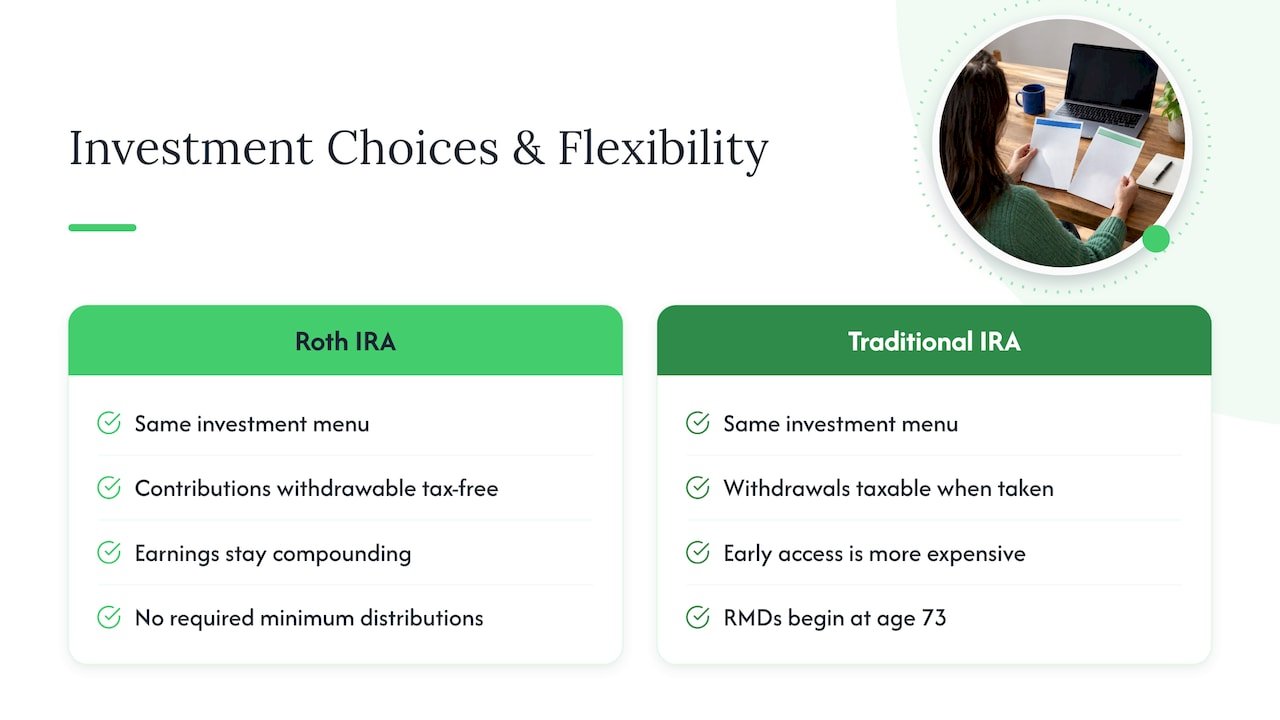
Roth and Traditional IRAs offer identical investment menus once the money is inside the account. Both can hold stocks, bonds, mutual funds, exchange-traded funds, and in some cases real estate or other alternative assets, depending on your custodian. The tax treatment differs, but the investment options themselves do not.
Where the accounts diverge is in day-to-day flexibility. Because Roth contributions can be withdrawn tax- and penalty-free at any time, a Roth IRA doubles as a more accessible fallback fund without disturbing the earnings that are still compounding. Traditional IRA withdrawals, by contrast, are taxable the moment they leave the account, which makes early access considerably more expensive even before a penalty applies.
Required withdrawals also shape how freely you can let investments ride. Because Traditional IRAs force RMDs starting at 73, you may be required to sell assets or pull cash at a time that is not ideal for your portfolio, particularly in a down market. Roth owners have no such deadline, which means a Roth IRA invested in growth-oriented assets can stay fully invested through a market downturn without a forced sale.
Neither account restricts how aggressively or conservatively you invest. The right allocation depends on your time horizon and risk tolerance, not on which IRA type you chose; the account is a tax wrapper, not an investment strategy in itself.
10. Coordinating Your IRA Choice With a 401(k) or Other Workplace Plan
Most people juggling a 401(k) and an IRA are really managing one combined retirement tax strategy, not two separate ones. Your workplace plan directly affects what you can do with your IRA, especially on the Traditional side.
If you or your spouse are covered by a 401(k) or similar employer plan, your ability to deduct Traditional IRA contributions phases out at a lower income than it would otherwise. Plenty of savers who assume they qualify for a full Traditional deduction discover they do not, simply because they have access to a workplace plan, even if they are not contributing much to it.
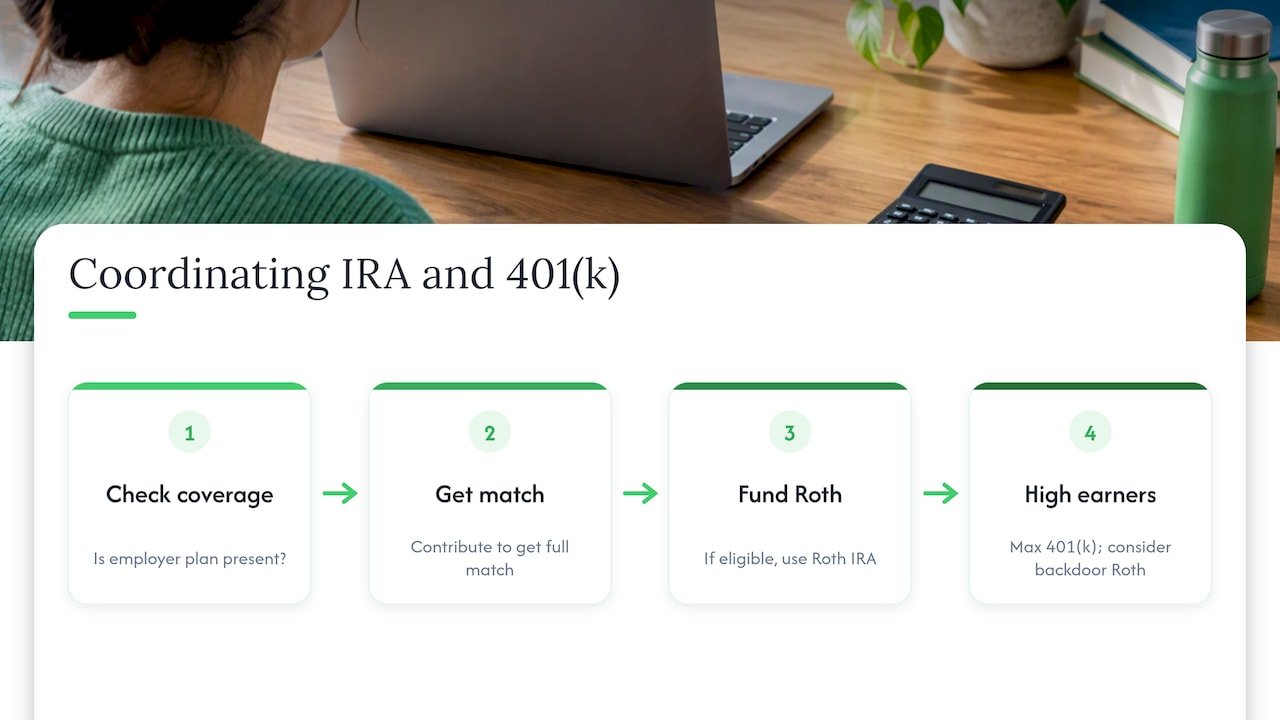
A common, effective combination: contribute enough to your 401(k) to capture the full employer match, since that is essentially free money, then direct additional savings toward a Roth IRA if you qualify, for the flexibility and tax-free growth. If your employer plan offers a Roth 401(k) option, you get a second lever to pull for tax diversification, since Roth 401(k) contributions have no income limit, unlike a Roth IRA.
High earners who are phased out of both a Roth IRA and a Traditional deduction often lean more heavily on maxing out the 401(k) first, then consider a backdoor Roth IRA contribution, watching carefully for the pro-rata rule if they have other pre-tax IRA balances sitting around from old 401(k) rollovers.
11. Estate Planning Details Beyond Naming a Beneficiary
Naming a beneficiary is the easy part. The tax character of the account you leave behind matters just as much to the people who inherit it.
A Roth IRA passed to heirs generally continues to grow and distribute tax-free, which makes it one of the more efficient assets to leave behind, since your beneficiaries will not owe income tax on withdrawals the way they would with an inherited Traditional IRA. Inherited Traditional IRA distributions count as taxable income to the beneficiary, potentially pushing them into a higher bracket in the very years they are also settling an estate.
Spouses have more flexibility than other beneficiaries, often able to treat an inherited IRA as their own. Non-spouse beneficiaries, including most adult children, generally face a compressed distribution timeline, meaning the account’s tax impact lands over a shorter period than the original owner might have planned for.
If leaving a tax-efficient inheritance is a priority, a partial Roth conversion during your lifetime, especially in years when your income is lower, can shift future tax burden off your heirs and onto you, at a rate you control. That is a strategic decision worth discussing with a CPA, since the right amount to convert depends on your full financial picture, not a one-size formula.
12. How Your IRA Choice Affects Financial Aid and Benefit Programs
Retirement account choice can ripple into places you might not expect, including financial aid applications and means-tested benefit eligibility.
For federal student aid purposes, retirement account balances, Roth or Traditional, are generally not counted as assets on the FAFSA. However, distributions you take during the base income year do count as income, and Traditional IRA withdrawals are fully taxable, which can inflate reported income more than a comparable Roth withdrawal of your own contributions would.
For means-tested benefit programs, retirement accounts are often treated differently than regular savings accounts, but the rules vary by program and state. What is more consistently relevant is income: Traditional IRA withdrawals count as taxable income that can affect eligibility thresholds for programs that look at modified adjusted gross income, while Roth withdrawals of contributions typically do not add to your taxable income at all.
If you anticipate applying for financial aid, Medicaid, or similar benefits in the years you plan to draw down retirement savings, the income-counting difference between Roth and Traditional withdrawals is worth factoring into your timeline, alongside the tax-rate comparison that drives the rest of this decision.
13. Why We Lean Toward Holding Both Account Types
We favor tax diversification because nobody can predict tax policy or their own income decades out. Splitting contributions between Roth and Traditional hedges that uncertainty. For conversions or complex situations, talk to a CPA who can run your specific numbers.
— Win Personal Finance
Resources From Win Personal Finance
We offer guidance to help you put this decision into action without an overwhelm of spreadsheets and tax jargon.

- Start with our personal finance guidance for a full view of where retirement saving fits into your broader money plan.
- Free up contribution room with our budgeting habits guide.
- Model your own break-even scenario using our free financial tools roundup.
This article is general information, not a substitute for advice from a qualified financial advisor. Consult a qualified financial professional about your own circumstances before acting on anything here.
FAQ
How much will $10,000 in a Roth IRA be worth in 20 years?
The actual figure depends entirely on the investment return you earn, which no account type guarantees. Run your own assumption through a retirement calculator, since the tax-free growth feature matters more for the comparison than any single projected dollar amount.
What does Warren Buffett say about Roth IRA?
We did not find a specific, verifiable statement from him endorsing Roth IRAs over Traditional accounts. The core decision still comes down to comparing your current and expected future tax rates, as covered above.
Does Dave Ramsey recommend Roth or traditional IRA?
Financial personalities differ in their general leanings, but the right choice for you depends on your own income, tax bracket, and retirement timeline rather than a one-size-fits-all rule. Use the break-even framework in this guide to decide for your specific situation.
What is the downside of having a Roth IRA?
You get no upfront tax deduction, so your take-home pay takes a bigger hit today compared to a Traditional contribution. Roth contributions also phase out at higher incomes, which can require a backdoor conversion and its pro-rata complications for some savers.
Sources
- IRS newsroom — 401k limit increases to $24,500 for 2026; IRA limit increases to $7,500
- Vanguard — analysis on Roth conversions and break-even logic