If your debt charges more interest than your investments can reasonably be expected to earn, pay the debt first. If it charges less, investing usually wins. In practice, most people land on a mix: get any employer 401(k) match, wipe out high-interest debt fast, then split what is left between lower-rate debt and investing.
That is the short version. Below we walk through the comparison step by step, with real numbers, so you can decide for your own situation instead of following a rule that was written for somebody else.
TL;DR
- Compare the interest rate on each debt with the return you could realistically earn after taxes. The higher number gets the next dollar.
- Credit cards and other debt at roughly 8% or more should usually be paid off before you invest beyond an employer match.
- An employer 401(k) match is free money, so most people keep contributing enough to get all of it while they pay down debt.
- Low-rate debt, such as many mortgages and some student loans, can reasonably coexist with investing.
- Keep a small cash cushion first, so an unexpected bill does not land back on a credit card.
Table of Contents
- The one comparison that drives the decision
- Which debts count as “high interest”
- Taxes can change the math
- A practical order of priorities
- When to pay down debt and invest at the same time
- Should you lower your 401(k) contribution to pay off debt?
- Perspective: why we lean toward expensive debt first
- Make the decision easier with a written plan
- Ways to free up more money for either goal
- Common mistakes to avoid
- FAQ
- Sources
The one comparison that drives the decision
Every extra dollar can do one of two jobs. It can pay down a balance, which saves you that balance’s interest rate with certainty. Or it can be invested, where the return is uncertain but may be higher.
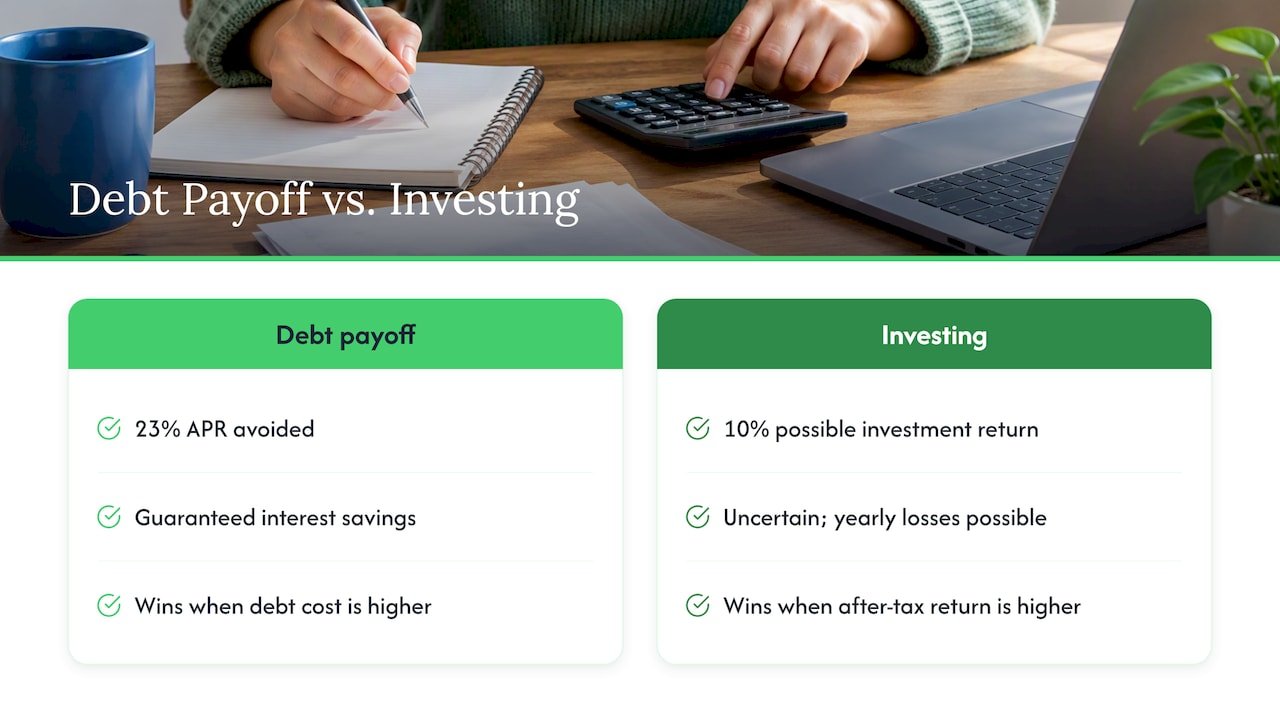
The general rule financial educators use: if the after-tax return on your investment is higher than the after-tax cost of your debt, investing makes more mathematical sense. If it is lower, paying the debt is the better use. The University of Illinois Extension gives a clean example: if you could earn 10% investing but your debt charges a 23% APR, paying down the debt wins, because the interest you avoid is greater than what you would earn.
There is also a difference in certainty. Paying off a 23% card is a guaranteed 23% “return.” An investment that averages 8% over decades can lose money in any given year. The comparison is never quite apples to apples, and that tilts close calls toward paying off debt.
A worked example
Suppose you have $400 a month of extra cash, and two choices:
- Put it toward a credit card balance at 22% APR.
- Put it into a diversified investment fund that you assume might earn 8% a year over the long run (an assumption for illustration, not a promise).
Every $1,000 you pay off the card saves roughly $220 a year in interest for as long as that balance would have lingered. The same $1,000 invested might grow by about $80 in a typical year, or shrink in a bad one. The card payoff is not close.
Now change the debt to a 4% loan. Paying it down saves about $40 per $1,000 each year. The assumed investment return of $80 is higher, but it is not guaranteed, so this is a judgment call rather than a clear win. That is where your comfort with risk and your timeline matter.
Which debts count as “high interest”
The federal investor education site Investor.gov draws the line at about 8% or above for debt that carries no tax advantage, and says the same advice applies to credit cards: pay balances off in full as fast as you can. When you carry balances on several cards, it recommends paying the highest-rate card first while making the minimum payment on the rest.
It also makes a point worth remembering: it says virtually no investment will reliably match the rate of a typical credit card, which can run 18% or more. Recent figures agree. The average credit card rate was about 21% APR as of May 2026, according to Federal Reserve data.
Here is how common debts usually sort out:
| Type of debt | Typical situation | Usual priority |
|---|---|---|
| Credit cards | Often around 20% or higher | Pay off first, aggressively |
| Payday or other short-term loans | Very high effective rates | Pay off first, or refinance if you can |
| Personal loans | Varies widely by credit | Compare the rate with the 8% guideline |
| Private or higher-rate student loans | Varies | Compare the rate with the 8% guideline |
| Federal student loans at lower rates | Often moderate, with repayment options | Pay on schedule, invest alongside |
| Auto loans | Varies by rate and credit | Rate decides: lower rates can coexist with investing |
| Mortgage | Often the lowest rate you hold | Usually keep paying as scheduled, invest alongside |
Check your own statements for the exact rate on each balance. A debt’s rate, not its size, tells you where it belongs in the order.
Taxes can change the math
Because the comparison is meant to be after tax, two details matter.
- Mortgage interest. If you itemize deductions, mortgage interest can reduce your taxes, so a 5% mortgage can cost you less than 5% in practice, depending on your bracket, as the Illinois Extension explains. Many households take the standard deduction instead, in which case there is no extra benefit. A tax professional can tell you which applies to you.
- Retirement accounts. Money in a traditional 401(k) or IRA is contributed before tax, while Roth accounts are funded with after-tax dollars. Which one fits you is its own question, and our Roth vs. traditional IRA break-even test walks through it.
If you are comparing a mortgage with investing, it also helps to know how large a mortgage you are comfortable carrying in the first place. Our guide on how much house you can afford covers that side of the budget.
A practical order of priorities
Most people do best following a sequence rather than choosing one or the other. Here is the order we suggest.
- Make every minimum payment. Missed payments bring fees, penalty rates and credit score damage, which cost more than almost any investment earns. Investing before you can cover minimums is not a plan.
- Build a small starter cushion. Even a modest buffer keeps a car repair or medical bill from going straight onto a card at 20% or more. How much is right depends on your income stability and expenses, so start small and grow it later.
- Contribute enough to get your full employer match. The SEC notes that if your employer offers a retirement plan and you do not contribute enough to get the maximum match, you are passing up free money. A match is an immediate return that no card payoff can beat.
- Attack high-interest debt. Send everything beyond the steps above to the highest-rate balance. Keep minimums on the rest, then roll the freed-up payment to the next-highest rate.
- Grow your emergency fund. Once the expensive debt is gone, build the cushion toward several months of expenses.
- Split what is left. With only low-rate debt remaining, divide extra money between investing and extra debt payments based on rates and how you feel about debt.
The order is a guide, not a law. If your employer offers no match, step 3 disappears. If your cash flow is shaky, step 2 deserves more attention before step 4.
When to pay down debt and invest at the same time
Paying off debt and investing are not mutually exclusive. Doing both makes sense in a few common situations.
You have an employer match
The match is the clearest case. Contributing just enough to capture it while you chase a card balance gives you an instant boost on part of your savings and keeps a retirement habit alive. The upper limits on contributions change by year, and you can check the current numbers in our 401(k) contribution limits guide.
Your debt rate is moderate
If your remaining debts sit at or below the mid-single digits, such as a mortgage or a low-rate auto or student loan, the guaranteed savings from extra payments are small. Splitting extra cash is a reasonable approach: part to the debt, part invested. Many people choose the split by how uneasy debt makes them. The Illinois Extension points out that personal values and personality shape this decision, and some people strongly prefer to carry no debt at all. That preference is legitimate, even when the math is close.
You have a long time horizon
The longer you have until you need the money, the more time investments have to recover from downturns. A 25-year-old with a 4% loan has a stronger case for investing than a 58-year-old who plans to retire in a few years and wants fixed costs low.
A simple split you can try
Say you have $600 a month of surplus. Your employer match needs $150 a month. The remaining $450 goes toward a 24% card. Once the card is gone, that $450 becomes available to split, perhaps $250 invested and $200 extra toward a 6% loan. The percentages matter less than having a written plan and sticking to it.

Should you lower your 401(k) contribution to pay off debt?
This is one of the most common follow-up questions, and the answer depends on your match and your interest rate.
- If lowering contributions forfeits a match, think twice. CBS News reports that pausing retirement contributions is generally not advisable when it costs you an employer match. It also notes that high-rate revolving debt, such as card balances above 21%, can change the calculation, since diversified investments struggle to reliably beat that rate.
- If you are above the match, a temporary cut can be reasonable. CNBC Select says temporarily lowering contributions can make sense to attack credit-card debt, especially when your job or cash flow is uncertain. It recommends a concrete plan to restore contributions once the debt is gone. Put a reminder on your calendar for the date you expect to finish, and raise your contribution again that same week.
- Do not withdraw from the 401(k) to pay debt. The National Foundation for Credit Counseling advises against this except as a last resort for a serious emergency, because withdrawals before age 59½ generally bring a 10% penalty plus income tax, on top of the growth you give up.
If your situation involves a loan against the plan, a hardship withdrawal or a large tax bill, talk with a tax professional or a nonprofit credit counselor before you move money.
Perspective: why we lean toward expensive debt first
At Win Personal Finance, our focus is simple, practical money guidance for people who feel overwhelmed by their finances. When readers ask us whether to pay debt or invest, we almost always see the same pattern: the decision feels complicated because the advice online is full of averages and theory, while the reader’s real problem is a 22% card balance that keeps growing.
So our view is plain. Treat high-interest debt as an emergency with a known cost, grab the free match, and then use the rate comparison to decide the rest. We would rather you finish one clear step than stall while you debate the perfect split. And because behavior matters as much as arithmetic, we think a plan you will actually follow beats a theoretically optimal one you abandon in month three.
If you tend to lose momentum, pick the method that keeps you going, whether that is paying the highest rate first to save the most interest or the smallest balance first for quick wins. The first usually costs less. The second can keep you motivated. Either one beats drifting.
— Win Personal Finance
Make the decision easier with a written plan
Numbers on paper make the choice far less stressful. List each debt with its balance, rate and minimum payment. Add your match, your cushion goal and the amount you can add each month. Then run the order of priorities above and write down the result.
If you want help with the tracking itself, our roundup of free financial wellness tools covers budgeting, debt tracking and credit monitoring apps that cost nothing to start.

You can also browse more step-by-step guides on Win Personal Finance, including our financial management plan walkthrough and our list of budgeting habits that actually work.
Ways to free up more money for either goal
The argument over debt versus investing eases when there is more money to go around. Three places to look:
- Lower the cost of your debt. If you carry card balances, moving them to a lower rate can speed up payoff. We compare the options in balance transfer vs. personal loan, including how to keep balances from coming back.
- Trim recurring costs. Review subscriptions, insurance and bills once a year. Even $50 a month redirected to a 22% card adds up quickly.
- Raise your income. A side hustle or other extra income can be pointed entirely at the highest-rate balance, which shortens the payoff considerably.
If student loans are part of your picture, federal repayment options have changed in recent years. Our guide to what to do now that the SAVE plan is over explains your options before you decide how much extra to send.
Common mistakes to avoid
- Investing while carrying card balances you could clear. The market may rise, but a card’s interest does not take a year off.
- Dropping the match to pay debt faster. You lose the free money and the compounding on it.
- Emptying all cash to pay debt. Without a cushion, the next surprise goes back on the card.
- Running up the card again. Paying off debt only helps if the balance stays down. Track spending monthly.
- Never revisiting the plan. Rates change, raises arrive and debts disappear. Review your order of priorities a couple of times a year.
FAQ
Should I pay off debt or invest first?
If the debt has a high rate, roughly 8% or above, pay it off first, apart from contributing enough to get any employer match. If the debt rate is low, such as a mortgage or a low-rate loan, investing alongside regular payments is often reasonable. Compare each debt’s rate with a realistic after-tax return to decide.
Should I lower my 401(k) contribution to pay off debt?
Only if it does not cost you an employer match, or if your card rate is very high and your cash flow is tight. Plan the date you will restore the contribution. Avoid taking money out of the account, since early withdrawals generally trigger a 10% penalty and income tax.
What counts as debt in this decision?
Include credit cards, personal loans, student loans, auto loans and mortgages, but treat them differently. Higher-rate, non-deductible debt belongs near the top of your payoff list. Low-rate debt, especially with a tax benefit, ranks lower and can be paid on schedule while you invest.
Do I need a financial advisor to decide?
Not for the basic comparison, since your rates and your match tell you most of what you need. A licensed planner or tax professional is worth considering if you have large balances, a complicated tax situation, or multiple goals competing for the same dollars. A nonprofit credit counselor can help if your payments feel unmanageable.
Sources
- Pay Off Credit Cards or Other High Interest Debt, Investor.gov
- Pay down debt or invest my money?, University of Illinois Extension
- Ten Things to Consider Before You Make Investing Decisions, SEC
- Should I Withdraw Money From My 401(k) to Pay Off Debt?, NFCC
- Should you stop contributing to retirement while paying off debt?, CBS News
- Should You Lower Retirement Contributions to Pay Off Debt?, CNBC Select
- The Average Credit Card Interest Rate, The Motley Fool