
A good starting point is to keep your total monthly housing cost at about 25% to 30% of your gross (pre-tax) income, then work backward to a price from there. That one number is not the answer, though. Your down payment, interest rate, debts, property taxes and insurance can move the price you can afford by six figures on the same salary. Below we walk through the rules, show worked examples at $100,000 and $200,000, and explain how to set a budget you will still be comfortable with after the move-in boxes are gone.
TL;DR
- Start with a housing payment of roughly 25% to 30% of gross income, and count the full payment: principal, interest, taxes, insurance, mortgage insurance and HOA dues.
- Existing debts shrink your limit. Lenders look at your total debt-to-income ratio, not just the house payment.
- A lender’s maximum approval is not your comfortable budget. Only you can decide that.
- Plan cash beyond the down payment: closing costs of about 2% to 5% of the loan, moving costs, repairs and 3 to 6 months of reserves.
- Test any price with real quotes (a Loan Estimate), not a rule of thumb alone.
Table of Contents
- The rules of thumb, and what each one is good for
- The four things that actually set your price
- What counts in your monthly housing cost
- How to calculate it yourself, step by step
- Worked examples: $100,000 and $200,000 salaries
- Debts, credit and the other half of the equation
- The cash you need beyond the down payment
- Why approval is not the same as affordable
- Our perspective
- Get your budget ready before you shop
- Compare real offers before you commit
- FAQ
- Sources
The rules of thumb, and what each one is good for
No single rule tells you the price. Each one answers a slightly different question, so it helps to know which is which.
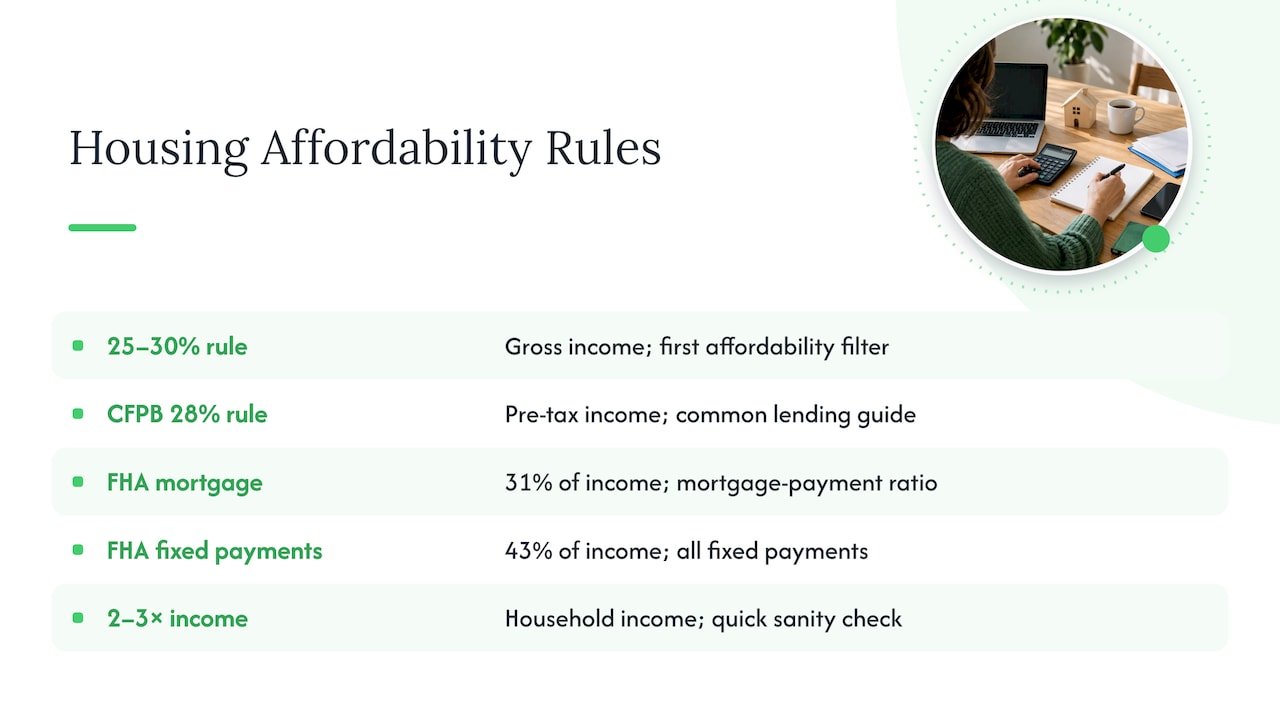
The 25% to 30% housing rule. Fannie Mae says housing should generally cost 25% to 30% of your gross income. The CFPB describes 28% of pre-tax income as a common lending rule of thumb. This is the best first filter because it works from your paycheck, not from a listing price.
Lender ratios. For FHA-insured loans, HUD materials describe a typical framework of 31% of income for the mortgage payment and 43% for all fixed payments. Automated underwriting and documented compensating factors can change who qualifies. These ratios tell you what a lender may approve, which is a ceiling and not a target.
The 2 to 3 times income rule. The FDIC’s Money Smart material notes that many people estimate an affordable mortgage at roughly two to three times household income. It calls this an older shortcut, and it ignores interest rates entirely. If you searched for an income-to-house-price ratio, this is that rule. Use it for a quick sanity check only. At today’s rates and prices, your monthly payment is the number that matters.
The take-home pay rule. Some guidance suggests keeping the payment under about 25% of take-home pay. Because take-home pay already reflects taxes and retirement contributions, it is a more conservative and often more realistic view of your budget.
The four things that actually set your price
The CFPB names four key drivers: your monthly payment, your down payment, the loan type, and the interest rate and term. Income matters mainly because it shapes the first two.
Here is why the same salary can buy very different homes:
- Monthly payment. The amount you can sustain after all your other bills and savings goals.
- Down payment. Every extra dollar you put down is a dollar you don’t borrow. A down payment under 20% will likely require mortgage insurance, which adds to the monthly cost.
- Interest rate and term. A higher rate cuts the loan your payment can support. A 15-year loan has a higher payment than a 30-year loan for the same balance.
- Loan type. Conventional, FHA and other programs have different down payment and insurance rules. Our guide to FHA vs. conventional loans explains how the choice changes your costs.
What counts in your monthly housing cost
Many first-time buyers compare a mortgage payment to their rent and stop there. Fannie Mae’s guidance says housing costs should include principal, interest, property taxes, homeowners insurance, mortgage insurance and HOA or condo fees, not only principal and interest.
Then add the costs that never show up on a loan form: maintenance, utilities that may be higher than in your apartment, and furnishing. None of these appear in a lender’s ratio, but all of them come out of the same paycheck.
How to calculate it yourself, step by step
The CFPB’s method is simple: pick a payment you can sustain, subtract estimated taxes and insurance, use what remains for principal and interest, then add your down payment to the loan amount that payment supports.
- Find your gross monthly income. Divide annual gross income by 12.
- Apply your target ratio. Multiply by 0.28, for example. This is your total monthly housing ceiling.
- Subtract the non-loan costs. Take out estimated property taxes, homeowners insurance, HOA dues and any mortgage insurance.
- Subtract the pressure from other debts. Car loans, student loans and credit card minimums reduce what lenders will allow, because they count them in your debt-to-income ratio.
- Convert the remainder to a loan amount. Use a mortgage calculator with a current rate quote. As an illustration, at a 7% rate on a 30-year fixed loan, each $1,000 of monthly principal and interest supports about $150,000 of loan.
- Add your down payment. The total is your estimated price.
Worked examples: $100,000 and $200,000 salaries
People often ask whether they can afford a $300,000 house on a $100,000 salary, or what a $200,000 salary buys. There is no universal answer, so here are two clearly labeled illustrations. They use assumptions, not quotes: a 7% rate, a 30-year fixed loan, and the amounts shown for taxes and insurance. Your real numbers will differ.
| $100,000 salary | $200,000 salary | |
|---|---|---|
| Gross monthly income | $8,333 | $16,667 |
| Housing ceiling at 28% | about $2,333 | about $4,667 |
| Assumed taxes, insurance and HOA | $500 | $900 |
| Left for principal and interest | about $1,833 | about $3,767 |
| Loan that payment supports at 7% | about $275,500 | about $566,000 |
| Assumed down payment | $40,000 | $100,000 |
| Estimated price | about $315,000 | about $666,000 |
The 28% figures match the Fannie Mae calculator guidance and are housing-payment ceilings, not approvals. A $300,000 home on a $100,000 salary can work in this example, but it leaves almost no cushion if the down payment is small, if property taxes run higher, or if you carry a car payment and student loans.
Notice also what changes the result most. Drop the rate by one point and the loan your payment supports rises noticeably. Raise your monthly debts by $500 and a lender may lower your limit. The same logic applies to bigger targets: a $400,000 house, or even a $1,000,000 house, has to be tested against your own rate, down payment, taxes, insurance and debts, not matched to a salary chart.
Debts, credit and the other half of the equation
Your housing payment is only one slice of the ratio a lender checks. Your total debt-to-income ratio adds car loans, student loans, credit card minimums and other required payments. Every dollar of existing debt is a dollar your housing budget loses.
Two practical moves help before you apply:
- Pay down revolving balances so the minimums shrink. Our student loan repayment guide can help if education debt is the biggest drag on your ratio.
- Check your credit reports for errors. Your credit score influences the rate you are offered, and a better rate raises the price your payment can support. If you want to see how credit-record clean-up works in another country, this South African overview of credit clearance for home loans describes the kind of steps involved, though US readers should use the free federal process and their own lender’s guidance.
The cash you need beyond the down payment
The down payment is the number buyers plan for. The other cash requirements are what catch them.
- Closing costs. Fannie Mae guidance suggests budgeting 2% to 5% of the mortgage amount. On a $300,000 loan, that is $6,000 to $15,000.
- Moving and setup. Movers, deposits, furniture and the first round of repairs or appliances. Our moving-out budget guide breaks down what to expect at different budget levels.
- Reserves. The CFPB’s monthly payment worksheet suggests keeping at least 3 to 6 months of expenses saved.
Low down payment options exist. FHA loans have a minimum down payment of 3.5%, and Fannie Mae’s HomeReady program allows as little as 3% for eligible borrowers. A lower down payment preserves savings, but it usually raises your monthly cost through mortgage insurance. Neither choice is automatically better. Compare the total monthly payment and the cash left in your account after closing.
Why approval is not the same as affordable
The CFPB’s home loan toolkit says that in most cases a lender considers only whether you can repay the mortgage, not whether the payment is comfortable for you. The FDIC makes the same point: qualifying for an amount does not mean the payments will feel comfortable.
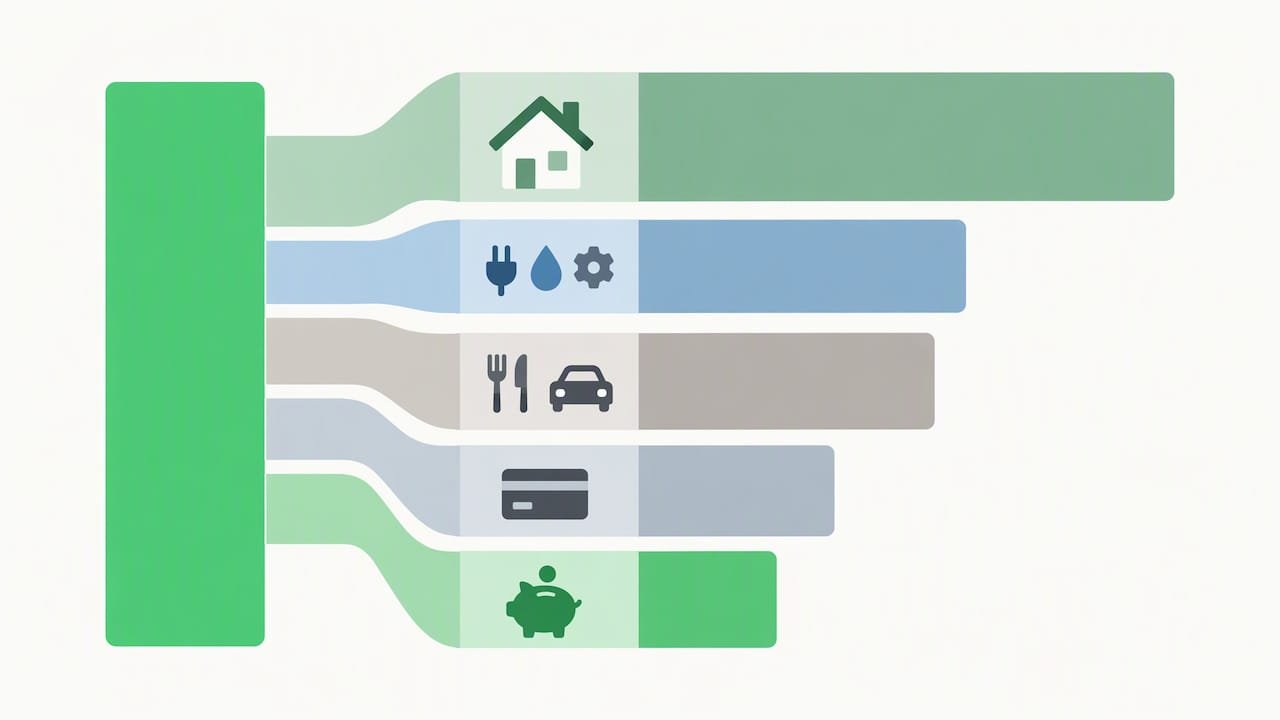
A simple test: write out your take-home pay, then list the new housing payment, utilities, maintenance, food, transportation, debt payments and savings. If the total passes your take-home income, or leaves nothing for emergencies and retirement, the price is too high regardless of what a lender offers.
Our perspective
We see the same pattern in the questions readers send us: people look for a single number, a salary multiple or a calculator result, and treat it as permission. We think the better question is what payment still lets you save, handle a surprise repair and keep your other goals moving.
That is why we suggest working in three layers. First, the rule of thumb gives you a range. Second, a real budget shows what you can sustain. Third, a lender quote tells you what is possible. Buy at the lowest of those three, not the highest. A slightly smaller house with room in the budget is easier to live with than a stretched purchase that depends on nothing going wrong.
If your numbers fall short today, that is useful information, not a verdict. Raising income, trimming debt and building the down payment all move the answer, and each is within your control.
— Win Personal Finance
Get your budget ready before you shop
A home budget works only if your everyday budget does. Our seven budgeting habits show you how to track spending and find the monthly room a mortgage needs, and our list of free financial wellness tools can help you monitor credit, spending and savings goals in one place. If the gap is income, our guides to asking for a raise and starting a side hustle are good next steps.
Compare real offers before you commit
Once you apply, the numbers become official. For most closed-end mortgages, the lender must give you a Loan Estimate within 3 business days of your application, and a Closing Disclosure at least 3 business days before closing. Use these forms to compare the interest rate, projected payment, loan costs and cash to close across lenders.
When the Closing Disclosure arrives, check it against the estimate. Differences in the rate, fees or monthly payment are worth a question before you sign.
FAQ
How much house can I afford on a $100,000 salary?
In our illustration with a 7% rate, $40,000 down and modest taxes and insurance, a 28% housing ceiling supported a price near $315,000. A lower rate, larger down payment or fewer debts would raise that, while higher taxes, HOA dues or car and student loan payments would lower it. Run your own numbers with a calculator and a lender quote.
What is the 28/36 rule?
It is a guideline that says no more than 28% of gross monthly income should go to housing, and no more than 36% to total debt payments. Lenders use similar ratios, and FHA’s framework is 31% and 43%. Treat these as limits for lenders, not as a comfortable budget.
Is the 2 to 3 times income rule still reliable?
Only as a rough screen. The FDIC describes it as an older rule of thumb, and it ignores interest rates, taxes and debts. At a $100,000 income it would suggest $200,000 to $300,000, but your monthly payment gives a better answer.
How much should I save before buying?
Plan for the down payment, closing costs of about 2% to 5% of the loan, moving and setup costs, and 3 to 6 months of expenses in reserve. Because loan terms vary, check your Loan Estimate for the exact cash to close.
Sources
- Decide how much you want to spend on a home, CFPB
- Your home loan toolkit, CFPB
- Monthly payment worksheet, CFPB
- TILA-RESPA integrated disclosure guide, CFPB
- Mortgage Affordability Calculator, Fannie Mae
- Homebuyer Resources, Fannie Mae
- HomeReady Low Down Payment Mortgage, Fannie Mae
- Dispelling Homebuying Myths, HUD
- How Much Mortgage Can I Afford?, FDIC