

The IRS set the 2026 elective deferral limit for 401(k), 403(b), most 457 plans, and the Thrift Savings Plan at $24,500, with total annual additions capped at $72,000. Catch-up contributions push the effective maximum to higher specified limits depending on your age, and a new rule forces high earners into Roth catch-ups starting this year.
TL;DR:
- SIMPLE plans cap employee deferrals at $17,000, while employers calculating matches or profit sharing cannot count compensation above $360,000 in 2026.
- Workers age 50 or older can add $8,000, while those ages 60 through 63 may add $11,250 only if their plan adopted the enhanced option.
- The Roth rule applies when one employer paid more than $150,000 in 2025 Box 3 FICA wages; wages from separate employers are not combined.
Table of Contents
- 2026 headline contribution limits: employee deferrals, SIMPLE limits, and compensation cap
- Catch-up contributions: standard age 50+, enhanced 60-63, and plan-by-plan differences
- Mandatory Roth catch-up rule for high earners: threshold, measurement, and payroll impact
- Total annual additions (415©) and how employer contributions interact with employee deferrals
- Plan checks and payroll steps: what to ask HR or your plan administrator now
- How to maximize your 2026 retirement savings given these limits
- Win Personal Finance interpretation: who benefits most and plain-English examples
- Our priorities for savers heading into 2026
- Tools and guides to help you plan your contributions
- FAQ
- Sources
2026 headline contribution limits: employee deferrals, SIMPLE limits, and compensation cap
If you’re trying to figure out exactly how much you can put into your workplace retirement plan in 2026, the numbers below are your starting point. The 402(g) elective deferral limit applies to traditional and safe harbor 401(k) plans, 403(b) plans, most 457 plans, and the federal Thrift Savings Plan. It covers the combined total of your pretax and Roth employee contributions, so you can’t contribute $24,500 to each side separately.
SIMPLE 401(k) and SIMPLE IRA plans work on a lower scale. These plans, common at smaller employers, come with their own deferral ceiling that’s well below the standard 401(k) limit.
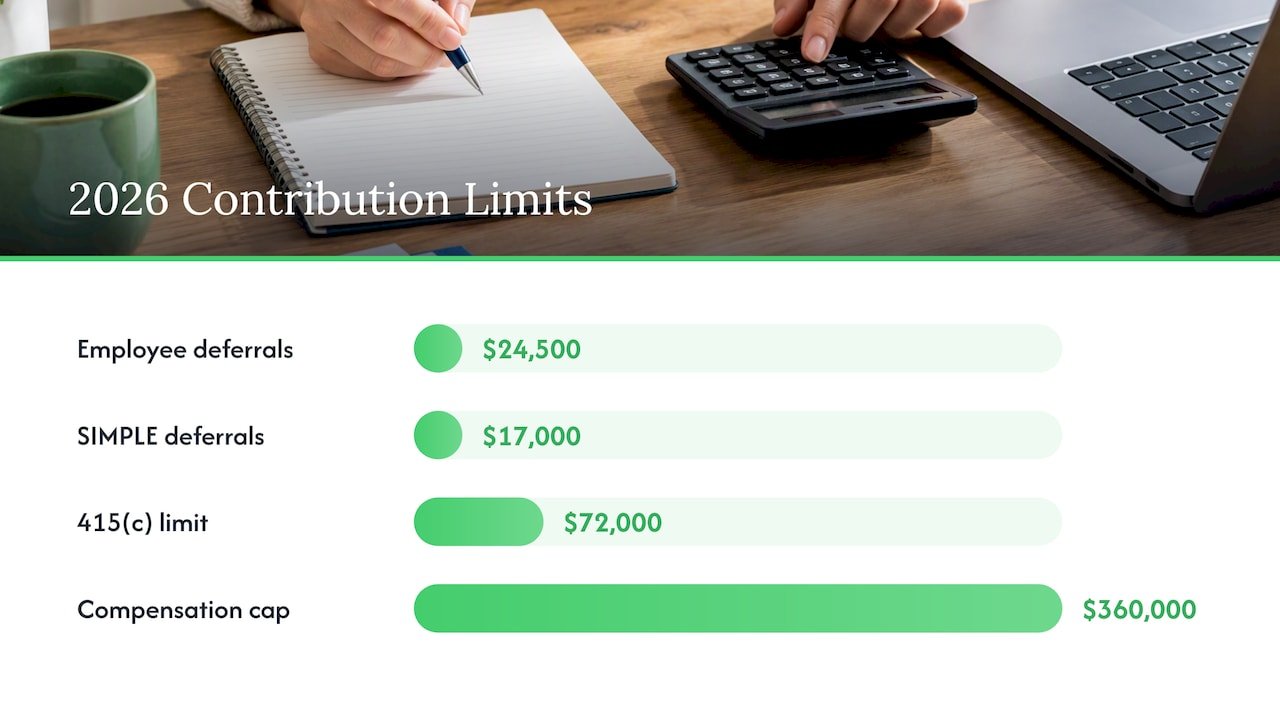
There’s also a compensation cap that matters if you’re a high earner whose employer calculates matching or profit-sharing contributions as a percentage of pay. Once your salary crosses that cap, your employer can’t use anything above it when figuring your contribution.
Here’s the quick reference for 2026:
- Employee elective deferral limit (401(k), 403(b), most 457, TSP): $24,500
- SIMPLE plan elective deferral limit: $17,000
- Compensation cap for calculating employer contributions: $360,000
- Total annual additions limit (415©): $72,000
These figures reset every year based on cost-of-living adjustments, so what applied in 2025 won’t match what you see on your pay stub in 2026. Check your first paycheck of the year against these numbers to confirm your plan administrator updated the system correctly.
Catch-up contributions: standard age 50+, enhanced 60-63, and plan-by-plan differences
Catch-up contributions let savers closer to retirement put away more than younger workers, and 2026 includes increased limits for both the standard and enhanced versions as set by IRS guidance.
- Standard catch-up, age 50+: You can contribute an extra $8,000 in 2026 if you’re turning 50 or older this year, available in most 401(k), 403(b), and governmental 457 plans.
- Enhanced catch-up, ages 60-63: Under SECURE 2.0, savers in this specific age window can contribute an extra $11,250 instead of the standard $8,000, but only if their plan has adopted this optional feature through a formal amendment.
- SIMPLE plan catch-ups: Standard catch-up for SIMPLE plans is set lower, with an enhanced version for ages 60-63.
The enhanced 60-63 catch-up isn’t automatic just because SECURE 2.0 authorized it. Your employer has to amend the plan document and configure payroll to support it, and plenty of smaller plans haven’t bothered. If you turn 60 this year and assume you qualify for the higher number, check first.
Pro Tip: Ask your plan administrator directly whether your plan has adopted the enhanced 60 to 63 catch-up option.
Mandatory Roth catch-up rule for high earners: threshold, measurement, and payroll impact
Starting in 2026, a SECURE 2.0 provision requires high earners to make all catch-up contributions on a Roth, after-tax basis rather than pretax. This is one of the biggest structural changes to hit 401(k) rules in years, and it catches a lot of people off guard.
The threshold is $150,000. If your Box 3 FICA wages from a single employer exceeded $150,000 in 2025, any catch-up contributions you make in 2026 must go into a Roth account rather than pretax.
A few things to understand about how this works in practice:
- The threshold is measured per employer, not per household or combined income, so a job change can change your status.
- If your plan doesn’t currently offer a Roth option, your employer must either add one or block catch-up contributions entirely for affected employees.
- Wages from a previous employer earlier in 2025 typically don’t carry over to determine your status at a new employer in 2026.
If you switched jobs mid-year in 2025 and your combined wages crossed $150,000 but no single employer paid you that much, you likely fall outside the mandatory Roth requirement. Confirm this with your current plan administrator rather than assuming.
Total annual additions (415©) and how employer contributions interact with employee deferrals
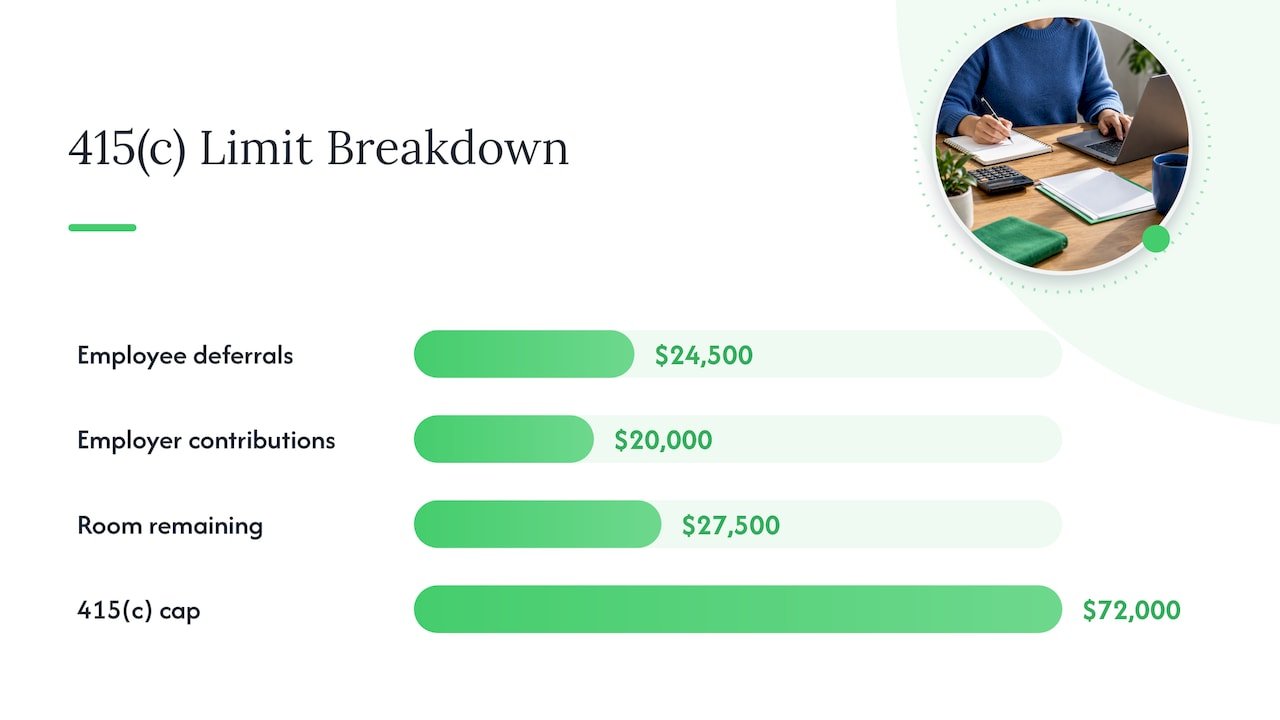
The 415© limit caps the total going into your account each year, combining your own deferrals with everything your employer adds. For 2026, that ceiling is $72,000, or 100% of your compensation if that’s lower.
Catch-up contributions sit outside this cap in a practical sense: once you add them, your effective maximum becomes $80,000 if you’re using the standard $8,000 catch-up, or $83,250 if you qualify for the enhanced $11,250 version.
What counts toward the 415© limit:
- Your own elective deferrals (pretax and Roth combined)
- Employer matching contributions
- Employer profit-sharing or nonelective contributions
- After-tax contributions to the plan, where permitted
Catch-up contributions themselves don’t count toward the base $72,000 figure, which is why they raise your effective ceiling rather than eating into the standard limit.
Picture a worker deferring $24,500 and receiving a $20,000 employer match and profit-sharing contribution combined. That’s $44,500 against a $72,000 cap, leaving room before hitting the ceiling even before factoring in any catch-up.
Plan checks and payroll steps: what to ask HR or your plan administrator now
Before you adjust your contribution elections for 2026, a short conversation with HR or your plan administrator can save you from a payroll correction later.
- Confirm whether your plan allows standard catch-up contributions and whether it has separately adopted the enhanced 60 to 63 option.
- Ask whether your plan offers a Roth contribution feature, since that determines whether high earners subject to the new mandate can make catch-ups at all.
- Find out how payroll will apply the $150,000 wage threshold and whether catch-up contributions will be automatically redirected to Roth for anyone affected.
- If you worked for more than one employer in 2026, ask how your combined deferrals will be tracked against the $24,500 elective deferral limit.
Plan amendments and payroll system updates take time, and some employers are still finalizing their approach to the Roth catch-up mandate. Don’t assume your contribution elections are configured correctly without checking.
Pro Tip: Pull up your latest pay stub and compare your year-to-date deferral percentage against the $24,500 limit now, rather than waiting until December to notice you’re behind or over.
How to maximize your 2026 retirement savings given these limits
Hitting the full 2026 limits isn’t realistic for everyone, but a few priorities make a real difference regardless of your budget.
- Capture your full employer match before anything else. It’s an immediate return on your money that you won’t find anywhere else.
- Work toward the $24,500 elective deferral limit, adding catch-up contributions if you’re 50 or older and your plan supports them.
- Coordinate your 401(k) strategy with IRA contributions. Our Roth vs traditional IRA breakdown walks through how to decide between the two when you’re also maxing out a workplace plan.
- If you’re subject to the mandatory Roth catch-up rule, model how the after-tax contribution affects your take-home pay this year versus your tax picture in retirement, and loop in a tax advisor if your situation involves multiple income sources.
Win Personal Finance interpretation: who benefits most and plain-English examples
The 2026 increases help two groups most: savers in their final working years who can use the enhanced catch-up, and anyone receiving a strong employer match who now has more room to defer before hitting the 415© ceiling.
- A 61-year-old contributing the enhanced $11,250 catch-up pretax reduces taxable income by that full amount today.
- The same contribution made as a mandatory Roth catch-up (required once wages cross $150,000 at one employer) comes out of take-home pay after taxes, but grows tax-free for withdrawal later.
Availability of options depends on your plan documents, so consider general guidance on opening a Roth IRA if you’re weighing where extra savings should go next.
Our priorities for savers heading into 2026
If we had to rank what matters most this year: get the full employer match first, confirm catch-up and Roth availability with your plan administrator second, and build the Roth catch-up tax impact into your budget third if it applies to you.
Everything else, including fine-tuning IRA contributions, comes after those three boxes are checked.
— Win Personal Finance
Tools and guides to help you plan your contributions
There are practical, no-jargon guides available to help with these decisions, including a tax bracket guide to understand pretax versus Roth contributions, and free financial wellness tools to model contribution scenarios against take-home pay.
- Compare Roth and traditional IRA tradeoffs when coordinating with your 401(k)
- Use free calculators to test contribution scenarios before changing your payroll elections
- Review your overall financial management plan to see where retirement savings fits your bigger budget

Start with a financial management plan guide to explore how a 2026 contribution strategy might fit into broader money goals.
This article is general information, not a substitute for advice from a qualified financial advisor. Consult a qualified financial professional about your own circumstances before acting on anything here.
FAQ
Is there a maximum you can contribute to your 401(k) each year?
Yes, the IRS sets an annual elective deferral limit, which is $24,500 for 2026. Savers 50 and older can add catch-up contributions on top of that base limit, and the total amount going into your account from all sources, including employer contributions, is separately capped at $72,000 under the 415© rule.
Can I max out both my IRA and 401(k) in the same year?
Yes, the 401(k) elective deferral limit and the IRA contribution limit are separate, so contributing the maximum to one doesn’t reduce what you can put into the other. Our Roth vs traditional IRA guide can help you decide which type of IRA pairs best with your 401(k) strategy.
How many Americans have $1,000,000 in their 401(k)?
We don’t have a verified figure from an IRS or government source to cite here, so we’d rather point you to the limits themselves than guess at a number. What we can say is that reaching seven figures typically requires consistent decades-long contributions combined with employer matching and investment growth.
How many Americans have $500,000 in their 401(k)?
Building a sizable balance generally depends on starting contributions early, capturing the full employer match, and increasing your deferral rate as your income grows.
What is the Roth catch-up mandate for high earners in 2026?
Starting in 2026, anyone whose Box 3 FICA wages from a single employer exceeded $150,000 in 2025 must make all catch-up contributions on a Roth, after-tax basis instead of pretax. If your plan doesn’t offer a Roth option, your employer has to either add one or stop offering catch-up contributions to affected employees.
Sources
- Retirement topics – 401(k) and profit-sharing plan contribution limits | Internal Revenue Service
- 401(k) limit increases to $24,500 for 2026, IRA limit increases to $7,500 | Internal Revenue Service




[…] account balance. If you want to understand how much you can add to it each year, our guide to 401(k) contribution limits covers the current rules, and our comparison of Roth vs. traditional IRAs can help you decide where […]