

Yes, you can open a Roth IRA today if you have taxable compensation and your modified adjusted gross income falls within IRS limits. The fastest path is simple: pick a U.S. custodian, open the Roth IRA account, then fund and invest it before your contribution deadline. Before you deposit a dollar, check your contribution limit and label the deposit for the correct tax year.
TL;DR:
- The 2026 Roth IRA contribution limit is $7,500 for those under 50 and $8,600 for those aged 50 or older, depending on income phase-outs.
- Eligibility to contribute depends on having taxable compensation and staying within MAGI limits, which start phasing out at $153,000 for singles and $242,000 for married filing jointly.
- Funding a Roth IRA can be done via ACH transfer, rollover, or conversion, but contributions must be labeled for the correct tax year to avoid mistakes.
- A typical beginner should compare custodian fees, fund expense ratios, and investment options, especially if considering self-directed accounts or alternative assets.
- Keeping detailed records of contributions and automating regular deposits reduce mistakes and help maximize long-term growth.
Table of Contents
- What a Roth IRA is and why people choose one
- Eligibility, MAGI phase-outs, and 2026 contribution limits
- Step-by-step: how to open a Roth IRA
- How to choose a custodian: the features and fees to compare
- Ways to fund a Roth IRA and labeling contributions correctly
- Investing inside the Roth IRA: basic choices and a simple approach
- Withdrawals, conversions, and avoiding penalties
- Fees, protections, and required tax forms
- Practical opening checklist and timeline you can follow now
- Win Personal Finance tips: recordkeeping and automated habits
- Why a Roth IRA is often a good first retirement account
- How Win Personal Finance can help you get started
- FAQ
- Sources
What a Roth IRA is and why people choose one
A Roth IRA is a retirement account you fund with money you’ve already paid taxes on. In exchange, qualified withdrawals in retirement are generally tax-free, including all the growth your investments earn over the years. Unlike a traditional IRA, the Roth doesn’t require minimum distributions during the original owner’s lifetime, so your money can keep growing as long as you want it to.
There’s another perk beginners appreciate: you can withdraw your original contributions at any time, for any reason, without taxes or penalties, since you already paid tax on that money going in. The tradeoff is that you don’t get an upfront tax deduction the way you do with a traditional IRA, and eligibility phases out at higher incomes. Converting other retirement funds into a Roth can also trigger a tax bill, so that move deserves its own careful look before you commit.
Eligibility, MAGI phase-outs, and 2026 contribution limits
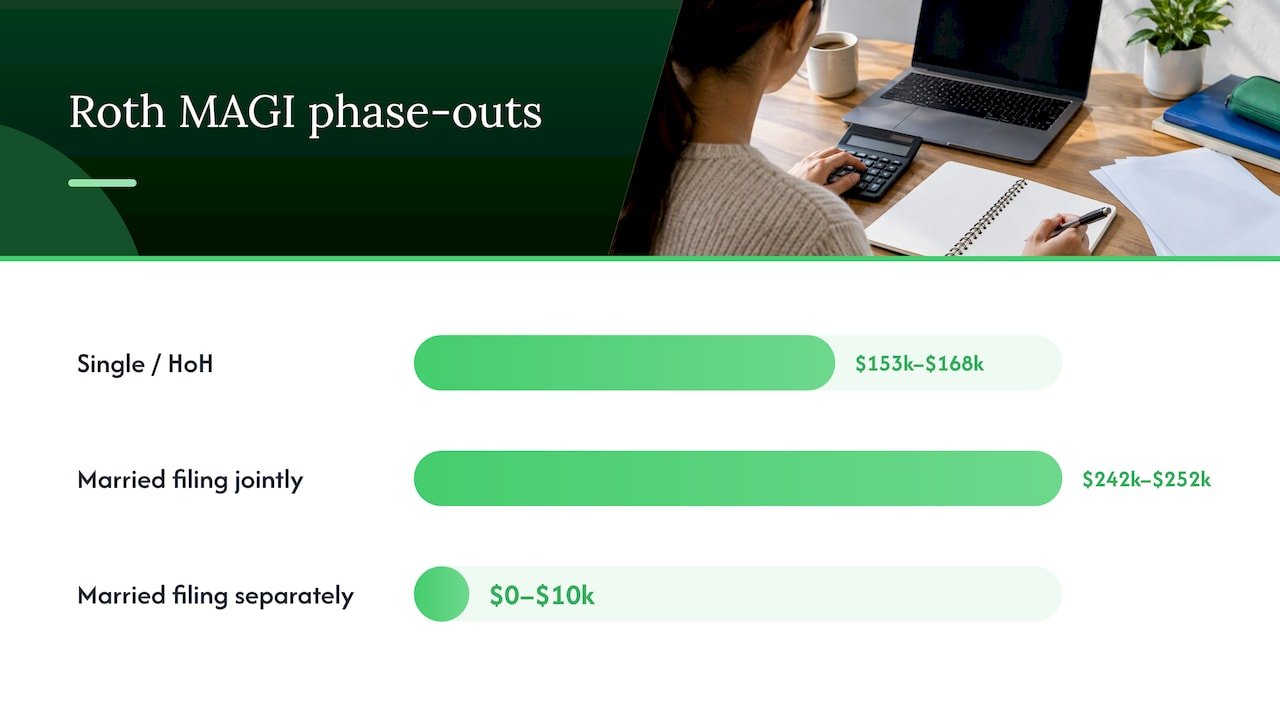
Before you open an account, run three checks: do you have taxable compensation, what’s your combined IRA contribution limit, and does your modified adjusted gross income (MAGI) put you in phase-out territory. For 2026, the combined annual limit across all your traditional and Roth IRAs is $7,500, or $8,600 if you’re 50 or older.
Your ability to contribute to a Roth directly depends on your filing status and MAGI:
- Single or head of household filers phase out between $153,000 and $168,000 in MAGI.
- Married filing jointly couples phase out between $242,000 and $252,000.
- Married filing separately (if you lived with your spouse during the year) phase out between $0 and $10,000, a notably tight range worth planning around.
You generally have until the tax filing deadline to make a contribution for the prior year, but you must label it for the correct tax year when you deposit it. Missing that label is one of the most common beginner slipups, since custodians apply contributions to the current year by default unless you specify otherwise.
Step-by-step: how to open a Roth IRA
Opening the account itself takes less time than most people expect, often under fifteen minutes online. Here’s what to expect:
- Choose a custodian type. Decide whether you want a brokerage for hands-on investing, a robo-advisor for automated portfolios, or a bank for simplicity, based on how involved you want to be.
- Start the application and select “Roth IRA.” The IRS requires the account to be designated as a Roth IRA at the time it’s established, so this choice matters from the first screen.
- Provide your personal information. Expect to enter your Social Security number, a government ID, your address, and employment details as part of identity verification.
- Designate beneficiaries. Name who inherits the account, which you can usually update later as life circumstances change.
- Link your bank account. Enter routing and account numbers so you can transfer money in, whether as a lump sum or recurring deposits.
- Choose your initial funding method. Most custodians let you fund by ACH transfer immediately or schedule a transfer for a later date.
Once the account is open and funded, the money sits in cash until you place an investment order, so don’t stop at step six.
How to choose a custodian: the features and fees to compare
Not all custodians cost the same, and small fee differences compound over decades. Compare these before you commit:
- Account fees and minimums, including any annual maintenance or inactivity charges.
- Fund expense ratios, since a 0.5% difference on index funds adds up significantly over 30 years.
- Advisory fees or commissions, which matter more if you want a managed portfolio versus a DIY approach.
- Investment menu breadth, so you’re not stuck with a narrow list of fund choices.
- Cash sweep options and FDIC coverage for uninvested balances, alongside SIPC protection for the brokerage itself.
Investor reviewing a firm’s Form CRS, or relationship summary, and checking its background through FINRA BrokerCheck before opening an account, especially if you’re considering a self-directed IRA with alternative assets, which Investor.gov notes often carries added fees and fraud risk.
Pro Tip: Pull up a custodian’s fee schedule and relationship summary side by side before applying. It takes ten minutes and can save you hundreds in fees over time.
Ways to fund a Roth IRA and labeling contributions correctly
You can fund a Roth IRA through a direct ACH contribution from your bank, a trustee-to-trustee transfer from another IRA, a rollover from an employer plan like a 401(k), or a conversion from a traditional IRA. Each method has its own paperwork, but transfers and rollovers typically move faster when done custodian-to-custodian rather than through a check you deposit yourself.
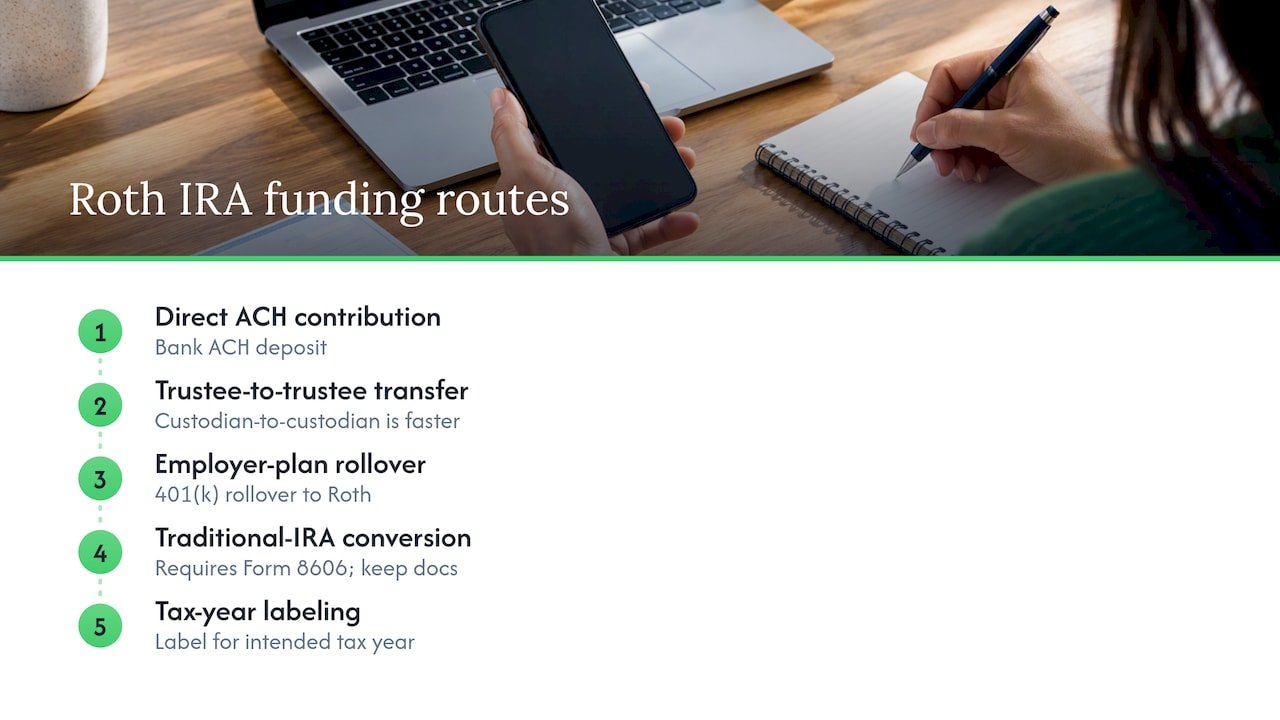
Whichever method you use, label the deposit for the tax year you intend it to cover. The IRS allows contributions for a given tax year to be made up until the filing deadline the following spring, but your custodian needs the correct label to apply it properly. Conversions carry their own tax reporting requirements, often involving Form 8606, so keep documentation from the start.
Investing inside the Roth IRA: basic choices and a simple approach
A Roth IRA is just the account wrapper. Once it’s funded, you still need to choose investments, or your cash will sit idle and miss out on growth. Common beginner-friendly options include broad index funds, ETFs, and target-date funds that automatically adjust their mix as you age.
A simple three-slice approach works well for many new investors: a core low-cost index fund for broad market exposure, a smaller satellite allocation for any specific tilts you want, and optionally a target-date fund that handles rebalancing for you if you’d rather not manage it manually. Whatever you choose, prioritize low expense ratios, since fees are one of the few things in investing you can control directly. Setting up automatic recurring investments removes the temptation to time the market and keeps your money working consistently.
Withdrawals, conversions, and avoiding penalties
A distribution counts as “qualified,” meaning tax-free, only if you meet the five-year rule and a qualifying event, such as reaching age 59½. The IRS outlines ordering rules for withdrawals: your original contributions come out first, tax- and penalty-free, followed by converted amounts, and finally earnings, which are the last dollars out and the ones subject to the strictest tax treatment.
Conversions have their own five-year clock separate from your contribution history, so a recent conversion may not be penalty-free to withdraw even if your account is older. Inherited Roth IRAs follow different distribution rules entirely, so beneficiaries should consult IRS Publication 590 and related form guidance rather than assume the standard rules apply.
Fees, protections, and required tax forms
Know the difference between the two protections your account may carry:
- SIPC protects against custodian failure, covering up to $500,000 including a $250,000 cash limit, but it does not cover market losses.
- FDIC coverage applies only to cash sweep balances held at a bank, not to invested securities.
Fees quietly erode returns over time, particularly fund expense ratios and any advisory fees layered on top. If you overcontribute or need to report a conversion, the IRS requires specific forms: Form 5329 addresses excess contributions, while Form 8606 reports conversions and basis. Handle either promptly with your custodian.
Practical opening checklist and timeline you can follow now
Work through these steps in order:
- Confirm you have taxable compensation and your MAGI fits within the limits for your filing status.
- Decide whether you want a DIY brokerage or a managed robo-advisor, then gather your ID and bank details.
- Open the account, select Roth IRA, complete identity verification, and designate beneficiaries.
- Choose your funding method, label the contribution for the correct tax year, place your investments, and save every confirmation.
Win Personal Finance tips: recordkeeping and automated habits
We’ve seen beginners trip up on the same few things, so build these habits early. Save every contribution confirmation and label the tax year immediately rather than relying on memory later. Keep a short running log of contribution dates and amounts, it takes minutes and prevents confusion with ordering rules down the road.
Start small and automate, even $100 a month, using a low-cost target-date or broad index fund while you learn the ropes. If you’re considering a conversion or a large rollover, talk to a tax professional and keep your Form 8606 paperwork organized from day one.
Why a Roth IRA is often a good first retirement account
A Roth IRA rewards the beginner investor because it’s flexible: you can access your contributions if life throws a curveball, and your growth compounds tax-free for decades. The checklist and recordkeeping habits above exist because we’ve watched readers lose track of tax-year labels or skip the investment step entirely, leaving cash sitting idle for months.
— Win Personal Finance
How Win Personal Finance can help you get started
Opening the account is only half the work. Freeing up the cash to fund it consistently is often the harder part, and that’s where our budgeting habits guide can help you find room in your monthly numbers.

We also round up free financial wellness tools that make automating contributions and tracking your progress easier, without personalized tax advice, just practical steps you can act on. Visit Win Personal Finance for more guides on building the habits that keep your Roth IRA funded year after year.
This article is general information, not a substitute for advice from a qualified financial advisor. Consult a qualified financial professional about your own circumstances before acting on anything here.
FAQ
How much will $10,000 make in a Roth IRA?
Growth depends entirely on your investment choices and market performance, so there’s no fixed return to promise. A broad index fund inside a Roth IRA grows tax-free, and the longer your money stays invested, the more compounding works in your favor.
How much money is needed to open up a Roth IRA?
Minimums vary by custodian, with many brokerages and robo-advisors allowing you to open an account with no minimum deposit at all. Check your chosen custodian’s requirements directly, since some ask for a small initial funding amount before you can start investing.
What disqualifies you from opening a Roth IRA?
You need taxable compensation for the year to contribute, and your ability to contribute phases out once your MAGI exceeds the limits for your filing status. For 2026, that phase-out begins at $153,000 for single filers and $242,000 for those married filing jointly.
Is $100 a month enough for Roth IRA?
Yes, $100 a month is a reasonable starting point, especially automated through recurring contributions rather than waiting to save a larger lump sum. Consistent small contributions placed in low-cost index or target-date funds give your money more time in the market, which matters more than the size of any single deposit.
Sources
These official sources cover the rules, limits, and forms referenced throughout this guide, useful if you want to verify details or dig deeper before you open your account.




[…] enough that you understand what you own, why you own it and which goal it serves. Consider an IRA as an option if you’re looking for retirement […]
[…] dedicated account can also make the money feel less available for everyday purchases and consider a retirement account for long-term […]