

Most budgets need between 10 and 15 categories, grouped under three headings: needs, wants, and savings and debt. Fewer than that and your spending hides in a vague “miscellaneous” line. More than that and tracking turns into a chore you quit by week three. Below you’ll find a complete list to pick from, a way to set percentages, real U.S. spending averages to compare against, and a short process for making the categories fit your life.
TL;DR
- Start with three big groups: needs (housing, utilities, groceries, transportation, insurance, minimum debt payments), wants (dining out, entertainment, subscriptions), and savings and debt payoff.
- A common starting split is 50% needs, 30% wants and 20% savings and debt repayment, applied to take-home pay. The CFPB says it is only one possible rule, so adjust it.
- Add a category for irregular costs (car repairs, annual fees, gifts) so they stop wrecking your month.
- Use 10 to 15 categories, review actual spending monthly, and rebuild the list after any major life change.
Table of Contents
- What budget categories are and why they matter
- The master list of budget categories
- How much to put in each category
- Build your category list in five steps
- Categories people forget
- Savings categories deserve the most attention
- Our perspective: fewer categories, more follow-through
- Where to build your budget
- Keeping categories current
- FAQ
- Sources
What budget categories are and why they matter
A budget is a plan for how to spend and save money. According to the CFPB’s Learning about budgets guide, it helps you decide how much to spend on necessities, how much to put aside, and what is left over. Categories are the buckets that make that plan visible. Without them, you only know your total balance, not where the money went.
Good categories do three jobs:
- They show you which costs are fixed and which you can change.
- They give each dollar an assignment before the month starts.
- They make your month-end review quick, because you compare one number per bucket against its target.
One rule applies before anything else: build the budget on net income, meaning what you take home after taxes and deductions. The CFPB’s guidance stresses this, because starting from gross pay overstates what you can spend. If your pay varies, use your lowest typical month.
The master list of budget categories
Here is the list we recommend starting from. Not every row will apply to you. Delete what doesn’t, and add rows only when a real expense keeps landing nowhere.
Needs: the costs you can’t skip
| Category | What goes in it |
|---|---|
| Housing | Rent or mortgage, property tax, HOA dues, renters or homeowners insurance if paid monthly |
| Utilities | Electricity, gas, water, trash, internet, phone |
| Groceries | Food and household basics bought to cook at home |
| Transportation | Car payment, gas, tolls, parking, transit passes, routine maintenance |
| Insurance | Auto, health premiums, life, disability |
| Health and medical | Copays, prescriptions, dental, vision |
| Minimum debt payments | Credit card minimums, student loans, personal loans |
| Childcare and dependents | Daycare, school costs, child support, elder care |
Yes, minimum debt payments belong under needs. They are a contract, and missing them costs you in fees and credit damage. Anything you pay above the minimum goes under savings and debt, which is where it works toward a goal.
Wants: the costs you choose
| Category | What goes in it |
|---|---|
| Dining out and takeout | Restaurants, coffee, delivery |
| Entertainment | Streaming, games, concerts, movies, hobbies |
| Shopping | Clothing beyond basics, electronics, home decor |
| Subscriptions | Apps, memberships, gym, news |
| Travel | Flights, hotels, trips |
| Gifts and donations | Birthdays, holidays, charity |
| Personal care | Haircuts, salon, spa |
| Pets | Food, vet visits, boarding (some people count basic pet care as a need) |
The line between need and want is personal. A phone is a need, but the premium plan with the newest handset leans toward a want. Be honest, but don’t agonize: what matters is that the category exists and has a limit.
Savings and debt: the costs that build your future
| Category | What goes in it |
|---|---|
| Emergency fund | Cash set aside for surprises |
| Retirement | 401(k), IRA, other retirement contributions |
| Short-term goals | Vacation, new laptop, moving costs, holiday spending |
| Extra debt payments | Anything above minimums |
| Down payment or large purchases | Home, car, wedding |
| Irregular expenses | A sinking fund for annual or unpredictable bills |
Income categories
List income at the top, too: your paycheck, side income, and any regular benefits or support. If you track side earnings separately, you can see what they contribute, and our side hustle ideas plan shows ways to start one.
How much to put in each category
The 50/30/20 starting point
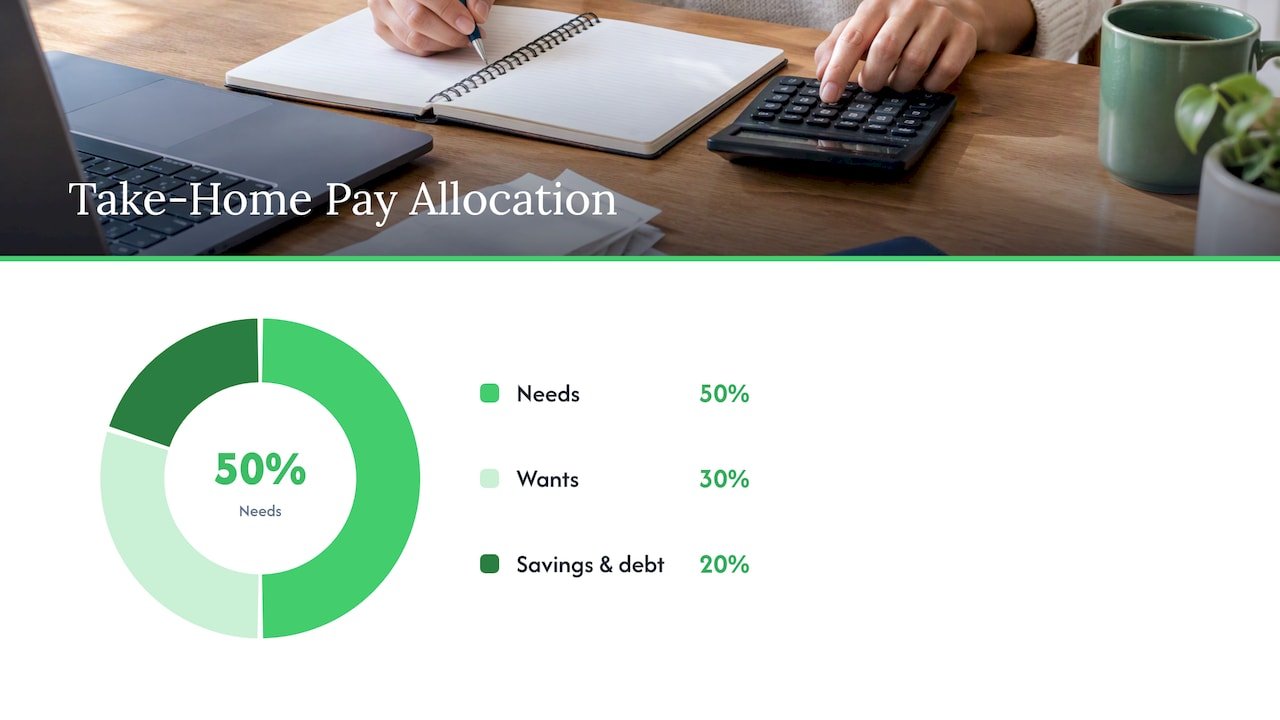
The CFPB describes a simple rule: 50% of take-home pay to needs, 30% to wants and 20% to savings and debt repayment. The agency also says this is one of many possible rules and that you should adjust the percentages to your situation.
Here is what it looks like on a $4,000 monthly take-home pay:
| Group | Share | Monthly amount |
|---|---|---|
| Needs | 50% | $2,000 |
| Wants | 30% | $1,200 |
| Savings and debt repayment | 20% | $800 |
If your rent alone is $1,700, the needs line is already almost full before you buy a single grocery item. That is normal in high-cost cities. It simply means the wants slice has to shrink, or income has to grow.
What households actually spend
Real averages help you sanity-check your plan. The Bureau of Labor Statistics reports that average U.S. household spending was $78,535 in 2024, or $6,545 a month. In the same release:
| Category | Share of spending | Average per year |
|---|---|---|
| Housing | 33.4% | $26,266 |
| Transportation | 17.0% | $13,318 |
| Food | 12.9% | $10,169 |
Housing and transportation together made up more than half of the total. Within food, BLS found about $6,224 went to groceries and $3,945 to meals away from home, so dining out is a bigger line than many people assume.
These are averages across all households, not targets. Your numbers will differ with your income, family size and city. Use them to spot a category that looks out of proportion, not to judge yourself.
Adjusting the split to your situation
- Heavy debt: Shift toward 50/20/30 in the other direction: trim wants and send more to debt. Our guide on balance transfers versus personal loans covers how to keep card debt from coming back.
- High rent: Needs may be 60% or more for a while. Protect at least a small savings contribution anyway.
- Higher income or short-term goal: Raise savings to 30% or more and shrink wants.
- Variable income: Budget off your lowest month and treat extra as a bonus for savings.
If you are deciding on housing, see how much house you can afford before locking in your largest category for years.
Build your category list in five steps
- Track a month of spending. The CFPB’s spending tracker tool explains why a full month is better than a week or two: you see all income and expenses in one place. Pull bank and card statements if you didn’t write things down.
- Sort every transaction into a group. Needs, wants, savings and debt. Don’t overthink edge cases.
- Merge or split until you land on 10 to 15 categories. If “shopping” holds $600 of mixed purchases, split out clothing. If “gifts” has $9 in it, fold it into a wants catch-all.
- Assign a dollar amount to each. Start with fixed bills, then savings, then wants. Total assignments should equal your take-home pay.
- Review at month end. Compare actual with planned, and move dollars between categories. Don’t scrap the budget because one category ran over.
Our seven smart budgeting habits go deeper on keeping this routine going once the setup is done.
Categories people forget
Most broken budgets share the same blind spots. Check whether yours include these:
- Irregular expenses. Car registration, annual subscriptions, vet emergencies, holiday gifts and back-to-school costs. Divide the yearly total by 12 and set that amount aside monthly.
- Medical costs. Premiums are only part of it. Copays, prescriptions and deductibles are real money, and an unplanned bill is a common reason budgets collapse.
- Child-related costs. If you pay or receive support, treat it as a fixed line. Child support as a budget floor explains why it covers the basics and often not everything a child needs, so many parents add separate lines for activities and extras.
- Fun money. A budget with zero wants usually fails within weeks. A small, guilt-free line keeps the rest intact.
- Fees and interest. Bank fees, late fees and card interest tend to hide inside other categories. Give them their own row so you can see and eliminate them.
Savings categories deserve the most attention
The FDIC points out that an emergency fund is a foundation of financial stability. It suggests starting with $500 to $1,000 to cover smaller common surprises, and working toward six months of living expenses over time. Put that in its own category and fund it first.
The same FDIC page recommends paying yourself first: automate a transfer to savings so it leaves your paycheck before bills. With a categorized budget, this is easy to do. Make the savings categories the first lines you fund, set up automatic transfers on payday, and give wants whatever remains.
For retirement, check your plan’s contribution rules, and read our breakdown of 2026 401(k) limits and the Roth versus traditional IRA break-even test before choosing where that line goes. If saving feels slow, a savings challenge can make the habit stick.

Our perspective: fewer categories, more follow-through
We hear the same problem from readers again and again: the budget looked perfect on day one and was abandoned by day twenty. In our experience that is almost never a math problem. It is a complexity problem. A 40-line spreadsheet takes so long to maintain that people stop.
So we favor a simple structure. Use the three groups. Keep each group to a handful of lines. Add one line for irregular costs and one for fun. Then review once a month and change only what clearly isn’t working.
We also think percentages are a starting point, not a grade. If your rent takes 45% of your take-home pay, the answer isn’t to feel guilty about the 50% needs target. It is to see precisely where the rest of the money goes and decide what to do next, whether that is trimming wants, building income or both. Our approach at Win Personal Finance is to turn financial confusion into a plain list of next steps you can finish this week.
— Win Personal Finance
Where to build your budget
You don’t need to pay for software to start. Many people begin with a spreadsheet, a notes app or a free tool that pulls in transactions automatically. We keep a list of free financial wellness tools for budgeting, tracking and credit monitoring, so you can pick one that matches how you like to work. If you want a bigger picture beyond monthly categories, our financial management plan walks through goals, budget and savings in order, and you can find more guides on our Win Personal Finance home page.
Keeping categories current
A budget is a living plan. Consumer agency guidance says to compare actual spending with your plan at the end of each month, and to revisit the budget after major changes such as a new job, a move or a new loan. In practice that means:
- After a raise: Decide in advance how much goes to savings and debt before lifestyle spending expands.
- After a move: Rebuild housing, utilities and transportation from real quotes and bills.
- After a new loan: Add the payment as a need, then rebalance wants.
- After a goal is met: Redirect that category’s money to the next goal instead of letting it drift into spending.
If you run over in a category two months in a row, the target was probably unrealistic. Change the number, not your self-image.
FAQ
What are the most common budget categories?
Housing, utilities, groceries, transportation, insurance, health care, debt payments, savings, entertainment and dining out show up in nearly every budget. Most people group them as needs, wants, and savings and debt. Start with these and add only what your own spending shows you need.
What is the 50/30/20 rule?
It is a guideline that puts 50% of take-home pay toward needs, 30% toward wants and 20% toward savings and debt repayment, as described in CFPB materials. The CFPB notes it is only one of many possible rules. Adjust the shares to your income, housing costs and goals.
How many budget categories should I have?
Aim for 10 to 15. That is enough detail to see where your money goes and few enough to maintain every month. If a category never has money in it, remove it, and if one holds a big mix of purchases, split it.
How much should I save each month?
The 50/30/20 rule suggests 20% of take-home pay for savings and extra debt payments, but any steady amount beats none. If you have no emergency fund, the FDIC suggests starting with a goal of $500 to $1,000 and building toward six months of expenses. Automate the transfer so it happens on payday.
Sources
- CFPB: Learning about budgets
- CFPB: My spending rule to live by
- CFPB: Spending tracker tool
- FDIC: Saving for the Unexpected and Your Future
- BLS: Housing and transportation accounted for 50 percent of household spending in 2024




[…] to give utilities a line in your budget. If you have not broken your spending into categories, our budget categories list shows where utilities usually fit and how much room to leave for seasonal […]
[…] The same Michigan State guide recommends a calendar that tracks paydays, shopping days, spending limits, food assistance arrivals and store sales or coupons. When shopping day lands a few days after payday, you avoid the mid-month scramble that leads to expensive convenience buys. For help placing food in your overall plan, see our list of budget categories. […]
[…] you are unsure what to include, our practical list of budget categories gives you a starting set. The FTC’s budget worksheet also covers recurring and irregular […]