
Paycheck budgeting means planning your money one payday at a time instead of one month at a time. You decide which bills each check covers, how much goes to savings and what is left for daily spending, using the amount that actually lands in your account. Below are seven ways to do it, from the simplest to the most flexible, so you can pick the one that fits your pay schedule.
TL;DR
- Budget from take-home pay, the amount that reaches you after taxes and deductions, not your salary.
- Match each bill to the paycheck that arrives before its due date, using a calendar.
- Pick a split rule such as 50/30/20 as a starting point, then adjust it to your rent, debt and income.
- Automate savings on payday. A first goal of $500 to $1,000 is realistic for most people.
- If your income is uneven, budget from your lowest typical paycheck and save the extra.
Table of Contents
- Why budget by paycheck instead of by month
- 1. Map every bill to a specific paycheck
- 2. Build the budget from your pay stubs
- 3. Split each check with the 50/30/20 rule
- 4. Try the 70/20/10 rule if you carry debt
- 5. Automate savings on payday
- 6. Use the “four walls” to protect a tight paycheck
- 7. Budget from your lowest paycheck when income is uneven
- Our perspective: keep it boring and repeatable
- Put your paycheck plan to work
- FAQ
- Sources
Why budget by paycheck instead of by month
A monthly budget treats your income as one pool that arrives on the first. Real life rarely works that way. If you are paid every two weeks, your rent might be due before your next check clears, while your car insurance falls right after it. Paycheck budgeting accounts for the exact timing of cash flow, which matters most when your bills do not follow the first-of-the-month cycle, as the Consumer Financial Protection Bureau (CFPB) explains in its financial empowerment toolkit.
There is also a simple calendar quirk. Someone paid every two weeks gets 26 paychecks a year, not 24, so two months each year include three paychecks. A plan built around those extra checks can fund savings or a debt payoff instead of disappearing into everyday spending.
The seven methods below can be used alone or combined.
1. Map every bill to a specific paycheck
This is the core of paycheck budgeting and the best place to start.
- List every bill and expense, including the ones that are not monthly, such as annual fees or insurance premiums.
- Write down your take-home pay for each paycheck and the date it arrives.
- Place each bill’s due date on a calendar.
- Assign each bill to the last paycheck that arrives before it is due.
- Add up what each check has to cover and compare it with the check’s amount.
The CFPB recommends using a calendar to map due dates against expected income. If a check comes up short, you have three choices: move a due date, split a large payment, or trim spending in that pay period. Many creditors will agree to a different due date if you ask. Our guide to negotiating bills with ready-to-use scripts shows how to make that call.
A quick example: you earn $1,800 per biweekly check. Rent of $1,200 is due on the 1st, and your paychecks land on the 28th and the 12th. Rent is assigned to the 28th check, so that check is mostly spoken for before you start. The 12th check covers utilities, a phone bill, insurance and groceries. Seeing that imbalance is the point: you can then ask to move your rent date or plan to set money aside from the lighter check.
2. Build the budget from your pay stubs
Before you assign anything, you need accurate numbers. Gather your bills and pay stubs. The FTC’s consumer site tells you to list bills and expenses, record income from pay stubs and subtract expenses from income. If the result is below zero, you adjust the plan until it is not.
Two habits make this work:
- Use net pay. The CFPB’s budgeting guidance says to base a budget on net income, the amount that reaches you after taxes and other deductions. Retirement contributions and health premiums that come out of your check are already gone, so do not budget them twice.
- Track spending as you go. The same FTC page suggests recording spending daily, comparing it with your plan at the end of the month, and using what you learn to plan the next one.
If you are unsure what to include, our practical list of budget categories gives you a starting set. The FTC’s budget worksheet also covers recurring and irregular categories such as housing, food, transportation, health, childcare, debt, donations, entertainment, fees and savings, so your paycheck plan does not leave out nonmonthly costs.
3. Split each check with the 50/30/20 rule
If you want a ready-made split, 50/30/20 is the best-known option. The CFPB describes it as 50% for needs, 30% for wants and 20% for savings goals, applied to take-home pay.
Here is how it looks on a $2,000 paycheck:
| Category | Share | Amount per paycheck |
|---|---|---|
| Needs (housing, food, utilities, transport, minimum debt payments) | 50% | $1,000 |
| Wants (dining out, streaming, hobbies) | 30% | $600 |
| Savings goals | 20% | $400 |
The split is a guide, not a law. The CFPB’s own view is that a percentage rule is one personal guideline, and you should choose the one that fits your situation. Advisers quoted by Time describe it as a flexible rule of thumb: high housing costs can justify a bigger needs share, and someone early in a career may save less for now and raise the rate later.
If your rent already takes 45% of your pay, a 60/30/10 split may be more honest than forcing 50/30/20 and quitting after two weeks.
4. Try the 70/20/10 rule if you carry debt
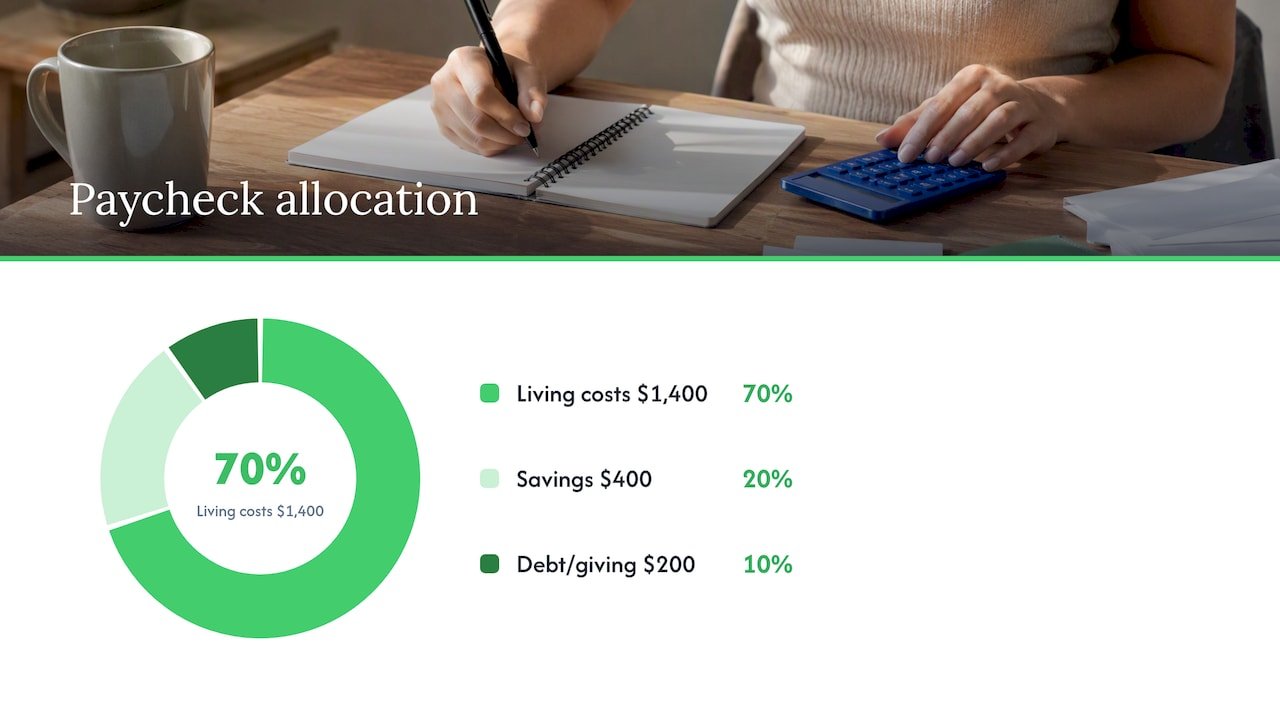
The 70/20/10 rule changes the buckets. U.S. News explains that monthly bills and daily spending go in the 70% bucket, savings and investing in the 20% bucket, and extra debt payments or donations in the 10% bucket, with minimum debt payments counted as regular spending.
On a $2,000 check that is $1,400 for living costs, $400 for savings and $200 for extra debt payments or giving. The same article notes the percentages can shift for circumstances such as high housing costs or high-interest debt, and a financial planner it quotes calls these guidelines rather than hard-and-fast rules.
A useful way to choose between rules: if you have no high-interest debt and want simplicity, start with 50/30/20. If a credit card balance is draining you every month, 70/20/10 gives that debt its own line.
5. Automate savings on payday
The most reliable paycheck habit is paying yourself first. The FDIC says automating transfers to a savings or investment account every pay period helps you build savings consistently before the money is spent. You can do it through your employer’s direct deposit split or a recurring transfer scheduled for the morning after payday.
Start small. The CFPB’s toolkit gives an example of moving $10 from a $245 weekly paycheck, and says that if left untouched the balance would exceed $500 after a year. Ten dollars a week is $520 over 52 weeks, so the math holds.
For a first target, the FDIC suggests an emergency fund goal of $500 to $1,000, which can cover many unexpected expenses. Once you reach it, raise the amount a little with each raise or when a bill ends.
If you want a structured way to keep going, our savings challenge plans offer seven formats you can start this week.
How much to set aside per paycheck for a savings goal
To reach a goal by a date, divide it by the number of paychecks before that date. For $2,000 in three months with biweekly pay:
| Paychecks in the window | Savings per paycheck |
|---|---|
| 6 paychecks | $333.33 |
| 7 paychecks | $285.71 |
Count your actual pay dates, since a three-month window can hold six or seven. Saving $1,000 per paycheck would produce $6,000 over six checks. That is realistic only if the money is left after essential bills, debt minimums and irregular expenses. If it is not, extend the deadline, lower the per-check target, or add income.
6. Use the “four walls” to protect a tight paycheck
When money is tight, the question is not how to split a surplus but what must be paid first. Start with the four walls: food, utilities, shelter and transportation. The FDIC’s guidance on prioritizing expenses says to rank them by the severity of consequences, such as those that put shelter, health or your ability to earn income at risk.
In practice, each payday:
- Pay housing, utilities, groceries and the transportation you need to get to work.
- Pay minimums on debts to avoid late fees and credit damage.
- Send a small automatic amount to savings, even $10 or $20.
- Spend what remains, and no more.
The FDIC also reminds borrowers that bills remain your responsibility, and you should plan to pay them as soon as you are able. If you cannot cover a bill, contacting the creditor before the due date usually gives you more options than staying silent.
Groceries are often the most flexible of the four walls. A weekly system, like the one in our budget meal planning guide, can free up a surprising amount per check.
7. Budget from your lowest paycheck when income is uneven
Hourly shifts, gig work and commissions make every paycheck different. A standard monthly budget can fail here, so use a cash flow budget. The CFPB describes it as a projection that tracks the timing of both income and expenses, and says it is often more effective for irregular, seasonal or one-time income.
Here is a workable routine:
- Base your fixed bills on your lowest typical paycheck, not your average.
- When a check is larger than that baseline, put the surplus in a buffer account.
- In a lighter period, draw from the buffer to cover the gap. The CFPB advises using savings from higher-income months to cover lighter ones.
- Ask your utility about a level payment plan. These plans average your annual usage over 12 months, which keeps seasonal spikes from wrecking one paycheck.
If the baseline is simply too low for your bills, the answer may be more income rather than more cutting. Our side hustle plan and beginner passive income ideas lay out options, and the money from a tax refund can help too. The FDIC notes that the IRS Volunteer Income Tax Assistance program helps taxpayers receive all the credits they qualify for, which can mean a refund to put toward savings or debt.
Our perspective: keep it boring and repeatable
We see the same pattern with readers who feel overwhelmed by money. They look for the perfect budgeting system, build an elaborate spreadsheet, and abandon it by the second month. Paycheck budgeting works best when it is dull.
Our advice is to pick one rule, write down the three or four bills that cause the most stress, and automate a small amount of savings on the next payday. Review it once per pay period, not every day. If a category keeps failing, change the category, not yourself. A budget that matches your real life beats a perfect one you ignore.
The habits matter more than the formula. If you want the routines that make any budget stick, start with our seven smart budgeting habits, then turn them into a financial management plan.
— Win Personal Finance
Put your paycheck plan to work
You do not need to buy anything to start. Pick the method above that fits your pay schedule, set up one automatic transfer and review the result at your next payday. When you are ready to add tools, our list of the best free financial wellness tools can help you track spending and bills without a subscription.

We publish step-by-step guides on budgeting, debt, saving and earning more at Win Personal Finance, written for beginners and for anyone tired of confusing advice.
FAQ
What is the best way to budget my paycheck?
The best way is the one you will keep using. Start by assigning each bill to the paycheck that arrives before it is due, then apply a simple split such as 50/30/20 to what remains. Automate savings on payday, and adjust the percentages if your housing or debt costs do not fit the rule.
Is saving $1,000 every paycheck good?
It is excellent if you can do it, but only after essentials, debt minimums and irregular expenses are covered. On a biweekly schedule, $1,000 per check is $6,000 over six paychecks. If that is out of reach, a smaller steady amount saved every payday builds the habit and still adds up.
How do I save $2,000 in three months with biweekly pay?
Divide $2,000 by the number of paychecks in your window. Six paychecks means about $333.33 each, and seven means about $285.71. If that squeezes your essentials, extend the timeline, lower the target or add income.
Should I budget by paycheck or by month?
Budget by paycheck if your bills fall on uneven dates, your income varies or you live close to the edge between paydays. Budget by month if your pay and bills line up neatly. Many people use both: a monthly view for totals, and a paycheck view for timing.
Sources
- A financial empowerment toolkit for community volunteers (CFPB)
- Making a Budget (consumer.gov)
- Make a Budget worksheet (consumer.gov)
- Analyzing budgets (CFPB)
- Why a 60/30/10 Budget Could Be the New 50/30/20 (Time)
- How the 70/20/10 Budget Rule Works (U.S. News)
- Saving for the Unexpected and Your Future (FDIC)
- Your Money, Your Goals: A financial empowerment toolkit (CFPB)
- Money Smart for Adults, Module 5 (FDIC)
- Money Smart for Young Adults, Module 4 (FDIC)
- Improving cash flow (CFPB)




[…] If you use a card for most of your spending, split the payment. Pay once mid-month and again at the due date. You still avoid interest, and the reported balance stays lower. This pairs well with a plan that assigns each paycheck a job, which we cover in paycheck budgeting. […]