A savings challenge is a structured plan that turns saving into small, repeated tasks: put a set amount aside on a schedule until you hit a total. The best one is the one your paycheck can actually carry. The classic 52-week challenge ends at $1,378, the 100-envelope challenge ends at $5,050, and gentler versions land anywhere in between. Below, we show the exact math for each, how to adjust it when money is tight, and where to keep the cash.
TL;DR
- The 52-week challenge saves $1 in week 1 and adds $1 each week, reaching $1,378 with a largest deposit of $52.
- The 100-envelope challenge totals $5,050 over about 100 days. Halve the amounts or draw weekly if that is too steep.
- Automate the transfers and keep the money in a federally insured account, so the habit does not depend on willpower.
- Challenges are a starter system. High-interest debt and an employer 401(k) match usually come first.
Table of Contents
- Why savings challenges work
- Seven savings challenges compared
- The $27.40 rule and other quick targets
- How to choose the right challenge for your budget
- Make it automatic
- Where to keep challenge money
- Doing a savings challenge with other people
- Our perspective
- Make the challenge stick with our free guides
- Frequently asked questions
- Sources
Why savings challenges work
Most people do not fail at saving because they do not understand it. They fail because the goal feels far away and vague. Bank of America’s savings guidance explains that challenges shift your attention from a distant outcome to a repeatable process. Each deposit is a small, visible win, and wins are what keep a habit going.
The amounts also matter less than you might think. The CFPB gives the example that saving 75 cents a day gets you to $100 in under six months (the same idea, shown by Investor.gov, is that $1 a day becomes $365 in a year). Consistency beats intensity.
Seven savings challenges compared
Here is how the most popular formats stack up. All totals are simple arithmetic from the stated schedule and assume you complete every deposit.
| Challenge | How it works | Total | Biggest single deposit | Best for |
|---|---|---|---|---|
| 52-week | $1 in week 1, up $1 each week | $1,378 | $52 | Steady paychecks, beginners |
| Reverse 52-week | Start at $52, drop $1 each week | $1,378 | $52 (week 1) | People who want the hard part done early |
| 26-week | $3 in week 1, up $3 each week | $1,053 | $78 | A six-month goal |
| 100-envelope | Envelope numbered 1 to 100, one per day | $5,050 | $100 | Higher or flexible income |
| Half-size 100-envelope | Same, each amount halved | $2,525 | $50 | Tighter budgets |
| Flat weekly transfer | $26.50 every week | $1,378 | $26.50 | Irregular motivation, easy automation |
| Monthly challenge | Same set amount each month, say $100 | $1,200 | $100 | Anyone paid monthly |
The 52-week challenge
This is the one most people mean when they search for a 52 week savings challenge. You save $1 in week 1, $2 in week 2, and so on to $52 in week 52. Fidelity confirms the total is $1,378, and that you can swap in an even $26.50 weekly transfer to reach the same number.
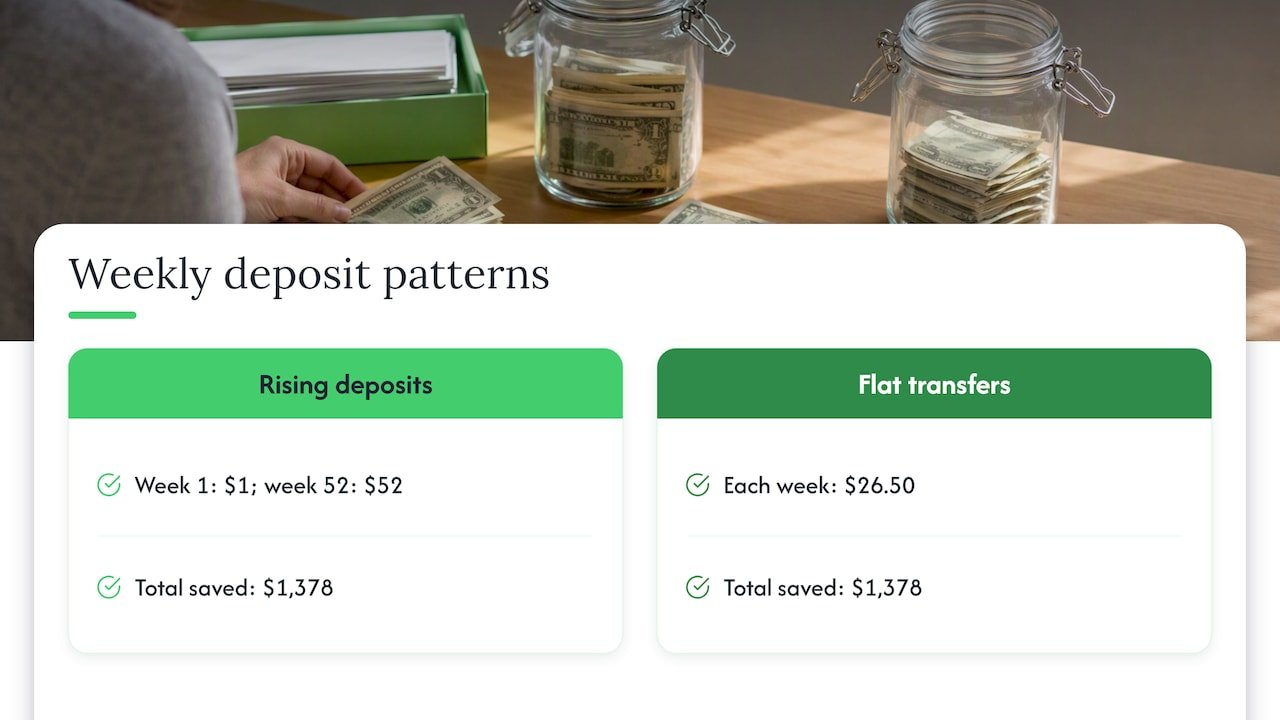
The catch is timing. The biggest deposits arrive in December, when holiday spending peaks. Flip the order and start at $52 if you would rather front-load the effort while motivation is high and bills are lighter.
If you want to pair the challenge with extra income, some readers use paid surveys, app testing and microtasks to cover the larger late-year deposits instead of cutting into the regular budget.
The 26-week challenge
This version suits people who find a full year too long. Bank at First describes starting with $3 and adding $3 weekly, which means a final deposit of $78 and a total of $1,053 after six months. You finish twice a year, which means two chances to feel good about it.
The 100-envelope challenge
Label envelopes 1 through 100. Each day, pick one and put in that many dollars. Because 1+2+…+100 equals $5,050, finishing gives you exactly that amount in a little over three months, as Fidelity’s explanation lays out.
That is a big number: roughly $50 a day on average. It is a fun game, but it is not realistic for every household. Fidelity suggests halving the amounts if you cannot afford the full version. Other adjustments keep the game while changing the pace:
- Draw one envelope per week instead of per day (100 weeks is long, so use 52 envelopes numbered 1 to 52 instead).
- Multiply every number by 0.5, or use $0.50 steps, for a $2,525 total.
- Move money digitally. Instead of storing cash, transfer the amount to savings and tick the number off a printed chart.
Other formats worth trying
Consumer-finance guides, including Experian’s roundup, also describe no-spend and no-dining-out challenges, round-up challenges, a fishbowl challenge and a retirement-contribution challenge. Fidelity’s list adds the guess-your-bills challenge and a 1% retirement challenge.
The right format depends on cash flow. Gradual weekly increases build habits. Fixed or reduced amounts suit irregular income, like gig work or commission.
The $27.40 rule and other quick targets
People often ask about the $27.40 rule. It is simple division: $27.40 a day over 365 days comes to about $10,001. It is a daily-target version of a $10,000 goal, not an official rule. Only use it if $27.40 a day, roughly $192 a week, leaves your bills covered.
The same logic answers the question of how to save $5,000 in three months. The 100-envelope challenge does it in about 100 days, but only if you can really set aside $50 a day on average. If you cannot, pick a longer timeline and a smaller daily figure rather than quitting on day nine.
How to choose the right challenge for your budget
Copying a viral chart is the most common mistake. Work backward from your own numbers instead.
- Name the goal. A $1,000 starter emergency fund, a trip, a holiday budget or a car repair fund each deserve a label. The CFPB’s emergency fund guide recommends choosing a specific goal first.
- Find your safe weekly amount. Look at the last two months of spending. If you have about $25 a week of true slack, the flat $26.50 plan is close. If you have $5, use a small-increment version.
- Check your worst week. In the 52-week plan, add up weeks 40 to 52. Can your pay handle $40 to $52 on top of bills? If not, reverse the order or cap the top amount.
- Match the format to your pay schedule. Paid every two weeks? Use a biweekly version and double the weekly amount. Paid monthly? Use the monthly plan.
- Pick a start date tied to payday. Starting the day after you are paid beats starting on the 28th of the month.
If you want to set the goal more rigorously, our guide to SMART financial goals and a weekly plan walks through the same process in more detail.
Make it automatic
The difference between a challenge that survives and one that fades is usually the system behind it. The CFPB recommends setting up recurring transfers from checking or a split direct deposit into savings. It also warns that automatic transfers can cause overdraft fees if your checking balance runs short.
In practice:
- Schedule the transfer for the day after payday, when the balance is highest.
- For rising-amount challenges, set a new recurring transfer each month, or schedule the total for the month in advance.
- Check your checking balance weekly. Revisit the amount whenever income or bills change.
A challenge is a flexible framework, not a contract. Skipping a week does not end it. Add the missed amount later, or drop to a smaller number and keep going.
Where to keep challenge money
Put it somewhere you can reach but will not casually spend. Investor.gov notes that a savings account suits short-term goals and emergency funds because the money stays accessible, while investing is meant for longer horizons and carries risk. A jar of cash under the bed is easy to raid and is not insured.
When you compare accounts, look at APY (which reflects compounding), fees, minimum balances and withdrawal rules. The FDIC says deposits at insured banks are covered to at least $250,000, so confirm the institution is insured.
Rates vary widely. The FDIC’s April 2026 table puts the national average savings rate at 0.38%, with a rate cap of 4.39%. That is a benchmark, not a promise that any account pays it. At small balances, the habit matters more than the rate. As your balance grows past a few thousand dollars, rate shopping starts to pay. Our comparison of HYSAs and CDs explains when each makes sense.
Doing a savings challenge with other people
Challenges are easier with company. Roommates can save for a shared deposit, families for a trip, coworkers for a gift. A shared tool that tracks group contributions and sends reminders can keep everyone honest without awkward follow-up texts. Agree on the amount, the deadline and what happens if someone falls behind before the first dollar moves.
Our perspective
We see savings challenges as a gateway, not a destination. They work because they make saving visible and a little playful, which is exactly what people who feel overwhelmed by money need. A new saver rarely needs a better spreadsheet. They need one easy win.
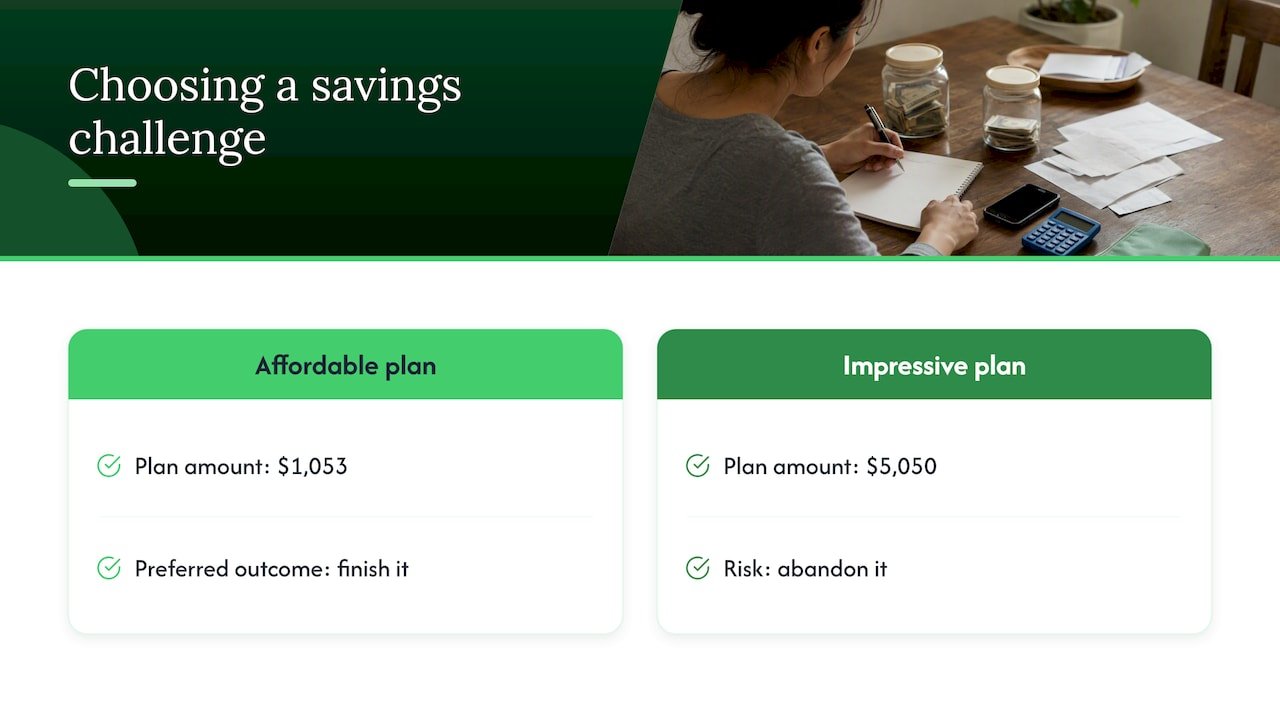
But we also see where challenges go wrong. People choose the most impressive chart, not the most affordable one, then quit in week 14 feeling like they failed. We would rather you finish a $1,053 plan than abandon a $5,050 one.
The order of priorities matters too. Investor.gov points out that credit card interest can far exceed what savings earn, and its guidance describes three to six months of living expenses as an emergency fund target for those able to build one. So use the challenge to build a starter cushion and a routine, then widen the plan: pay down expensive debt, capture any employer match (see the 2026 401(k) limits) and set up a longer-term financial management plan.
The best challenge is the one you finish and then replace with an automatic habit.
— Win Personal Finance
Make the challenge stick with our free guides
If you are building a savings routine from scratch, start with our seven budgeting habits that actually work to find the slack in your month, then browse the best free financial wellness tools to track your progress. Need more room in the budget? Our side hustle plan and raise-negotiation scripts show how to raise your income, and the bill negotiation scripts show how to lower your costs.
Frequently asked questions
What is the best savings challenge for beginners?
The 52-week challenge is the most common starting point because the first deposits are tiny. If the late-year amounts worry you, reverse the order or use the flat $26.50 weekly version, which reaches the same $1,378. Choose whichever one you will realistically complete.
Can I save $10,000 in three months?
Only if you can set aside roughly $770 a week, which is out of reach for most households without a windfall or a very high income. A more workable approach is a longer timeline: $27.40 a day gets close to $10,000 in a year. Do the math on your own budget before committing.
What happens if I miss a week?
Nothing breaks. Make up the amount in the next week or two, or restart from the week you missed at a smaller step. The CFPB’s guidance stresses consistency and adjusting when your income or balances change, so treat the chart as flexible.
Should I do a savings challenge if I have credit card debt?
Yes, but keep it small. A modest challenge builds a starter buffer so a surprise bill does not go on the card, while most of your extra cash goes to the high-interest balance. If your debt feels unmanageable, a nonprofit credit counselor can help you build a plan.
Sources
- Fidelity: 52-week money challenge guide
- Fidelity: 100-envelope challenge
- Fidelity: 10 money savings challenges
- Bank of America: money saving challenges
- Bank at First: 26-week challenge
- CFPB: essential guide to building an emergency fund
- Investor.gov: small savings add up
- Investor.gov: introduction to investing
- FDIC: national rates and rate caps, April 2026
- FDIC: Money Smart for Adults, Module 5
- Experian: savings challenges to try