
If you need multi-year, predictable payments, a personal loan usually wins. The trade-off is a promotional APR plus a transfer fee against a fixed APR plus a possible origination fee. The Consumer Financial Protection Bureau warns about consolidation risks, and myFICO notes utilization is about 30% of a FICO score. In this article, we explore balance transfer vs personal loan.
TL;DR:
- A balance transfer costs least if you clear it before the promotional rate expires; otherwise, the remaining balance faces the card’s regular APR.
- Check the transfer fee and new card limit first, since fees add to debt and a low limit may leave high rate balances behind.
- Compare a loan’s origination fee and total interest, not just its monthly payment; extending the term can lower payments while increasing the overall cost.
- Keep paid off cards open at zero balance, avoid new purchases on a transfer card, and automate payments to protect utilization and prevent late fees.
Table of Contents
- What a balance transfer and a personal loan actually are
- How the costs compare, with two worked examples
- How each option affects your credit score and when
- When a balance transfer makes more sense
- When a personal loan makes more sense
- How to choose: a step-by-step checklist
- How to carry out your plan, with two payoff templates
- What missed payments and late fees do under each option
- Taxes: is any of this deductible?
- Our take: pick the tool that fits how you really live
- FAQ
- Sources
What a balance transfer and a personal loan actually are
Before you compare prices, it helps to know how each tool works day to day. They look similar on the surface, since both let you swap several credit card balances for one payment. Underneath, they behave very differently.
A balance transfer moves what you owe on one or more cards to a new card, usually one with a low or 0% introductory rate. A few terms matter here:
- Promotional APR: a temporary low rate, often 0%, that lasts for a limited time. When it ends, the regular APR applies to whatever is left.
- Balance transfer fee: a charge, commonly a percentage of the amount you move. The CFPB’s key terms page notes that promotional rates last a limited time and that penalty APRs can apply after missed payments.
- Promo length: offers vary by card, so the exact number of months is something you confirm in the card’s terms before you apply.
- Credit limit: the new card’s limit caps how much you can move, which can leave part of your debt behind.
A personal loan works differently. It is an installment loan: you borrow a fixed amount, use it to pay off your cards, and then repay the loan on a set schedule. You get a fixed term, a fixed monthly payment, and a clear payoff date. Some lenders charge an origination fee, which is often taken out of the loan amount before you receive the funds.
Here is the part many people miss: neither tool reduces what you owe by itself. The principal stays the same. What changes is how much interest you pay on it and how your payments are organized. Bankrate’s overview makes the same point, noting that both are tools for managing interest and payments, not debt eraser buttons.
That is why the choice comes down to two things: how fast you can realistically pay the balance down, and how much structure you need to stick with it. A tool that saves money on paper can still fail if it does not fit how you actually handle money.
How the costs compare, with two worked examples
APR is the yearly cost of borrowing, expressed as a percentage, and it is the number you use to compare cards and loans. Credit cards and personal loans price it differently. Cards are revolving credit with variable rates, and a promotional APR can drop that cost to zero for a while. Personal loans are installment debt with a fixed rate for the whole term, so the rate is set up front and does not change.
For market context, the Federal Reserve’s G.19 consumer credit release publishes average interest-rate data for credit card accounts and personal loans. NFCC expert guidance puts it plainly:
Average credit card interest rates were about 20.97% while average personal loan rates were about 11.65% in late 2025. That gap is why a personal loan can beat leaving a balance on a card at its regular rate, even before you consider promotional offers.
Fees move the math. A transfer fee is added to the cost of a balance transfer, and an origination fee is added to the cost of a loan. To compare them honestly, add the fee to the interest you would pay. Here are the steps we use for any comparison:
- Write down the balance, the fee percentage, and the rate after any promotional period ends.
- Add the fee to the balance for a transfer, or subtract it from the proceeds for a loan.
- Work out the monthly payment you can truly afford.
- Add up the total interest plus fees over your realistic payoff time.
- Compare the totals, not just the monthly payments.
Now two worked examples. These are illustrations with assumed inputs, not market data. In both, the balance is an illustrative amount.
Example A: balance transfer paid inside the promo. Suppose a card charges a transfer fee and offers a temporary promotional rate. The fee is added to what you owe, and your monthly payment depends on the balance, fee, and promotional period. If you pay it off before the promo ends, this may be a low-cost option.
Example B: personal loan. Suppose a loan has a fixed rate and no origination fee. The monthly payment and total interest depend on the rate, loan amount, and term. Compared with a faster payoff, a longer term can offer more breathing room but may cost more overall.
Now the break-even logic. The balance transfer wins as long as you clear the balance during the promo. If you cannot pay off the balance before the promotional period ends, the remainder starts accruing interest at the card’s regular rate, which could be much higher than the loan’s rate. The loan’s advantage grows the more of the balance would otherwise outlast the promo.
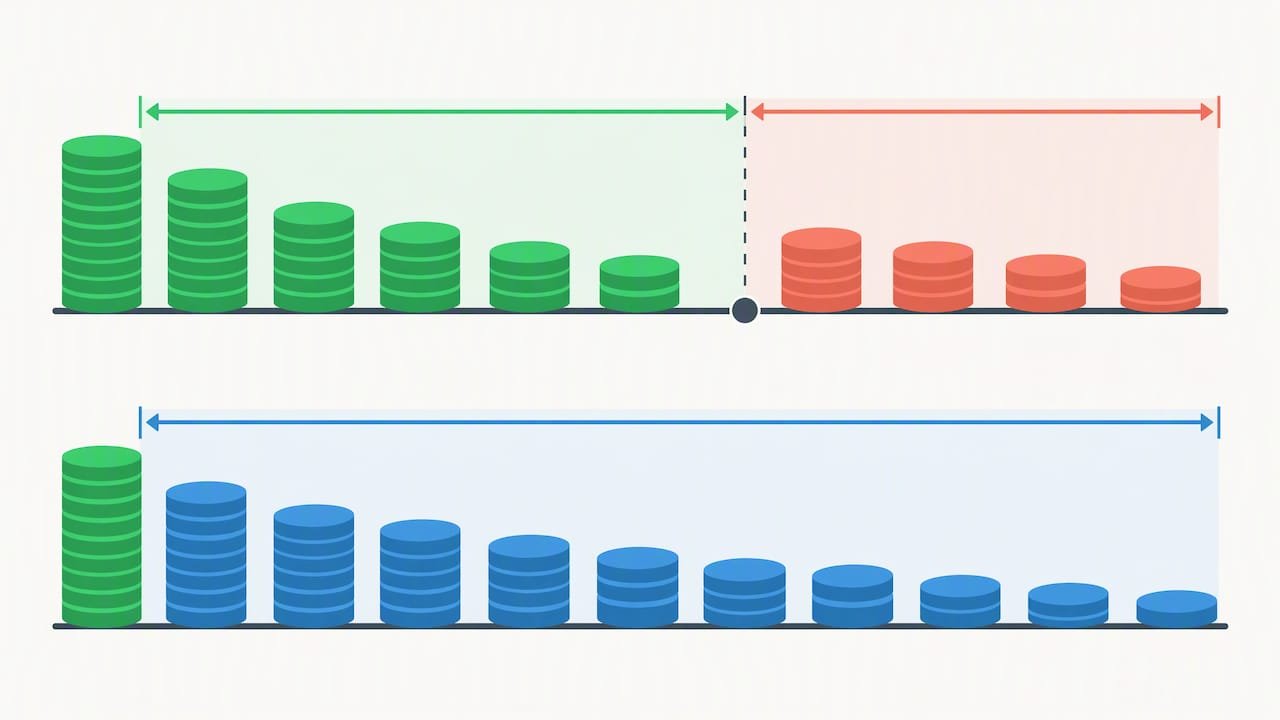
There is a trap on the loan side too. The CFPB cautions that consolidation can feel like debt reduction while increasing long-term costs if the loan lowers your payment by lengthening the term. Extending the loan term would shrink the payment further but could add interest. A lower payment is not the same as a cheaper loan.
For borrowers weighing installment loan types more broadly, our guide on federal vs private loans explains how those categories differ.
How each option affects your credit score and when
Your score reacts to both choices, but in different ways and on different timelines. Knowing what to expect keeps a small, temporary dip from surprising you.
Here is what moves when you apply and consolidate:
- Hard inquiry: applying for a new card or loan typically triggers one. It stays on your credit report for two years but, per myFICO, only affects FICO scores for the last 12 months.
- Utilization: this is the share of your available revolving credit that you are using. Moving card debt onto a loan can lower it quickly, since installment debt is not counted the same way. A transfer to a new card spreads the debt over more total credit, but a balance near the new card’s limit can still look high.
- Average age of accounts: a new account lowers the average age of your credit history, which can nudge your score down for a while.
- Payment history: on-time payments are the biggest driver of long-term score health, and consistent payments on a new account help rebuild what the inquiry took.
Credit utilization accounts for 30% of a typical FICO score. That is why keeping utilization low, ideally under about 30%, is worth planning around.
One habit protects your score after consolidating: keep the paid-off cards open. The CFPB’s guide to understanding your credit score explains that closing a paid-off card can hurt your score by reducing total available credit and increasing utilization. Leave them open at a $0 balance, and put a small recurring charge on each one if the issuer might otherwise close it for inactivity.
The CFPB also points out that using a transfer card for new purchases can cause interest to start on those purchases right away. So the score benefit of a transfer disappears quickly if you keep spending on it.
As for timing, a new inquiry and account can cause a temporary dip. Paying on time and keeping balances low may help your score recover as old card balances disappear. The bigger risk to your score is not the application itself. It is running the cards back up after consolidating.
When a balance transfer makes more sense
A balance transfer rewards a specific kind of borrower. If this sounds like you, it can be the cheapest path by a wide margin:
- You have good or excellent credit, which is usually what the best promotional offers require.
- Your balance is small to moderate, and you can finish paying it inside the promo window.
- You can stop using the card for new purchases, or at least keep those purchases separate.
- Your cash flow can handle the higher monthly payment that a short payoff period demands.
If you check every box, the fee becomes the main cost and the interest nearly disappears, as Example A showed.
A few practical habits make the difference between a transfer that saves money and one that does not:
- Run the fee math first. Transfer fees are commonly a percentage of the amount moved, so confirm the interest you avoid is more than the fee.
- Keep paying the old card until the transfer posts. Transfers can take a while, and a missed payment on the old account can bring late fees and credit damage.
- Do not make new purchases on the transfer card. The CFPB notes this can start interest accruing on those purchases immediately.
- Keep old accounts open. Closing them can raise your utilization, as covered above.
- Divide the balance by the promo months. That gives you the minimum monthly amount to finish on time. Set it as an automatic payment.
The CFPB also describes a pitfall it calls pyramiding: repeatedly opening new balance transfer cards to chase fresh promos. Lenders may view excessive transfers and new accounts as red flags, and each cycle adds fees without reducing what you owe.
Pro Tip: Only transfer what you can realistically finish before the promo expires. If the new limit is smaller than your debt, a partial transfer of the highest-rate balance is often smarter than stretching the offer past its end date.
When a personal loan makes more sense
A personal loan fits borrowers who value structure over the lowest possible sticker price. It tends to work well if:
- Your balance is large, so paying it off in a year or so would strain your budget.
- You want one predictable payment that never changes.
- Your credit is fair or you do not qualify for the best balance transfer offers.
- You are more likely to stay disciplined with an installment payment than with a revolving card.
The benefits are straightforward. You get a fixed payment and a fixed payoff date, which can make budgeting simpler. The NFCC guidance cited above reports lower average personal loan rates than average card rates, so some borrowers may reduce their interest cost compared with carrying a balance at the regular card rate. A fixed term also removes the cliff that comes when a promotional rate ends.
There are trade-offs to weigh as well:
- Origination fees: some lenders subtract a fee from your proceeds, so you receive less than you borrowed but owe the full amount.
- Longer terms cost more interest: a smaller payment stretched over more years can total more than a higher payment over fewer years. The CFPB specifically warns about this.
- Prepayment terms: check whether the lender charges anything for paying early, so you keep the option of finishing ahead of schedule.
- Rate depends on your credit: the lowest advertised rates go to the strongest borrowers, so compare offers based on your actual profile.
One more thing to watch: when your cards show a $0 balance after the loan pays them off, the temptation to use them again is real. The loan only helps if the cards stay quiet. If cash flow is tight, our guide to negotiating your bills can free up room in your budget to put toward the payment.
For a sense of how much higher-cost borrowing can run, this explainer on title loan interest rates shows why neither a loan nor a card with a reasonable rate should be swapped for something much pricier.
How to choose: a step-by-step checklist
You can make this decision in a single sitting if you work through the numbers in order. Here is the checklist we recommend:
- Gather your numbers. List every card with its balance and APR, estimate your credit score, and decide what monthly payment fits your budget without strain.
- Compare the true cost of each path. For a transfer, add the fee and any interest after the promo ends. For a loan, add the origination fee and the interest over the full term. Compute the monthly payment and total interest for each.
- Verify the terms. Confirm the promo length, what triggers a penalty APR, whether the loan has prepayment charges, and whether new purchases on a transfer card lose your grace period.
- Choose and protect your plan. Set up autopay, keep old accounts open at $0, and put a calendar reminder a month before any promo ends.
The CFPB’s guide on finding the best credit card suggests checking several details: the full APR or range, whether an advertised rate is conditional, transfer fees (commonly 3–5%), penalty APR triggers, and whether a low monthly payment is the result of a much longer term. Those are exactly the questions to ask before you sign anything.
Here are the questions to bring to the card issuer or lender:
- Is the rate I saw the rate I will actually get?
- What is the fee, and is it taken from the amount or added on top?
- What happens to my rate if I pay late once?
- Is there any charge for paying the whole balance early?
If your debt feels overwhelming rather than just expensive, the NFCC notes that Debt Management Plans and credit counseling are worth considering as alternatives. Neither of these tools is the right answer for every situation, and there is no shame in a different route.
Pro Tip: Do the math both ways before you apply. A one-page comparison of total cost, monthly payment, and payoff date will often make the choice obvious, and applying to only one product keeps hard inquiries to a minimum.
Our financial management plan guide walks through turning a decision like this into a plan you can follow.
How to carry out your plan, with two payoff templates
Once you have chosen, execution is where most of the savings are won or lost. Here are the steps for each route.
For a balance transfer:
- Apply for the card and wait for approval and your credit limit.
- Request the transfer, listing each account and the amount to move.
- Keep making at least the minimum payment on the old cards until the transfer posts.
- Confirm the old balances show $0 and that the new balance matches what you expected.
- Set autopay for your target monthly amount and a reminder before the promo ends.
For a personal loan:
- Compare offers and choose the lender, then submit the full application.
- Accept the loan and arrange for the funds to go to your card issuers if the lender offers direct payment.
- If the money lands in your bank account, pay off each card right away.
- Verify every card shows a $0 balance, then keep the accounts open.
- Set autopay for the loan payment.
Here are two templates, using illustrative examples:
| Plan | Monthly payment | Timeline | Cost |
|---|---|---|---|
| Plan | Monthly payment | Timeline | Cost |
| — | — | — | — |
| Promotional balance transfer | Depends on balance, fee, and promotional period | Before the promotional period ends | Transfer fee, plus any interest |
| Personal loan | Depends on loan amount, rate, and term | Set by the loan term | Interest and any fees |
Adapt the numbers to your own balance, then pick the row that matches what your budget can sustain every month.
What missed payments and late fees do under each option
A missed payment hurts on both paths, but the damage looks different. Knowing the difference helps you decide which tool you can trust yourself with.
On a balance transfer card, a late payment can trigger a late fee and, as the CFPB’s key terms page notes, a penalty APR. That penalty rate can replace your 0% promotional rate, which wipes out the main reason you chose the transfer. The savings you planned around can disappear after a single slip, which is why autopay is the first protection we recommend.
On a personal loan, a missed payment usually brings a late fee, and the lender may report the delinquency to the credit bureaus once the payment is far enough past due. Because your rate is fixed, there is no promotional rate to lose. But you still face fees, a damaged payment history, and, if the problem continues, collection activity. The loan’s rigid schedule is a strength when you stay on track and unforgiving when you do not.
Payment history is the biggest influence on your score, so a late payment on either product can set back the progress you were trying to make. The practical steps are the same for both:
- Turn on autopay for at least the minimum payment.
- Pick a due date that falls shortly after your paycheck lands.
- Keep a small cushion in checking for the payment date.
- Call the lender or issuer right away if you think you will miss a payment, since many will discuss options before the due date passes.
If you are worried about being able to keep up, build in a buffer before you commit, or choose the option with the smaller monthly payment.
Taxes: is any of this deductible?
For most people, the answer is no. Interest on a personal loan used to pay off credit cards is generally treated as personal interest, and personal interest is typically not deductible on a federal return. The same goes for interest on credit cards used for everyday spending. A balance transfer fee is also a personal cost for most borrowers, not something you subtract from your income.
The picture can change when the original debt was tied to a business. Interest on money borrowed for business purposes can sometimes be treated differently, and the rules depend on how the funds were used. If you carried business expenses on a personal card, or you are self-employed, talk with a tax professional about how to document and treat that interest. Keep records of what the debt paid for, since that history is what determines the treatment.
There is one other tax point worth knowing. If a lender forgives part of a debt you owe, the forgiven amount can count as taxable income in some cases. That mostly comes up in settlement or hardship arrangements rather than in a standard transfer or loan. Since the rules depend on your situation, we suggest confirming the details with the IRS or a qualified tax preparer before you rely on any deduction.
Our take: pick the tool that fits how you really live
We think the best consolidation tool is the one you will actually finish with. A 0% offer is only a bargain for someone who will pay on schedule, and a fixed loan is only a bargain for someone who will leave the cards alone afterward. The math matters, but the habits matter more. Pair whichever option you choose with a simple budget, and use our budgeting habits guide to build the routine. Then run your own numbers with the free financial wellness tools we have rounded up.
— Win Personal Finance
This article is general information, not a substitute for advice from a qualified financial advisor. Consult a qualified financial professional about your own circumstances before acting on anything here.
FAQ
Is a balance transfer or a consolidation loan better?
It depends on how fast you can pay the debt off. A balance transfer usually costs less if you can clear the balance during the promotional period, while a personal loan usually fits larger balances or anyone who wants a fixed payment and payoff date. Compare total fees plus interest for your own balance before choosing.
Do balance transfers hurt your credit score?
They can cause a small, temporary dip. Opening a new card creates a hard inquiry and lowers the average age of your accounts, and myFICO notes that hard inquiries affect FICO scores for about 12 months. On-time payments and low balances typically help the score recover.
What are the disadvantages of a balance transfer?
The main drawbacks are the transfer fee, a promotional rate that expires, and the risk of a penalty APR after a missed payment. New purchases on the card can also start accruing interest immediately, per the CFPB. A limit lower than your debt can also leave part of it behind.
How much would a $30,000 personal loan cost per month?
The payment depends on your rate and term, so it varies widely from one borrower to the next. A longer term lowers the monthly payment but raises total interest, which is the trade-off the CFPB warns about. Use a loan calculator with the exact rate and term from a lender’s written offer.
Can I use a personal loan to pay off credit cards and keep using them?
You can, but it defeats the purpose. The loan only helps if the cards stay at a low balance afterward, since new charges rebuild the debt on top of your loan payment. We suggest keeping the accounts open at $0 and spending only what you can pay in full.
Sources
- What do I need to know about consolidating my credit card debt? | Consumer Financial Protection Bureau
- Myfico
- Personal Loan to Pay Off Credit Card Bill? Ask an Expert
- Federal Reserve Board – Consumer Credit – G.19