
For most U.S. borrowers, we recommend taking federal student loans first because they come with standardized protections, income-driven repayment, and forgiveness options that private lenders simply do not offer. The U.S. Department of Education backs these programs directly. Private loans still have a place, usually to bridge a gap after you have exhausted federal aid, but refinancing federal debt into a private loan is a one-way door that closes off those protections for good.
TL;DR:
Federal student loans offer income-driven repayment plans, forgiveness options like PSLF, and discharge protections that private loans do not provide.
Private loans depend on market rates, require credit checks, and often involve higher interest rates and fewer borrower protections.
Borrowers should exhaust federal aid first, then consider private loans only for remaining gaps, especially if they have strong credit and a cosigner.
Refinancing federal loans into private debt is irreversible and results in losing eligibility for federal programs and protections.
Private loan terms can vary widely, and “low” interest rates may still come with hidden fees, prepayment penalties, and less transparent disclosures.
Table of Contents
-
When to consider private loans and the recommended borrowing order
-
Loan forgiveness options beyond Public Service Loan Forgiveness
What federal and private student loans actually are
Federal student loans are issued and guaranteed by the U.S. government under the Higher Education Act, administered through Federal Student Aid. This includes Direct Subsidized and Unsubsidized Loans for students and Direct PLUS Loans for graduate students and parents. Older Federal Family Education Loans, known as FFEL loans, were phased out in 2010 but some borrowers are still repaying them under similar federal rules.
Private loans work differently:
-
They are issued by banks, credit unions, state-affiliated lenders, or the school itself through an institutional loan program.
-
They are governed by a private promissory note and state law rather than federal statute.
-
Terms, rates, and borrower protections vary by lender instead of following one standardized federal framework.
That distinction, government program versus private contract, shapes nearly every other difference between the two.
Key differences at a glance
Before diving into rates and repayment details, it helps to see where federal and private loans diverge most sharply:
-
Interest rates: Federal rates are fixed and set annually by Congress; private rates are market-based and can be fixed or variable.
-
Protections: Federal loans offer income-driven repayment, deferment, forbearance, and forgiveness; private loans rarely offer comparable options.
-
Qualification: Most federal undergraduate loans require no credit check; private loans almost always require a credit check and often a cosigner.
-
Borrowing limits: Federal loans cap borrowing by year and program; private loans can cover up to the full cost of attendance.
Federal undergraduate borrowing is capped at $57,500 in aggregate, while graduate students can borrow up to $100,000 and professional students up to $200,000, according to Federal Student Aid. Private loans, by contrast, can fill the entire remaining cost of attendance once federal limits run out.
Interest rates, fees, and total cost: how to compare offers
Federal interest rates are set by statute each year, not by your credit score. For loans first disbursed between July 1, 2026, and June 30, 2027, Direct Subsidized and Unsubsidized undergraduate loans carry a fixed rate of 6.52%, graduate and professional Unsubsidized Loans sit at 8.07%, and PLUS Loans are priced at 9.07%.
Private loan rates depend entirely on your credit profile and the lender’s pricing model. Borrowers with excellent credit sometimes land rates near federal levels, but those with thin or damaged credit files can see rates climb well past them. Variable-rate private loans add another layer of risk since payments can rise as benchmark rates move.
When comparing offers, look past the headline rate:
-
Check whether the rate is fixed or variable, and how often a variable rate adjusts.
-
Factor in origination fees, since federal loans charge one, and some private lenders do too.
-
Watch for prepayment penalties or other fees buried in the fine print.
-
Compare total interest paid over the full term, not just the monthly payment.
Repayment flexibility and borrower protections
This is where federal loans separate themselves most clearly from private ones. Income-driven repayment plans adjust your monthly payment based on income and family size, and they are available across federal loan types. If your income drops, your payment drops with it, something no private lender is obligated to offer.
Public Service Loan Forgiveness forgives remaining federal loan balances after 120 qualifying monthly payments made while working for a qualifying employer, typically government or nonprofit organizations. The program has specific rules about which payments count, so it pays to confirm your employer and payment plan qualify before counting on forgiveness.
Federal loans also carry built-in discharge options:
-
Death or total and permanent disability discharge.
-
Borrower defense to repayment for cases involving school misconduct.
-
Deferment and forbearance options during financial hardship.
Private loans handle these situations inconsistently. Some lenders offer limited hardship forbearance, but none are required to match federal discharge rules.
Pro Tip: Before refinancing a federal loan into a private one, calculate what you would lose in IDR eligibility and forgiveness potential, not just what you would save in interest.
Eligibility, credit checks, and borrowing limits
Federal loans start with the FAFSA. Submitting it determines your eligibility, and most federal undergraduate loans require no credit check at all, PLUS Loans being the exception. Your school must participate in the Direct Loan program for you to receive federal funds through FAFSA.
Private loans work through traditional underwriting:
-
Lenders pull your credit report and score before approving a loan.
-
Many student borrowers need a cosigner because they lack established credit history.
-
Some schools offer institutional loans directly, which come with their own servicing terms.
If you have little or no credit history and no cosigner available, private borrowing often costs more, sometimes significantly more, than federal loans with the same loan amount.
When to consider private loans and the recommended borrowing order
A sensible borrowing sequence protects your long-term finances:
-
Apply for scholarships, grants, and work-study first since this money never needs repayment.
-
Use federal student loans next, maximizing subsidized and unsubsidized options before anything else.
-
Turn to private loans only to cover a remaining gap after federal aid runs out.
Private loans can make sense if you have exhausted federal limits, you have strong credit or a qualified cosigner, and the private APR genuinely beats what federal PLUS Loans would charge. Before signing, ask any private lender these questions: Is the rate fixed or variable? Does the loan include a cosigner release option? What deferment options exist? Are there prepayment penalties?
Pro Tip: Get written answers to these questions before you apply, since verbal promises from a lender representative are not binding.
Refinancing and consolidation: trade-offs and red flags
Refinancing federal loans into a private loan is irreversible. Once it happens, you permanently lose access to income-driven repayment, PSLF, and federal discharge options, a point the CFPB has repeatedly emphasized.
Refinancing may make sense only for borrowers with strong credit and stable finances who value a lower rate over federal protections.
CFPB supervisory findings have identified deceptive marketing practices among some private refinancers and rising complaint volumes tied to private loan servicing. Watch for these warning signs before refinancing:
-
Pressure to decide quickly without time to compare multiple offers.
-
Vague answers about what happens to IDR or PSLF eligibility after refinancing.
-
Unclear disclosure of whether the new loan re-amortizes your balance or just lowers the rate.
Verify any lender’s claims directly against your current servicer’s records before committing.
How to apply and practical next steps
Once you know your direction, moving forward is straightforward:
-
For federal loans: complete the FAFSA, review your school’s award letter, accept the loans through your financial aid portal, and save your servicer’s contact information.
-
For private loans: request estimates from several lenders, compare APR and total cost rather than just the monthly payment, check cosigner release terms, and get everything in writing.
-
If refinancing: get explicit written confirmation of which federal benefits you would lose, request a full amortization schedule, and use the three-day cancellation window if your lender offers one.
Taking these steps in order keeps you from locking in a decision before you have compared the full picture.
Loan forgiveness options beyond Public Service Loan Forgiveness
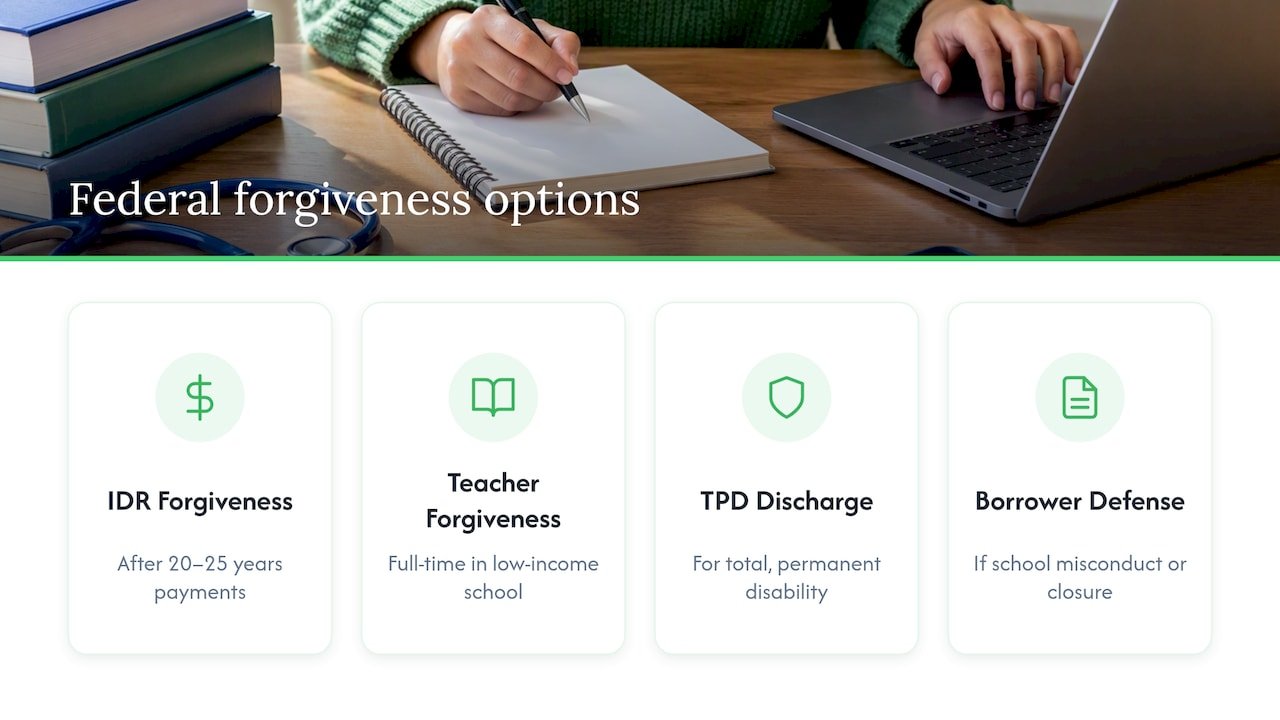
PSLF gets most of the attention, but it is not the only federal forgiveness path. Income-driven repayment plans themselves build in forgiveness: after making payments for the plan’s required term, typically 20 to 25 years depending on the plan, any remaining federal loan balance can be forgiven.
Teachers working full time in low-income schools may qualify for Teacher Loan Forgiveness, a separate federal program with its own service requirements. Borrowers who become totally and permanently disabled can apply for a Total and Permanent Disability discharge, which cancels the remaining federal balance entirely. Borrower defense to repayment offers discharge for students whose schools engaged in misconduct or closed abruptly.
None of these programs extend to private loans. A private lender can choose to offer hardship forbearance or a modified payment plan, but there is no federal mechanism forcing forgiveness on a private loan, and policies vary widely from one lender to the next. If forgiveness potential matters to your financial plan, that alone is a strong argument for keeping as much of your borrowing in the federal system as your aid package allows.
How cosigner release affects borrower responsibility
Many private student loans require a cosigner, usually a parent or other relative with established credit, because student borrowers often lack a credit history strong enough to qualify alone. The cosigner is legally responsible for the debt alongside the primary borrower until the loan is paid off or released.
Cosigner release lets the cosigner exit that obligation once the primary borrower meets specific conditions, commonly a set number of consecutive on-time payments and proof of sufficient income and credit on their own. Once release is granted, the loan becomes the primary borrower’s sole responsibility, and the cosigner’s credit report and liability are no longer tied to it.
This matters more than many borrowers realize. Until release happens, the loan appears on the cosigner’s credit report and affects their debt-to-income ratio, which can complicate their own ability to get a mortgage or car loan. Missed payments damage both credit files, not just the primary borrower’s. Review the release terms in the promissory note before signing, since some private lenders make the process difficult or set eligibility requirements that take years to satisfy.
Common myths about federal vs. private loans
A few persistent myths lead borrowers toward costly mistakes.
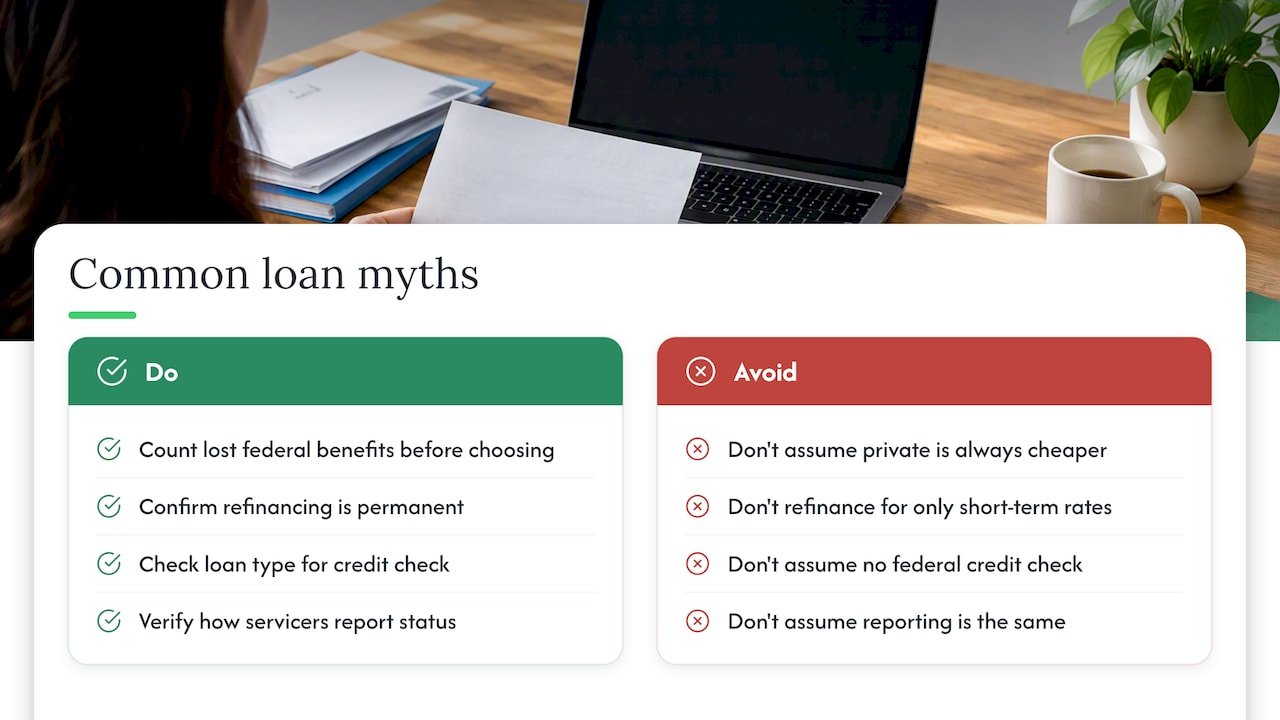
Myth: Private loans are always cheaper if you have good credit. Sometimes a private rate beats a federal one, but the comparison ignores what you give up: IDR, PSLF eligibility, and federal discharge options all disappear the moment you choose private debt over federal debt.
Myth: Refinancing federal loans is risk-free if rates look better today. CFPB guidance makes clear that refinancing is permanent. A temporary rate advantage does not restore access to income-driven repayment if your income drops later.
Myth: All federal loans require no credit check. This is true for most undergraduate Direct Loans, but PLUS Loans for graduate students and parents do involve a credit check, and an adverse credit history can affect approval.
Myth: Private loans and federal loans are reported to credit bureaus the same way. Both appear on your credit report, but federal loan servicing data and private loan servicing data can differ in how they report deferment, forbearance, or hardship status, which can affect how your credit profile reads during a tough financial stretch.
Clearing up these misconceptions before you borrow saves you from decisions that are difficult or impossible to undo later.
Our take on borrowing smart
We think the biggest mistake borrowers make is treating the lowest interest rate as the only variable that matters. A federal loan at a slightly higher rate that keeps income-driven repayment and forgiveness on the table is often the safer financial decision over a ten or twenty year horizon. Run the full comparison, not just the sticker price, before you commit.
— Win Personal Finance
Compare your options with Win Personal Finance
Deciding between federal and private loans gets easier when you can see the full cost picture laid out clearly. Our free financial wellness tools help you track payments, compare budgets, and plan around a new loan without the technical jargon getting in the way.

These are educational resources meant to help you reduce your total borrowing cost over time, not lending products themselves. Visit our personal finance resources to start comparing your options today.
This article is general information, not a substitute for advice from a qualified financial advisor. Consult a qualified financial professional about your own circumstances before acting on anything here.
FAQ
Is it better to do private or federal loans?
For most borrowers, federal loans are the better starting point because they offer income-driven repayment, forgiveness programs, and discharge protections that private loans generally do not match. Private loans can make sense as a supplement once federal aid is maxed out, especially for borrowers with strong credit and a clear repayment plan.
How much would I pay per month on a $100,000 student loan?
The monthly payment depends heavily on the interest rate and loan term, so there is no single answer. Using the current graduate Unsubsidized Loan rate of 8.07% as an illustrative example, a standard repayment term could put the payment over $1,000 a month, though income-driven plans could lower that substantially based on your income.
Are Sallie Mae private or federal loans?
Sallie Mae is a private lender, not part of the federal student loan system administered by Federal Student Aid. Loans from Sallie Mae follow private underwriting rules, including credit checks and lender-set rates, rather than the standardized terms that apply to Direct Loans.
What are the disadvantages of private loans?
Private loans typically require a credit check and often a cosigner, and they generally lack income-driven repayment, PSLF eligibility, and federal discharge options. CFPB supervisory findings have also flagged deceptive marketing practices among some private refinancers, making careful comparison essential before borrowing.