
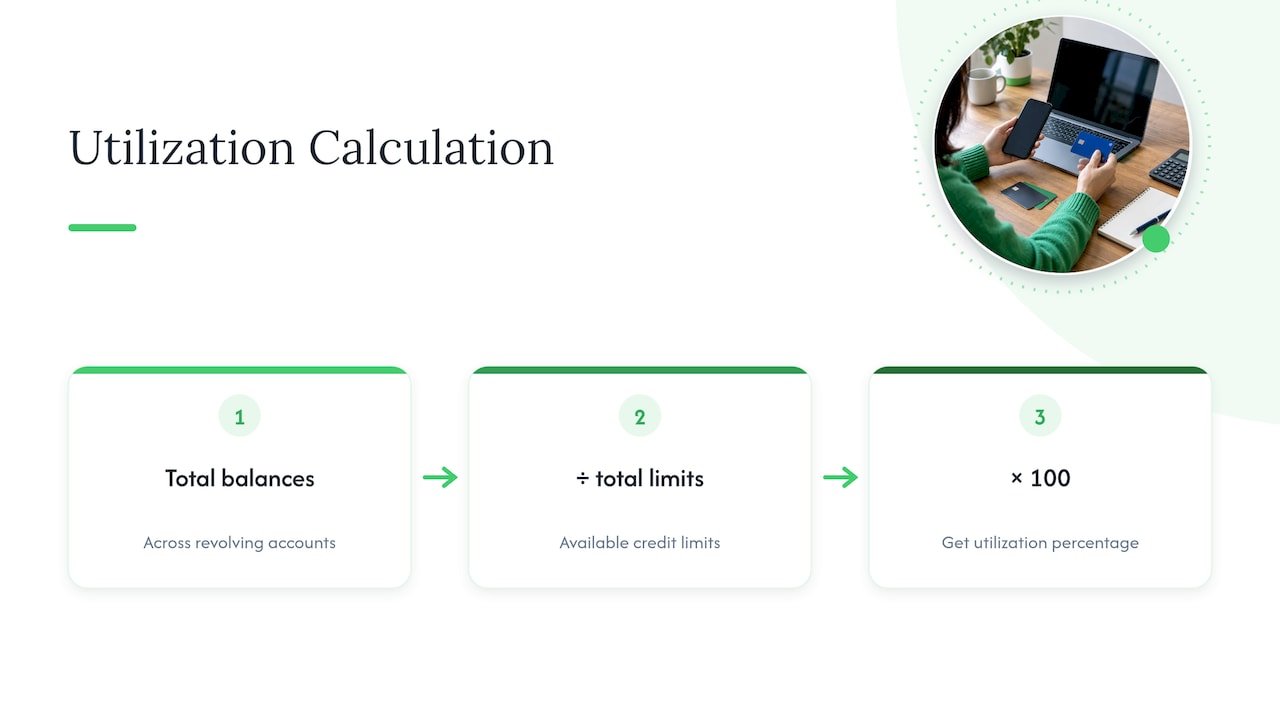
Your credit utilization ratio is the share of your available revolving credit that you are using, and it is one of the few credit score factors you can change in a single billing cycle. Add up your card balances, divide by your total credit limits, and multiply by 100. Most guidance says to stay at or under 30 percent, and lower is generally better. Below, we show the math, the benchmarks, and nine ways to bring the number down.
TL;DR
- Utilization = total revolving balances ÷ total credit limits × 100. Check it overall and card by card.
- Experts advise using no more than 30 percent of your total credit limit, and many people aim lower.
- On a $3,000 limit, 30 percent is $900 and 10 percent is $300.
- You do not need to carry a balance or pay interest to have a good score. Paying in full works.
- The fastest fixes: pay down balances before the statement posts, ask for a higher limit, and spread spending across cards.
Table of Contents
- What credit utilization is and why it matters
- How to calculate your credit utilization ratio
- What is a good credit utilization ratio?
- 9 ways to lower your credit utilization ratio
- Common mistakes that keep your ratio high
- How fast does a lower ratio show up?
- Perspective
- Put your numbers to work
- FAQ
- Sources
What credit utilization is and why it matters
Credit utilization measures how much of your available credit you are using across revolving accounts, such as credit cards and personal lines of credit. Installment loans, like a car loan or a mortgage, work differently, so the ratio is mostly about cards and lines of credit.
It matters because it carries real weight. According to the FDIC, credit utilization makes up 30 percent of a FICO score, and reaching the limit on your credit cards lowers your score. Lenders may also read a low ratio as a sign that you do not lean on credit to get by. Chase describes it as a possible signal that you are more likely to repay a lender.
The good news is that utilization has no long memory the way a missed payment does. It reflects the balances reported now, so it can improve quickly once your balances drop.
How to calculate your credit utilization ratio
You need two numbers for every card: the current balance and the credit limit. Both are on your statement or in your card app.
- List each card’s balance and limit. Include every credit card and any revolving line of credit.
- Add up the balances. This is your total balance.
- Add up the limits. This is your total available credit.
- Divide the total balance by the total limit.
- Multiply by 100. The result is your overall utilization percentage.
- Repeat for each card. Per-card percentages show where one account is running hot.
Here is a worked example with three cards:
| Card | Balance | Limit | Utilization |
|---|---|---|---|
| Card A | $900 | $1,000 | 90% |
| Card B | $100 | $4,000 | 2.5% |
| Card C | $0 | $5,000 | 0% |
| Overall | $1,000 | $10,000 | 10% |
The overall figure looks excellent at 10 percent. But Card A sits at 90 percent, and a single maxed-out card can still stand out in your file. That is why we always check both views. If you also want a tool that pulls your balances together, see our roundup of free financial wellness tools.
What is a good credit utilization ratio?
The most repeated benchmark is 30 percent. The CFPB says experts advise keeping your use of credit at no more than 30 percent of your total limit. Think of it as a ceiling, not a target. Many people who want the strongest profile aim for single digits.
A simple way to read your number:
| Utilization | How to read it |
|---|---|
| 0% to 10% | Very low. Typically the strongest range. |
| 11% to 30% | Generally fine. Room to improve if you are applying for a loan soon. |
| 31% to 50% | Worth working down. |
| Above 50% | High. Make this a priority. |
These bands are our own rule of thumb for planning, not an official scoring cutoff. Scoring models do not publish exact thresholds.
How much of a $3,000 limit should you use?
Use the same math on a single card. On a $3,000 limit:
- 30 percent is $900, the ceiling most guidance mentions.
- 10 percent is $300, a common goal if you want to be conservative.
- 1 percent is $30, which shows activity without much exposure.
If you spend $1,500 a month on that card, you would want to pay part of it before the statement posts, so the reported balance is lower than what you actually charged.
Is 0 percent utilization bad?
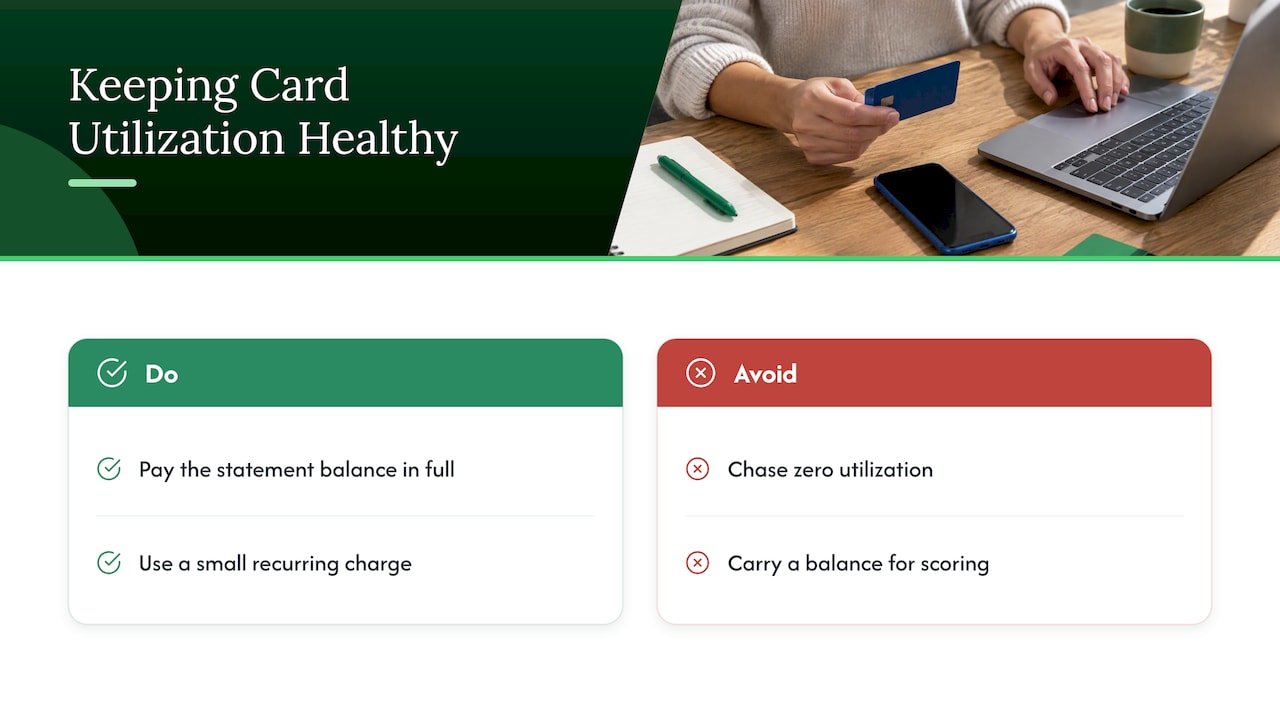
Not harmful in itself, but you do not need to chase it. The CFPB notes that you do not need to carry a balance on credit cards to get a good score. A card that shows a small balance on the statement and then gets paid in full is a sound habit. The one caution is that a card you never use may eventually be closed by the issuer, which would shrink your total limit, so a small recurring charge is a practical way to keep it active.
9 ways to lower your credit utilization ratio
Each of these works on one side of the formula: reduce the balance, or raise the limit. Several can be combined.
1. Pay your balance before the statement closes
Issuers choose when they report your balance to the credit bureaus, and many report around the statement date. That means a card you pay in full every month can still show a high balance if the statement posts before your payment does. A mid-cycle payment lowers what gets reported. Check your card’s terms or app to find the statement closing date.
2. Make two or more payments each month
If you use a card for most of your spending, split the payment. Pay once mid-month and again at the due date. You still avoid interest, and the reported balance stays lower. This pairs well with a plan that assigns each paycheck a job, which we cover in paycheck budgeting.
3. Pay in full instead of carrying a balance
There is a myth that you need to revolve a balance to build credit. You do not. The CFPB says that paying the balance in full each month helps get you the best scores and keeps interest costs as low as possible. If a balance is already there, paying it down is the single most direct way to cut utilization.
4. Target the card with the highest percentage first
When you cannot pay everything at once, look at per-card utilization. A card at 90 percent is a better target than one at 10 percent, even if the dollar amount is smaller. If the balances also carry interest, you may prefer to attack the highest interest rate first. Either approach lowers utilization over time, so pick the one you will stick with.
5. Ask for a credit limit increase
A higher limit with the same balance means a lower ratio. Many issuers let you request an increase in the app or by phone. Ask whether the request triggers a hard inquiry before you submit it, since that affects whether it is worth doing right before a mortgage or auto loan application. A higher limit only helps if your spending stays the same.
6. Spread spending across several cards
If you own more than one card, splitting purchases keeps each account’s percentage lower. Put recurring bills on one card and everyday spending on another, and pay each in full. This is a way to manage the ratio, not a reason to open cards you do not need.
7. Keep old, unused cards open
Closing a card removes its limit from your total, which can push your ratio up even if your balances do not change. If a card has no annual fee, keeping it open and using it for a small purchase now and then preserves your available credit.
8. Watch for temporary holds that eat into your limit
Some charges are not purchases at all. Hotels, rental cars and gas pumps often place authorization holds that reduce available credit until they clear. On a card with a small limit, a large hold can briefly push your reported percentage up. Travelers can learn how hotel credit card holds work and how to get them released sooner.
9. Consolidate high-interest card debt carefully
Moving card balances into a personal loan or a balance transfer card can reduce your revolving utilization, because an installment loan does not count the same way. The risk is running the cards back up. Before you consolidate, read our comparison of a balance transfer versus a personal loan and decide how you will keep the old cards at low balances.
Common mistakes that keep your ratio high
- Looking only at the overall number. One card near its limit can still be a problem.
- Paying on the due date only. If the statement already posted, the balance was already reported.
- Closing a paid-off card. You lose the limit and sometimes the ratio worsens.
- Raising spending after a limit increase. The benefit disappears if balances grow with it.
- Ignoring errors. A wrong limit or balance on your report distorts the math. If something looks off, follow our steps to dispute credit report errors.
How fast does a lower ratio show up?
Utilization is calculated from the balances your issuers report, so the change typically appears after the next report. In practice that means one to two billing cycles after you pay down. Because it is not tied to a negative mark, there is nothing to wait out. For the bigger picture, including payment history and credit age, see our guide to improving your credit score.
If the real obstacle is that your income does not cover your balances, the fix may sit on the income side. Our side hustle plan lays out how to build extra monthly cash that you can send straight to your cards.
Perspective
We built Win Personal Finance around one idea: you should not need a finance degree to manage your money. Credit utilization is a good example. It sounds technical, but it is a simple fraction, and you control both parts of it.
Our view is that the best approach is the boring one. Pay on time, pay in full when you can, check your balances before the statement closes, and keep your limits working for you. We do not believe in gimmicks, and we do not think you need to carry debt to prove you are creditworthy.
That is why we focus on step-by-step guides and free tools that help you see your numbers clearly, then act on them. Once you can see your ratio, lowering it becomes a routine habit rather than a worry.
Win Personal Finance
Put your numbers to work
Knowing your ratio is only useful if you act on it. Start by writing down your balances and limits, then pick two or three of the moves above and set reminders for your statement dates. Our financial management plan walks you through turning that into a monthly routine, and you can find more practical guidance on Win Personal Finance.

FAQ
Is a 30% credit utilization ratio better than a 50% ratio?
Yes. Lower is generally better, and 30 percent is the commonly cited ceiling. The CFPB says experts advise keeping your use of credit at no more than 30 percent of your total limit. A ratio of 50 percent is above that guideline and is worth working down.
Does credit utilization include installment loans?
The ratio is about revolving accounts, such as credit cards and lines of credit. Mortgages, auto loans and student loans are installment debt, and they are evaluated differently. Our student loan repayment guide covers that side.
Does paying off my card every month hurt my credit?
No. You do not need to carry a balance to have a good score, and paying in full also keeps interest costs as low as possible. Just remember that the balance reported to the bureaus may be the statement balance, so a payment before the statement closes can lower the reported figure even further.
What is the ideal credit utilization ratio?
There is no official single number. Staying at or below 30 percent is the standard guidance, and many people aim for under 10 percent. Pick a target you can sustain without missing payments or running short on cash.
Sources
- Credit Utilization Ratio: What to Know, Capital One
- Credit Reports, FDIC
- How much of your credit limit should you use? Chase
- How do I get and keep a good credit score? Consumer Financial Protection Bureau
- Stop a $1,500 Hotel Credit Card Hold