

A money market account and a savings account are both insured bank deposits that pay interest. The difference is mostly in how you reach your money and what the bank requires in return. Money market accounts often add a debit card or checks and sometimes pay a bit more, but they may ask for a higher balance. Savings accounts are simpler, usually have lower minimums, and can pay just as much once you compare the actual rate, which is the number that matters.
Below, we walk through the real differences, show what they mean in dollars, and give you a simple way to choose.
TL;DR
- Both account types are insured by the FDIC or NCUA up to $250,000 per depositor, per insured bank, for each ownership category, so safety is not the deciding factor.
- On national averages, money market accounts pay more than savings accounts, but a competitive high-yield savings account can match or beat many money market accounts. Compare the APY, not the account label.
- Choose a money market account if you want check-writing or a debit card on your savings. Choose a savings account if you want low minimums and simplicity.
- A money market account at a bank is not the same as a money market mutual fund, which is an investment and is not FDIC-insured.
- If you have a fixed date for the money, such as a down payment in 18 months, a CD may beat both.
Table of Contents
- What each account actually is
- Money market vs savings: the differences that matter
- Interest rates: what the numbers show
- Access to your money
- Minimums and fees
- Safety and insurance
- Taxes on the interest
- Which one fits your situation
- What about money market vs CD?
- Our perspective
- Where to go next
- A simple checklist before you open an account
- FAQ
- Sources
What each account actually is
Savings account
A savings account is the basic place to keep cash you are not spending right now. You deposit money, it earns interest, and you move it back to checking when you need it. Many online banks offer high-yield savings accounts (HYSAs), which are ordinary savings accounts that pay a much higher rate than the typical brick-and-mortar savings account.
Money market account
According to the Consumer Financial Protection Bureau, a money market account is a type of account offered by banks and credit unions, and like other deposit accounts it is insured by the FDIC or NCUA. In practice, it works like a hybrid: it earns interest like savings, and many versions add a debit card or paper checks like checking.
Not every money market account includes those extras, and some are savings accounts with a different name. Read the account’s fee schedule and feature list before you assume.
Money market vs savings: the differences that matter
| Feature | Savings account | Money market account |
|---|---|---|
| Interest rate | Varies widely; high-yield versions pay the most | Often higher than standard savings, frequently tiered by balance |
| Minimum balance | Often low or none | Often higher, especially to earn the top rate |
| Check-writing or debit card | Usually no | Often yes, but not always |
| Withdrawal limits | Federal cap removed, but some banks still enforce one | Same story, depending on the bank |
| Monthly fees | Common on in-branch accounts, often waived at online banks | Common if you drop below the minimum |
| Deposit insurance | FDIC or NCUA, up to $250,000 | FDIC or NCUA, up to $250,000 |
None of these rows is a rule. Each bank sets its own terms, which is why the account agreement matters more than the account’s name.
Interest rates: what the numbers show
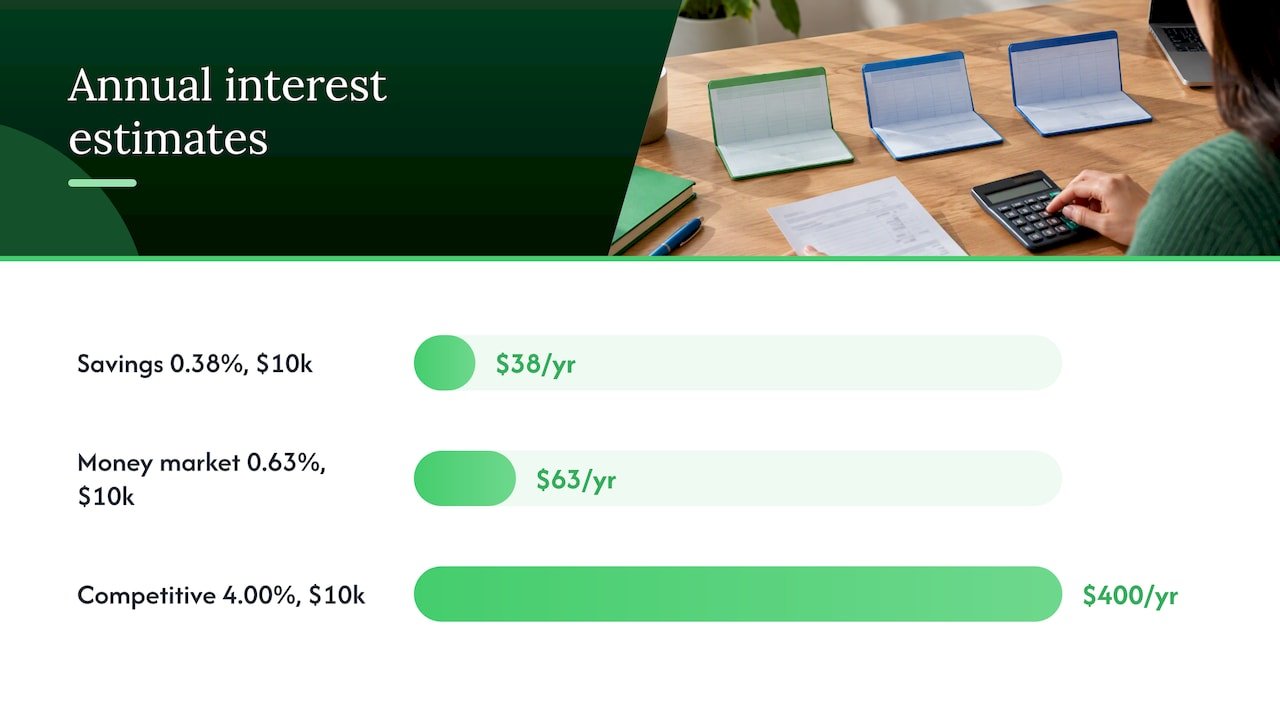
As of August 2026, the FDIC’s national rates page lists a national average of 0.38% for savings accounts and 0.63% for money market accounts. The FDIC bases the savings figure on a $2,500 account and the money market figure on $10,000 and $100,000 tiers. So the money market average is higher, partly because it reflects larger balances.
What does that look like on $10,000 over a year, ignoring compounding?
- At the 0.38% national savings average: about $38.
- At the 0.63% national money market average: about $63.
- At a hypothetical 4.00% APY, which is the kind of rate competitive online accounts have advertised: about $400.
The gap between the average and a competitive rate is far bigger than the gap between the two account types. If your money is sitting in a savings account that pays close to the national average, switching to a better-paying account of either type will do more for you than choosing between the two labels. Rates on both change, so check the current APY before you open anything.
Watch for tiered rates
Many money market accounts pay different rates at different balance levels. The headline rate may only apply once you hit, say, a five-figure balance. Read the rate table, find your tier, and compare that number with a savings account’s flat rate.
Access to your money
This is where money market accounts earn their reputation. Many include a debit card, checks, or both, so you can pay a large bill straight from the account. That feature can be useful for a home repair fund or a tax payment, but it also makes it easier to spend money you meant to leave alone.
The six-withdrawal rule
For years, federal Regulation D limited certain transfers and withdrawals from savings deposits to six per month. In 2020, the Federal Reserve removed that limit, according to its savings deposits FAQ. That FAQ also notes that banks can set their own limits, so many still enforce six per month and may charge a fee or convert the account if you go over.
Before you open either type, look for a line about the number of withdrawals and the penalty for exceeding it. If you plan to move money often, choose an account with no such limit.
Minimums and fees
Savings accounts often have low opening deposits, and online banks frequently skip monthly fees altogether. Money market accounts more often come with a minimum balance, and falling below it can trigger a monthly fee or drop you to a lower rate.
Run this quick check on any account you are considering:
- What is the minimum to open it?
- What balance earns the advertised APY?
- Is there a monthly fee, and how do you avoid it?
- Is there a limit on withdrawals or transfers, and what is the penalty?
- Do you actually need the debit card or checks?
A 0.25 percentage-point rate advantage disappears quickly on a $5,000 balance if a $12 monthly fee applies. That fee costs $144 a year, more than the extra interest.
Safety and insurance
Both account types are protected the same way. The CFPB explains that deposits at insured banks and credit unions are covered by the FDIC or NCUA up to $250,000 per depositor, per insured institution, for each account ownership category. If you hold more than that, you can spread money across banks or use different ownership categories, such as individual and joint accounts.
Money market accounts vs money market funds
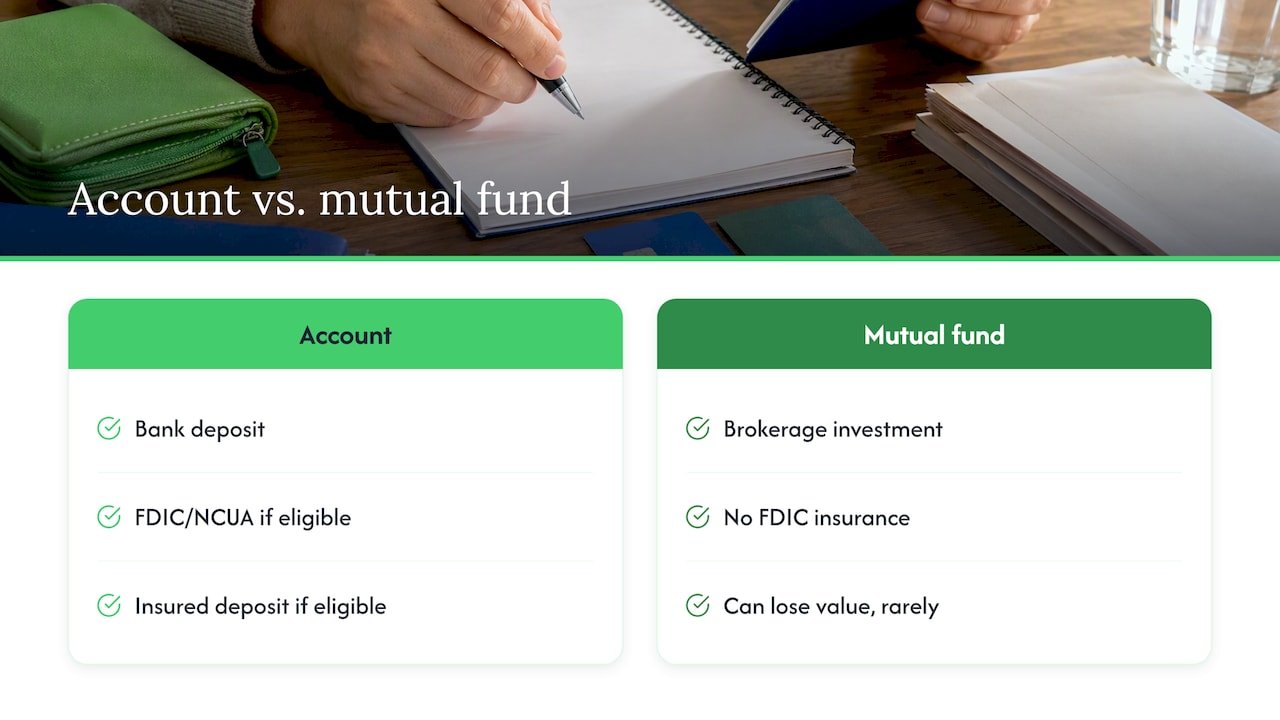
The names are nearly identical, and people mix them up. A money market account is a bank deposit. A money market mutual fund is an investment sold through brokerage firms, and it is not FDIC-insured. The CFPB page above draws that same line. Funds are designed to be low risk, but they can lose value, even if that is rare. If you want guaranteed deposit insurance, confirm that the product is an account at an FDIC-insured bank or NCUA-insured credit union.
Taxes on the interest
Interest from both account types counts as income. The IRS says that most interest you receive, or that is credited to an account you can withdraw from without penalty, is taxable in the year it becomes available to you. Banks typically report it on Form 1099-INT. The tax is the same for savings and money market accounts, so it should not push you toward either one. If you have a large balance and expect a sizable amount of interest, ask a tax professional how it affects your situation.
Which one fits your situation
Pick a savings account if…
- You want to build an emergency fund and leave it alone.
- You are starting with a small balance and want low or no minimums.
- You prefer a separate account that is not easy to spend from.
- You found a high-yield savings account with a rate that beats the money market options available to you.
Pick a money market account if…
- You keep a larger balance and a tier rate rewards it.
- You want check-writing or a debit card on your cash reserve.
- You use the account as a hub for irregular large expenses, like property taxes or a roof repair.
- You can comfortably meet the minimum balance without stretching.
Mini scenarios
Maya, 26, building her first emergency fund. She has $1,800 and adds $200 a month. A savings account with no minimum and no fee fits. She does not need checks, and a separate account helps her leave the money alone. Our savings challenge plans can help her pick a method for adding to it.
Carlos, 41, setting aside $30,000 for a home repair and property tax cushion. He sometimes needs to write a large check. A money market account with check-writing and a rate tier that begins at $25,000 may fit, as long as the fee is waived at his balance.
Dana, 34, saving a down payment in 12 months. She knows the date she needs the money. Both account types work, but a CD can lock in a rate for the term, which matters if rates fall. Our guide on using a HYSA and CDs together shows how to split the money.
What about money market vs CD?
Since many readers weigh all three, here is the short version. A CD pays a fixed rate for a set term and usually charges a penalty if you withdraw early. A money market account has a variable rate that can change at any time, but you can reach your money without penalty. If your goal has a fixed date, a CD can protect you from falling rates. If you might need the cash on short notice, an account is the safer fit. Many people use both: an account for the emergency fund and a CD for money with a known end date.
Our perspective
We get this question from readers who feel they are choosing between two complicated products. They are not. After looking at the numbers, we think the account type matters less than three things: the rate you actually earn, the fees you avoid, and whether the account helps you behave the way you want.
For most people building a first cash cushion, we lean toward a plain savings account at an insured bank, because it is simple, usually low-minimum, and kept apart from daily spending. We recommend a money market account when a reader has a bigger balance and a real use for checks or a debit card. We do not recommend chasing a half-point of extra interest if it means a minimum balance you cannot hold or fees that eat the gain.
The habit matters more than the product. A modest balance that grows every month beats a perfect account that stays empty.
— Win Personal Finance
Where to go next
Once you have picked an account, set up an automatic transfer on payday and decide what the money is for. If you want help tracking it, our list of free financial wellness tools covers apps that make saving visible, and our guide to budgeting habits that work shows how to find the money to move.
A simple checklist before you open an account
- Confirm the bank is FDIC-insured or the credit union is NCUA-insured, and that you are opening a deposit account, not a fund.
- Write down the current APY and whether it is tiered.
- List the minimum balance, monthly fee, and withdrawal limit.
- Decide whether you need checks or a debit card. If not, skip the extras.
- Set an automatic transfer and name the account after its goal.
- Review the rate every few months. Rates move, and you can switch.
FAQ
Is a money market account better than a regular savings account?
Not automatically. National averages show money market accounts paying more, but many high-yield savings accounts pay as much or more. A money market account is better if you want check-writing or a debit card and can meet the minimum. Otherwise, a savings account can be just as good.
What is the withdrawal limit on a money market account?
There is no federal limit anymore, because the Federal Reserve removed the six-per-month cap in 2020. Banks can still set their own, and many do, with fees for going over. Check your account agreement for the exact number and the penalty.
Are money market accounts and savings accounts both FDIC-insured?
Yes, when they are held at an FDIC-insured bank. Credit unions offer the same protection through the NCUA. Coverage is up to $250,000 per depositor, per insured institution, for each ownership category. Money market mutual funds are a different product and are not FDIC-insured.
How much interest would $10,000 earn in a year?
It depends on the rate. At the FDIC’s August 2026 national averages, it would be about $38 in savings and about $63 in a money market account. At a hypothetical 4.00% APY, it would be about $400. Compare the actual APY before you decide, since rates change.
Is the interest taxable?
Yes. The IRS treats interest on both account types as taxable income, and banks usually report it on Form 1099-INT. The account type does not change how it is taxed.
Sources
- FDIC: National Rates and Rate Caps, August 2026
- Consumer Financial Protection Bureau: What is a money market account?
- Federal Reserve Board: Savings Deposits Frequently Asked Questions
- IRS: Topic no. 403, Interest received




[…] Money Market vs Savings: Which Account Fits Your Cash? […]