The fastest way to improve your credit score is to pay every bill on time and bring your credit card balances down well below your limits. Those two habits drive most of your score. Everything else, from disputing errors to becoming an authorized user, either supports them or helps if you are starting with little or no credit. Below we walk through each step in the order we would tackle it, what results to expect, and the mistakes that quietly undo progress.
TL;DR
- Payment history is the biggest piece of your score. The FDIC says it makes up 35 percent, so one late payment costs more than almost any other slip.
- Keep card balances low. Experts quoted by the CFPB suggest using no more than 30 percent of your limit, and some say under 10 percent.
- Check your reports for free and dispute errors with both the bureau and the company that reported them.
- Starting from zero? A secured card, a credit-builder loan, or a store card can get you scoreable. There are no shortcuts, and results depend on your starting profile.
Table of Contents
- What actually moves your score
- Step 1: Pay every bill on time
- Step 2: Lower your credit card balances
- Step 3: Check your reports and dispute errors
- Step 4: Keep old accounts open
- Step 5: Apply for new credit sparingly
- Step 6: Consider becoming an authorized user
- Step 7: Plan for the surprises that cause missed payments
- Step 8: Start from scratch with the right first account
- How fast can you expect results?
- Our perspective: boring habits beat clever tricks
- Tools to track your progress
- Mistakes that quietly cost points
- FAQ
- Sources
What actually moves your score
Before you change anything, it helps to know what you are changing. According to the FDIC, scores are shaped by five things: payment history, credit utilization, length of credit history, new credit, and credit mix. Late payments, reaching your credit limits, and opening many accounts in a short period are the most common ways scores fall.
Two points surprise people:
- You do not have one score. The CFPB explains that each score varies with the data used, the scoring model, and the day it is calculated. A lender may see a different number from the one in your banking app. Track the trend, not a single reading.
- Models weigh things differently. The FTC notes that scoring systems are complex and may compare your information with people who have similar profiles. That is one reason the same habits produce different point changes for different people.
Because of this, no honest guide can promise “700 in six months.” What we can do is point you at the habits that every model rewards.
Step 1: Pay every bill on time
This is the one that matters most. The FDIC’s advice is plain: pay bills on time, and pay down card balances. A payment more than 30 days late is where real damage starts. MyCreditUnion.gov explains that debts unpaid 30 days past due are considered delinquent and may eventually be sold to a debt collector, typically within 180 days.
Practical ways to make on-time payments automatic:
- Set autopay for at least the minimum on every card and loan, then pay extra manually when you can.
- Keep a buffer in checking. The Federal Reserve cautions that if you use automatic payments, you need enough money in your account to avoid overdrafts.
- Line up due dates with paydays. Most issuers let you move your due date. If your income arrives on the 1st and 15th, a due date shortly after one of those is easier to hit.
- Call before you miss one. If you know money will be short, contact the lender first. Our guide to negotiating bills includes scripts for that conversation.
If you are already behind, bring the account current first. A single recent late payment hurts less as it ages, but only if no new ones pile on top.
Step 2: Lower your credit card balances
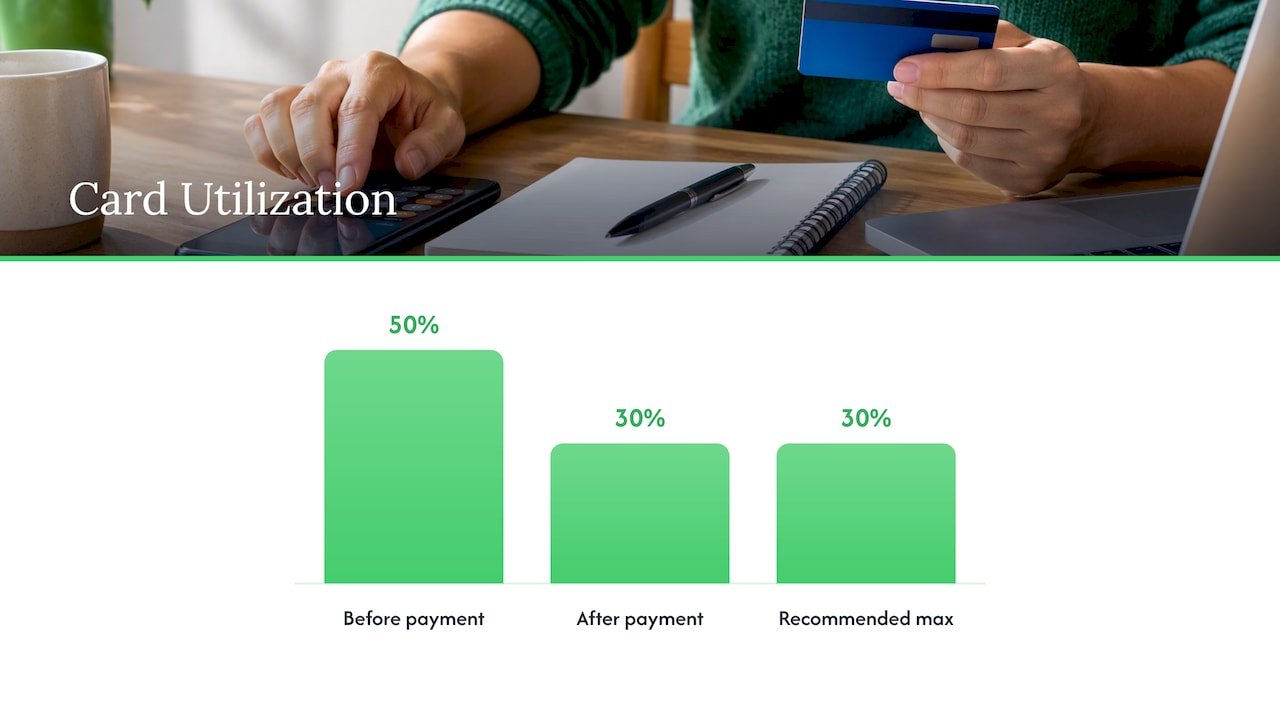
Utilization is your balance compared with your limit. If you carry $1,500 on a card with a $5,000 limit, you are at 30 percent. The CFPB says experts recommend keeping credit use at no more than 30 percent of your total limit, and in its rebuilding guide it adds that some experts advise less than 10 percent.
Here is a simple worked example. Say you have two cards with limits of $3,000 and $2,000, and balances of $2,100 and $400. Your total use is $2,500 of $5,000, or 50 percent. Paying $1,000 toward the first card drops you to $1,500 of $5,000, which is 30 percent. You did not need to pay everything off to cross the common guideline.
Timing matters more than most people think
The CFPB warns that if your score is calculated on a day when you have a high balance, it can affect your score even if you pay in full the next day. Issuers typically report your balance once a month, around your statement date. If you are applying for a loan soon, paying down before the statement closes can show a lower balance.
MyCreditUnion.gov also suggests that if you are paid more than once a month, you may make debt payments every pay period to keep utilization low.
You do not need to carry a balance
A common myth says you must carry a balance to build a score. The CFPB says you do not need to carry a balance or have outstanding debt to get a good score. Paying in full avoids interest and still builds history.
If high-interest card debt is the thing holding you back, compare your options in our guide to balance transfer vs. personal loan, which focuses on keeping the debt from coming back.
Step 3: Check your reports and dispute errors
Errors do happen: a payment marked late that was on time, an account that is not yours, a balance that was never updated. The CFPB says you can check your credit reports for free every 12 months at AnnualCreditReport.com, and that Equifax has offered additional free reports for a limited period. Check that page for the current terms.
If you find a mistake:
- Screenshot or print the error.
- Gather proof, such as a bank statement showing the payment date.
- Dispute it with the credit bureau showing it.
- Also dispute it with the company that supplied the information. The CFPB says to contact both.
- Keep copies of everything you send and note the dates.
Fixing a real error is one of the few moves that can lift a score quickly, because you are correcting the data rather than changing behavior.
Step 4: Keep old accounts open
Length of history is one of the five factors, and the CFPB observes that a long credit history helps your score, which is based on experience over time. The FDIC adds that you should not automatically close paid-off card accounts, because that may lower your available credit and raise your utilization.
If an old card has an annual fee you do not want to pay, ask the issuer about switching to a no-fee version rather than closing it. Use the card for one small purchase every few months and pay it off, so the issuer does not shut it down for inactivity.
Step 5: Apply for new credit sparingly
Every application can add a hard inquiry, and several accounts opened in a short period can pull your score down. The CFPB’s advice is to avoid applying for too much credit in a short time.
There is one useful exception to know about. The FTC says that in many scoring systems, multiple mortgage-lender inquiries made in a short time often count as only one. So comparing mortgage offers within a short window is not the same as applying for five credit cards in a month.
A good rule: apply only when you have a specific reason, and wait until your last application is reflected on your report before the next.
Step 6: Consider becoming an authorized user
Being added to a family member’s well-managed card can help, but only under certain conditions. Whether it works depends on whether the issuer reports the account to the bureaus and on the primary cardholder’s habits. A high balance or late payment on their side can hurt you, so only consider this with someone whose card use you trust. Ask the issuer whether authorized-user accounts are reported before you count on it.
Step 7: Plan for the surprises that cause missed payments
Most damaged credit starts with a cash-flow shock rather than carelessness: a car repair, a medical bill, a gap between jobs. MyCreditUnion.gov recommends building savings habits and an emergency fund to avoid setbacks that cause serious financial trouble.

Even a small cushion keeps a bill from going 30 days late. Start small with one of the plans in our savings challenge guide, and build a routine with the budgeting habits that actually work.
If the shock is a housing payment you cannot cover, act early. Missed mortgage payments are among the heaviest hits a report can take, and a resource on avoiding foreclosure walks through the options homeowners have before it reaches that point. For student loans, check the loan simulator guide to find a payment you can sustain.
Step 8: Start from scratch with the right first account
If you have little or no credit, you are not behind forever, but you do need an account that reports. The CFPB suggests starting with a secured card, a credit-builder loan, or a retail card, noting that payments are reported to the nationwide credit reporting companies and on-time payments can help build a strong history.
| Starter option | How it works | What to check |
|---|---|---|
| Secured credit card | You put down cash, for example $500, and can spend up to that amount. Paying the bill restores your spending amount. | Fees, interest rate, and whether it reports to all three bureaus |
| Credit-builder loan | The lender holds the money while you make payments, and the payments are reported. | Confirm the lender reports to all three bureaus; compare fees, interest, or subscription costs |
| Retail or store card | Easier approval, usually a low limit. | High interest rates; use it lightly and pay in full |
| Authorized user | You are added to someone else’s card. | Whether the issuer reports it, and the other person’s habits |
Experian’s guidance says secured cards and credit-builder loans can help someone become scoreable, but it advises verifying that a credit-builder lender reports to all three major bureaus and comparing costs.
If you want to build credit without a traditional credit card, a credit-builder loan is the closest fit. Whichever you choose, pay on time and keep the balance low. A $20 purchase paid off in full every month builds the same habits as a bigger one.
How fast can you expect results?
People search for ways to raise a score in 30 days, and a few moves can help in that window: paying card balances down, correcting an error on your report, or being added as an authorized user to a well-managed account. Results depend on your profile, though. Someone with a 40 percent utilization rate and no late payments may see a quick bump from paying a card down. Someone recovering from collections will not.
For building from nothing, expect months rather than weeks. A first score generally requires some qualifying history, and reaching a good score can take a year or more. The CFPB is direct on this: there are no shortcuts. Pay on time, stay well under your limit, and do not apply for too much credit at once.
Our perspective: boring habits beat clever tricks
We hear from readers who want a hack, a single move that adds 100 points. We understand the impulse, because a low score feels like a locked door. But when we look at what the FDIC, the CFPB and the FTC actually say, the advice is consistent and unglamorous: pay on time, keep balances low, check your reports, and do not open accounts you do not need.
What we think gets lost is the budget behind the score. A score is the result of a system: bills that are paid because money is set aside, cards that stay low because spending is planned, and an emergency fund that keeps a surprise from becoming a delinquency. That is why we start with a simple financial management plan before we talk about any credit product.
Our advice is to pick one habit this week, such as autopay on every account, and add the next one next month. Small, steady steps are easier to keep than a dramatic overhaul.
— Win Personal Finance
Tools to track your progress
The best credit plan is one you can see. We keep a running list of no-cost tools for tracking spending, balances, and scores in our roundup of the best free financial wellness tools. Pair a budgeting app with your free credit reports and you can watch utilization, due dates, and progress in one routine.

If you want a plan rather than a list, start at Win Personal Finance. We publish step-by-step guides on budgeting, debt reduction, and building habits that keep your score moving the right way, written for beginners and for anyone who feels overwhelmed by money.
Mistakes that quietly cost points
- Missing a due date by a few days. Set reminders and autopay.
- Maxing out a card, even briefly. A high balance on the reporting date counts.
- Closing your oldest card. It can shorten your history and reduce your available credit.
- Applying for several cards at once. Space out applications.
- Ignoring your reports. Errors stay until someone disputes them.
- Paying a collection or old debt without a plan. Before you send money, confirm the debt is yours and the amount is right, then get any agreement in writing.
FAQ
What is the biggest killer of credit scores?
Payment problems. The FDIC says payment history accounts for 35 percent of your score, and late payments hurt. Maxing out cards and opening many accounts quickly also push scores down.
How do I raise my credit score in 30 days?
Focus on what can change fastest: lower your card balances, dispute errors on your reports, and keep every payment on time. Becoming an authorized user on a well-managed account may also help. Results depend on your profile, so treat any specific point gain as a possibility rather than a promise.
Can I build credit without a credit card?
Yes. A credit-builder loan is one route, and the CFPB lists it alongside secured and store cards as a way to start. Make sure the lender reports to the credit bureaus, and compare the fees before you sign up.
Do I need to carry a balance to build credit?
No. The CFPB says you do not need a balance or outstanding debt to have a good score. Paying your statement in full builds history without costing you interest.
How long does it take to get to 700?
There is no fixed timetable. It depends on your starting point, payment history, utilization, and the age of your accounts. Many people need a year or more, and steady habits matter more than speed.
Sources
- Credit Reports, FDIC
- What is a credit score?, CFPB
- Credit Scores, FTC
- Money Basics Guide to Building and Maintaining Credit, MyCreditUnion.gov
- 5 Tips for Improving Your Credit Score, Federal Reserve
- Understand your credit score, CFPB
- How to rebuild your credit, CFPB
- How do I get and keep a good credit score?, CFPB
- Will paying off my credit card balance every month improve my score?, CFPB
- What are some ways to start or rebuild a good credit history?, CFPB
- How to Establish Credit if You’re Unscoreable, Experian