An HSA (health savings account) is the better long-term account, but only if you are on a qualifying high-deductible health plan. An FSA (flexible spending account) is usually the one your employer offers when you are not. Both let you pay medical costs with pre-tax money. They differ in who can open one, how much you can put in, and what happens to the money you do not spend. We have laid those differences out as a numbered list, then added a short checklist so you can make the call before open enrollment closes.
TL;DR
- An HSA requires a qualifying high-deductible health plan (HDHP). A standard health FSA does not, but it is tied to your employer.
- For 2026, the HSA limit is $4,400 for self-only coverage and $8,750 for family coverage. The health care FSA limit is $3,400.
- HSA money carries over and stays with you when you change jobs. FSA money is typically use-it-or-lose-it, with carryover only if your employer allows it.
- A standard FSA generally blocks HSA contributions, but a limited-purpose FSA can work alongside an HSA.
- Pick based on your plan type, your expected medical costs, and whether you can leave the money untouched to grow.
Table of Contents
- The 9 differences between an HSA and an FSA
- The quick comparison table
- 5 questions to help you choose
- Two examples with round numbers
- Mistakes to avoid
- Our perspective
- Put your health account into a bigger plan
- FAQ
- Sources
The 9 differences between an HSA and an FSA
1. Who can open the account
The biggest dividing line is your health plan. To contribute to an HSA, you must be covered by a qualifying HDHP, according to Optum’s HSA and FSA comparison. The IRS adds more tests: you generally cannot have other disqualifying health coverage, cannot be enrolled in Medicare, and cannot be claimed as a dependent on someone else’s return (IRS Publication 969).
An FSA works differently. It is offered through an employer, and you sign up during open enrollment or after a qualifying life event. You do not need a high-deductible plan to have one.
2. Who owns the money and whether it follows you
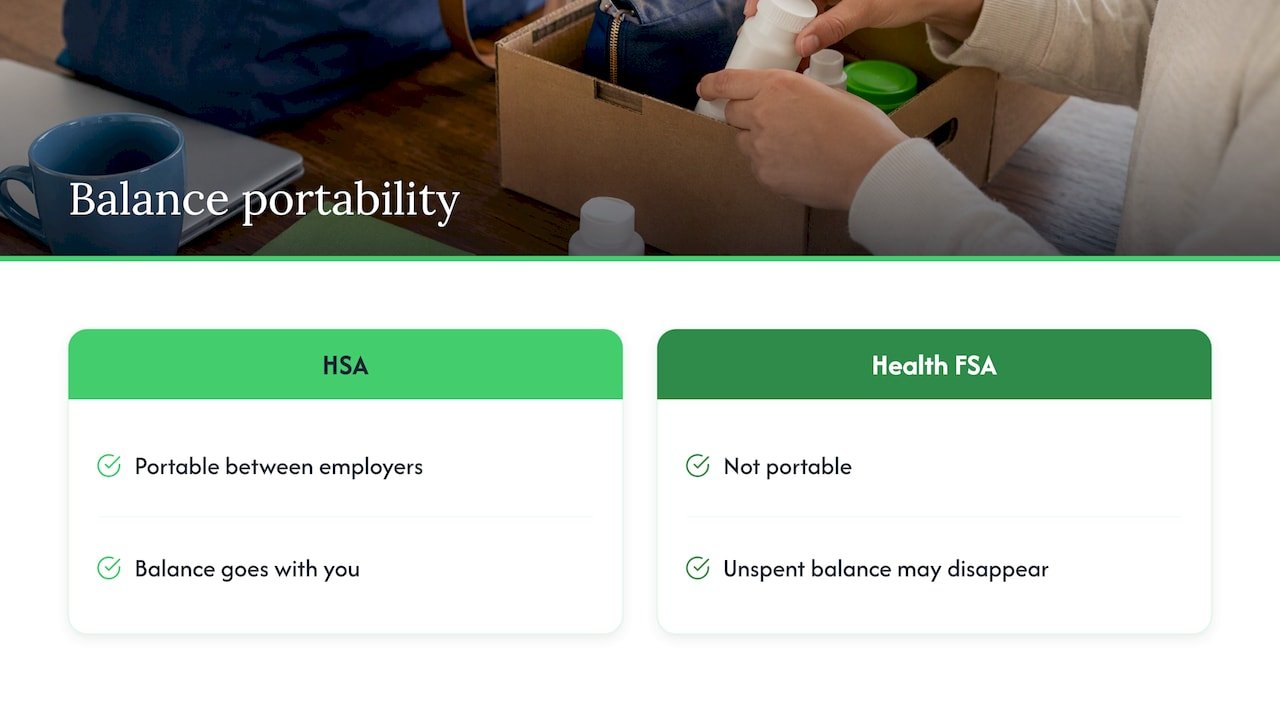
With an HSA, you are the account holder and the account is portable between employers. If you quit, get laid off or switch jobs, the balance goes with you. A health FSA, by contrast, is not portable (Optum).
That matters most if you change jobs often. An unspent FSA balance can disappear with the job, so a mid-year move calls for a quick look at what you can still claim.
3. 2026 contribution limits
The IRS sets annual caps. For 2026, the HSA limit is $4,400 for self-only coverage and $8,750 for family coverage. The health care FSA limit is $3,400 (IRS Publication 969). For comparison, the 2025 voluntary salary reduction limit for a health FSA was $3,300, per the same publication.
Here is the side-by-side:
| 2026 limit | HSA | Health care FSA |
|---|---|---|
| Self-only | $4,400 | $3,400 |
| Family | $8,750 | $3,400 |
The FSA cap is per employee, so it does not rise with family coverage. The HSA cap does.
4. How the limit is calculated
HSA eligibility is determined as of the first day of each month, and your contribution limit generally depends on how many months you were eligible (Congressional Research Service). If you join an HDHP in July, you should not expect to fund the full-year amount without checking the rules for your situation.
An FSA election is simpler: you choose an amount for the plan year, and it comes out of your paycheck in equal slices.
5. When you can spend the money
This difference surprises people. With an FSA, you can typically use the entire year’s election from the start of the year, even though your paychecks have not yet funded it. With an HSA, you can only spend what you have actually deposited.
That makes an FSA handy for a known expense early in the year, such as a planned procedure or new glasses. An HSA asks for a bit more patience if you start with a low balance.
6. What happens to unused funds
HSA funds carry over from year to year. There is also no requirement to begin spending down HSA balances at a certain age, unlike with qualified retirement plans (Congressional Research Service).
FSAs are stricter. HealthCare.gov notes the use-it-or-lose-it rule, which means you should plan your expenses carefully to avoid forfeiting unused money. Carryover is optional for employers (Optum), so read your plan documents to see what yours allows.
If you want to prepare for a big out-of-pocket cost, our friends at a deductible-help resource explain how to budget a $2,000 deductible across health, auto and an HSA. The same planning habit works for sizing an FSA election: add up what you know you will spend, then stay under it.
7. Taxes
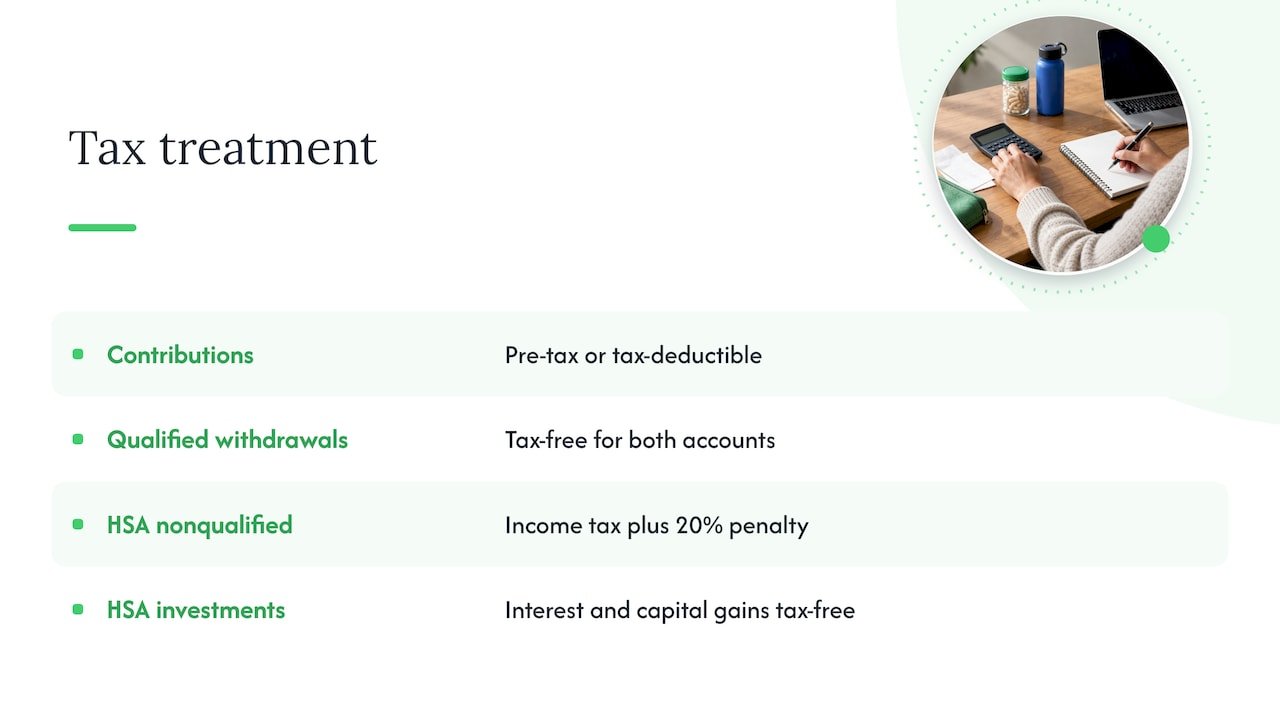
Both accounts are tax-advantaged. Contributions go in pre-tax or are tax-deductible, and qualified withdrawals are tax-free (IRS Publication 969).
The penalty side differs. Non-qualified HSA withdrawals are subject to income tax plus a 20% penalty, per the same IRS publication. That is a good reason to keep receipts and use the money for eligible care.
HSAs have one more edge. They allow investing, and interest and capital gains on those investments are tax-free (Optum). That is why many people treat an HSA as a second long-term savings bucket. If you are building that bucket, compare it with your 401(k) limits and your Roth or Traditional IRA choice.
8. Investing and growth
An HSA can be more than a spending account. Once your balance is large enough to cover your near-term costs, you may be able to invest the rest, depending on what your HSA provider offers. Growth stays tax-free as long as the withdrawals are for qualified care.
A health FSA is a spending tool only. It is built to be emptied within the plan year, so there is no growth to plan for.
9. Can you have both
Often, not in their standard forms. A standard health FSA generally is not compatible with HSA contributions. A limited-purpose FSA can sit alongside an HSA (Congressional Research Service).
The IRS notes that a general-purpose FSA or HRA usually disqualifies you from contributing, while limited-purpose, suspended, post-deductible and retiree-only arrangements may be compatible (IRS Publication 969). Also check your spouse’s coverage. A spouse’s general-purpose FSA can affect your HSA eligibility, so confirm it with your plan administrator or a tax professional before you contribute.
The quick comparison table
| Feature | HSA | Health care FSA |
|---|---|---|
| Plan requirement | Qualifying HDHP | None for the FSA itself |
| Portability | Goes with you | Not portable |
| Unused money | Carries over | Typically forfeited, carryover optional |
| 2026 limit | $4,400 self-only, $8,750 family | $3,400 |
| Investing | Allowed, tax-free growth | No |
| Non-qualified use | Income tax plus 20% penalty | Not allowed |
5 questions to help you choose
The research is clear on how the accounts work. Which is better for you depends on your own numbers. Walk through these in order.
1. Are you on an HDHP?
If not, an HSA is off the table, and an FSA may be your only tax-advantaged option. If you are, an HSA is available to you. Check that your plan is labeled as HSA-qualified, since not every high-deductible plan is.
2. How predictable are your medical costs?
If you know you will spend a set amount on prescriptions, therapy, dental work or vision, an FSA lets you pay for it pre-tax with little risk of losing money. If your costs are hard to predict, the HSA is safer because the balance does not expire.
3. Does your employer contribute?
Some employers add money to an HSA or an FSA. Free money changes the math, so look at your benefits guide. If the employer match only goes into one account, that is a strong reason to start there.
4. Can you leave the money alone?
The HSA’s long-term edge comes from carryover and tax-free investment growth. If you can pay current bills from your regular budget and let the HSA build, it works like extra retirement savings. If you need the cash now, the account still works for current expenses.
5. Do you change jobs often?
Portability favors the HSA. If you expect a move, an HSA balance stays yours, while an FSA balance may not.
Two examples with round numbers
These are illustrations, not predictions.
Example A: Healthy single worker on an HDHP. Maya expects about $600 in medical costs this year. She contributes enough to an HSA to cover that and a cushion. The unused part rolls over, so next year’s balance starts higher.
Example B: Family on a traditional plan. Dan and his spouse know they will have orthodontic payments and regular prescriptions. They are not on an HDHP, so they elect an FSA sized to those known costs, and they plan the spending before the plan year ends.
In both cases the move is the same: size the contribution to what you can actually foresee.
Mistakes to avoid
- Over-electing an FSA. Because of the use-it-or-lose-it rule, a number that is too high can cost you money. Choose a figure you are confident you will spend.
- Contributing to an HSA while ineligible. A general-purpose FSA or other coverage can disqualify you, so confirm your eligibility before each plan year.
- Using HSA money for non-medical costs. Non-qualified withdrawals carry income tax and a 20% penalty (IRS).
- Ignoring the cash flow. HSA money is only spendable once deposited, so keep a small buffer elsewhere for the first months.
- Forgetting about the account. An HSA has no required spend-down age, so it can sit and grow, but only if you remember to track it.
Where does the cash for contributions come from? A realistic financial management plan helps you decide how much to route to health accounts before other goals.
Our perspective
We think the right answer to HSA vs FSA starts with simplicity. Most people do not need to memorize tax code. They need to know three things: whether their plan qualifies, how much care they can predict, and whether they can let money sit.
The Office of Personnel Management points out that HSAs give people more flexibility and discretion over their health care funds, because they can save for both current and future medical expenses (OPM). We agree that this is the strongest feature. An account that you own, that follows you, and that can grow is a real financial habit, not just a benefit form.
At the same time, we do not treat the FSA as second best. For a predictable expense, it is a straightforward way to cut your tax bill. The goal is to match the account to your life, then build the habit of tracking it.
Win Personal Finance
Put your health account into a bigger plan
Picking an HSA or FSA is one step in a bigger money picture. If you want a simple system for budgeting, saving and paying down debt, start with our personal finance guides. They break each topic into short steps for beginners.

Need ideas for funding your contributions? Our free financial wellness tools can help you track spending, and our smart budgeting habits guide shows how to set money aside each month.
FAQ
Why would anyone use an FSA instead of an HSA?
Most often, because they are not on a qualifying HDHP, so an HSA is not an option. An FSA also lets you use the full annual election early in the year. For predictable costs and a plan year you can plan ahead for, it works well.
Do I need both an FSA and an HSA?
No. In most cases you choose one. A standard health FSA generally blocks HSA contributions, but a limited-purpose FSA can be paired with an HSA (Congressional Research Service). Ask your benefits team which FSA types your employer offers.
What happens to my HSA if I change jobs?
It stays with you. The HSA belongs to the account holder and is portable between employers (Optum). You can keep using it for qualified expenses, though you can only add new contributions while you remain eligible.
What are the main downsides to watch for?
For an HSA, you need an HDHP and must use the money for qualified care to avoid tax and a 20% penalty. For an FSA, the main risk is losing unspent funds, so plan your expenses carefully (HealthCare.gov). Both are easy to manage with a little planning.
Who is eligible for an HSA?
You need a qualifying HDHP, no disqualifying other coverage, no Medicare enrollment, and you cannot be someone else’s dependent (IRS Publication 969). Eligibility is determined monthly, so your limit can depend on how many months you qualify.
Sources
- Comparisons of HSAs and FSAs (Optum)
- Publication 969, Health Savings Accounts and Other Tax-Favored Health Plans (IRS)
- Health Savings Accounts (HSAs) (Congressional Research Service)
- Health Savings Accounts (Office of Personnel Management)
- Flexible Spending Accounts (HealthCare.gov)
- Budget a $2,000 Deductible