
To dispute a credit report error, get your reports from all three bureaus, mark each mistake, and send a written dispute to both the credit reporting company and the business that supplied the information. Disputing is free, the bureau generally has 30 days to investigate, and keeping proof of everything you send is what protects you if the dispute drags on.
This guide walks through the whole process in order: how to spot errors, what to put in a dispute letter, how to send it, what happens next, and what to do if the answer is no.
TL;DR
- Pull your free reports from all three bureaus at annualcreditreport.com and read every section, not just the score.
- Dispute in writing with the bureau and with the company that reported the information (the furnisher), and attach copies of your proof.
- Send by certified mail with a return receipt, or save confirmation if you dispute online.
- Expect an answer in about 30 days, up to 45 in some cases. If the item stays, you can add a statement of dispute to your file.
- Fixing an error only moves your score if the error was affecting scoring data, such as a wrong late payment or balance.
Table of Contents
- Why it is worth checking your reports for errors
- Step 1: Get your reports from all three bureaus
- Step 2: Read the report line by line
- Step 3: Gather your proof
- Step 4: Write the dispute letter
- Step 5: Send it to the bureau and the furnisher
- Step 6: What happens during the investigation
- Step 7: Read the results
- If the error is not fixed
- Will your credit score go up after a dispute?
- Our perspective
- Keep your credit healthy after the dispute
- FAQ
- Sources
Why it is worth checking your reports for errors
Lenders, landlords, and insurers may all look at what is in your file. A wrong late payment or an account that is not yours can mean a higher interest rate or a denied application, and nobody else is likely to catch it for you. The Consumer Financial Protection Bureau (CFPB) makes this point in its credit report review checklist: ordering a report is not enough, because you may be the only person who will read it closely enough to find a mistake.
The CFPB also notes that reviewing your reports at least once a year can help you spot identity theft and errors that could affect your access to credit or your loan terms. If you plan a big move, such as a mortgage application, check earlier than that so you have time to fix problems. Our guide on how much house you can afford is a good companion if that is your goal.
Step 1: Get your reports from all three bureaus
You can get one free report from each of the three major credit reporting companies, Equifax, Experian, and TransUnion, every 12 months at annualcreditreport.com, according to the CFPB. The site may also offer ways to view more frequently updated reports online, so check what is available when you visit.
Pull all three. The bureaus do not share a single file, so an error can sit on one report and be missing from the others. Save each report as a PDF or print it, because you will want to mark it up and attach it to your dispute.
A quick note: the three big bureaus are not the only ones. Specialty consumer reporting agencies may hold reports on tenant history, check-writing history, employment history, and insurance claims. If you were turned down for an apartment or a checking account and your main reports look clean, one of those may be the source.
Step 2: Read the report line by line
Go through each section slowly. The CFPB lists the common errors to look for, and we have turned them into a checklist.
- Personal information. Wrong name, a misspelled name, addresses you never lived at, or a Social Security number that is off by a digit.
- Mixed files. Accounts or addresses that belong to someone with a similar name or number. This often shows up as a stranger’s debts on your report.
- Accounts you did not open. These can point to identity theft and deserve fast action.
- Wrong account status. An account shown as open when you closed it, or as delinquent when you paid on time.
- Duplicate debts. The same debt listed twice, or listed by both the original creditor and a collector as if you owed it twice.
- Wrong balances or limits. A balance that is higher than what you owe or a credit limit that is lower than the real one, which makes your utilization look worse.
As you go, circle or highlight each problem and write a short note beside it: what the report says, and what is actually true. Those notes become the body of your letter.
Step 3: Gather your proof
A dispute with evidence is far easier to resolve than one without. Depending on the error, useful documents include:
- Account statements or payoff letters showing a zero balance or on-time payments
- Bank records showing a payment date
- Court orders, if a judgment was reported incorrectly
- A fraud affidavit or police report if the account came from identity theft
- Closure letters from the lender
The federal banking regulators’ consumer help site says that when you dispute with a furnisher, you can provide supporting evidence such as court orders, fraud affidavits, or account statements. Always send copies. Keep the originals.
Step 4: Write the dispute letter
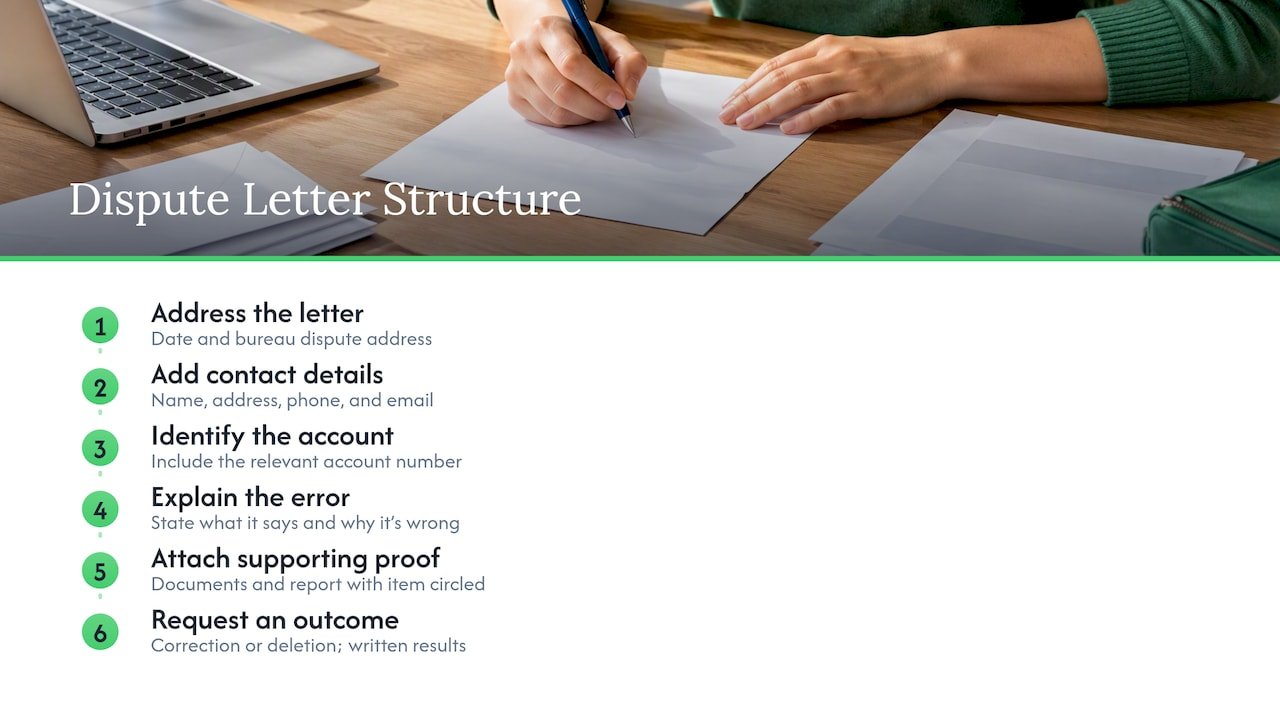
The CFPB advises that your letter include your contact details, the relevant account number, a clear explanation of the error, and a request for removal or correction. Enclose copies of your supporting documents and a copy of your report with the errors circled, as described on its page about how to dispute an error.
Keep it short and factual. You are not arguing; you are documenting. Here is a template you can adapt.
[Your full name]
[Your address]
[City, State ZIP]
[Phone and email][Date]
[Bureau or furnisher name]
[Dispute address from the company’s website or your report]Re: Dispute of inaccurate information, account number [number]
I am writing to dispute the following information on my credit report: [name of the account or item]. The report shows [what it says]. This is inaccurate because [one or two plain sentences, for example: the account was paid in full on March 3 and has had a zero balance since].
I have enclosed copies of [list documents] and a copy of my report with the item circled. Please investigate this item and [correct it to show X / delete it]. Please send me written confirmation of the results of your investigation.
Sincerely,
[Signature]
[Printed name]
Use one letter per bureau, and a separate letter for each furnisher. If you have several errors with the same bureau, list them as numbered items within one letter so nothing gets lost.
Step 5: Send it to the bureau and the furnisher
The CFPB says you should contact both the credit reporting company and the information furnisher, explaining what is wrong and including copies of your documents to each. The furnisher is the lender, card issuer, or collector that reported the information in the first place. Fixing it at the source helps keep the error from reappearing.
Find the current dispute address or online portal on each bureau’s website, since these details change. For the furnisher, check your statements or your credit report entry for a dispute address.
Online, phone, or mail?
You can dispute online, by phone, or by mail. Each has trade-offs.
| Method | Speed | Proof | Best for |
|---|---|---|---|
| Online portal | Fast to start | Confirmation page or email, so save it | Simple errors with few documents |
| Phone | Fast to start | Little unless you note the date, time, and name | Quick questions, not the full dispute |
| Certified mail with return receipt | Slower to send | Signed receipt showing delivery | Complex disputes, identity theft, or anything you may need to escalate |
The CFPB recommends certified mail with a return receipt so you have proof the letter arrived. If you dispute online, take screenshots of each page and save any confirmation number. Either way, keep a folder, paper or digital, with copies of every letter, receipt, and reply.
Step 6: What happens during the investigation
The clock starts when the bureau receives your dispute. According to the CFPB, investigations generally take 30 days, and can take up to 45 days if you dispute after getting your free annual report or if you send additional relevant information during the 30-day window. The company must tell you the results within five business days of finishing.
Two practical points follow from that.
- Send everything at once. If you mail extra documents in week three, you may extend the investigation by 15 days. Sometimes that is worth it, but it is better to have a complete package the first time.
- Do not be thrown off by demands for extra steps. Federal guidance says bureaus and furnishers must reasonably investigate qualifying disputes and cannot avoid that duty by imposing demands beyond those set by statute or regulation. If a company rejects your dispute because it did not use a special form, that is worth questioning.
During this time, keep paying your real bills on time. A pending dispute does not pause what you owe on accounts that are accurate, and it does not stop a late payment on those from being reported.
Step 7: Read the results
You will get a written result. It will usually say that the item was corrected, deleted, or verified as accurate. Get a fresh copy of your report and confirm the change actually shows up.
If the item was corrected or deleted, you can ask the bureau to send updated reports to others who received your file. The FTC says you can request that corrections go to anyone who received your report in the past six months, or in the past two years for employment purposes.
If the error is not fixed
The first answer is not always the final one. Here is how to keep going.
- Re-read the result. Did the bureau address the exact error you described? Sometimes a response covers a different point.
- Go back to the furnisher. If the furnisher keeps saying the data is right, send a second letter with stronger or clearer evidence, such as a payment confirmation with dates.
- Send a new dispute with new information. A repeat dispute with no new facts is more likely to be brushed off.
- Add a statement of dispute. If the furnisher decides the information is accurate, the CFPB says you can ask the credit reporting companies to add a statement explaining your side to your file for future reports.
- Escalate. You can file a complaint with the CFPB, and if the error cost you a loan, a job, or housing, a consumer protection attorney can tell you whether you have a claim under the Fair Credit Reporting Act.
The last step is where legal advice actually matters. For a routine error, the free process above is usually enough, and you do not need to pay anyone to file a dispute on your behalf, since disputing costs nothing.
Will your credit score go up after a dispute?
It depends on what was wrong. Filing a dispute does not by itself change your score. A correction can, if the information was part of your scoring data. According to Experian’s explanation of dispute outcomes, removing an inaccurate late payment, a new-credit inquiry, or a bankruptcy could raise your scores, while fixing personal details such as your name, address, or employer never affects them.
So set your expectations by error type:
| Error type | Likely score effect |
|---|---|
| Wrong address or misspelled name | None |
| Late payment you actually made on time | Often an increase |
| Account that is not yours | Depends on its balance and history, often an increase |
| Wrong balance or credit limit | Can help your utilization ratio |
No one can promise a specific number of points, and anyone who does is selling something.
Our perspective
Most people we hear from do not skip disputes because they do not care. They skip them because the process feels official and intimidating, and because a credit report looks like a wall of codes. We think that is the real barrier, so we keep the advice small: read the report, circle what is wrong, write three honest paragraphs, and keep proof.
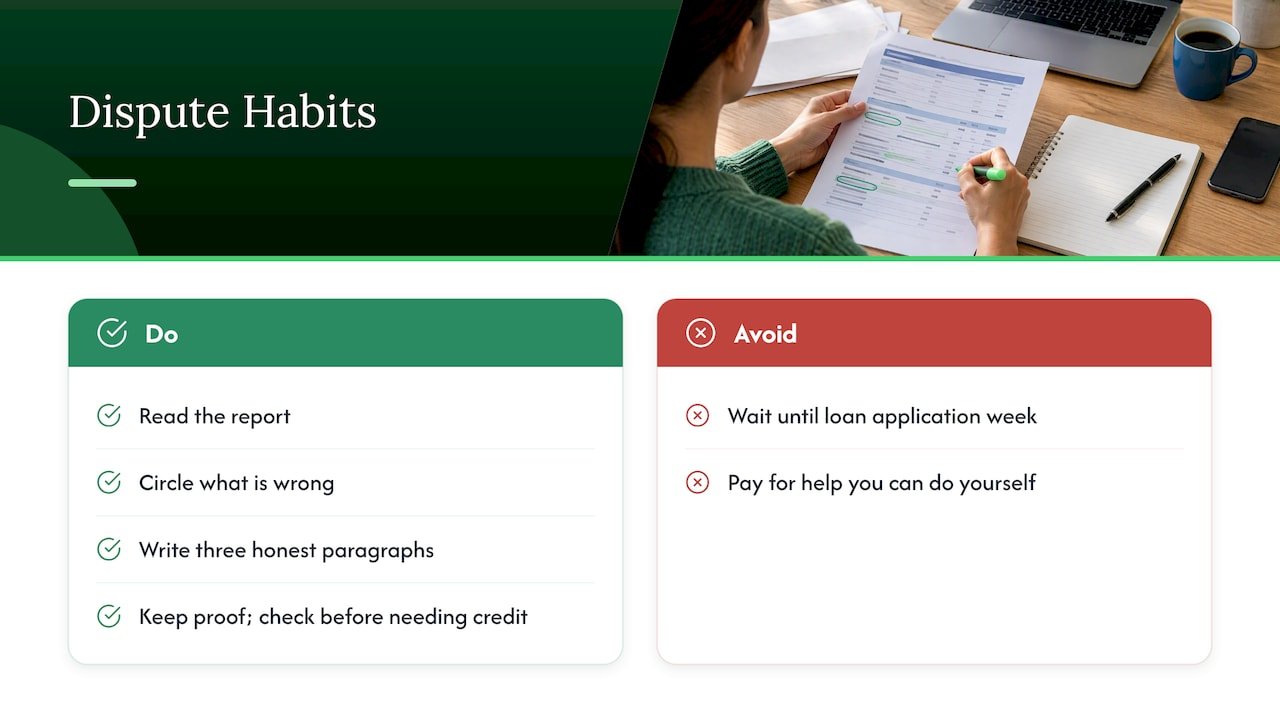
We also think timing matters more than most people realize. A credit check once a year is a good floor, but the best time to find an error is before you need credit, not the week before a mortgage or car loan application. Make it a habit alongside your other money routines, like the ones in our guide to smart budgeting habits.
And we would rather you avoid paying for help you do not need. The dispute process is free. Credit repair companies cannot do anything for you that you cannot do yourself with a letter and a folder. Save your money for the things that really move your finances, such as paying down debt or building an emergency fund.
— Win Personal Finance
Keep your credit healthy after the dispute
Once your reports are accurate, the goal is keeping them that way. Set a reminder to review your reports every year, and watch for new accounts you do not recognize. If you are working on card balances at the same time, our comparison of a balance transfer versus a personal loan shows how to lower interest without sliding back into debt.
If you want help staying on top of your money, we keep a running list of free financial wellness tools that cover tracking, budgeting, and credit monitoring without a subscription fee. It is a simple way to turn a one-time cleanup into a habit.
FAQ
Does it cost money to dispute a credit report error?
No. Disputing an error with a credit bureau or a furnisher is free, and you do not need a credit repair company or a lawyer to file one. A letter, copies of your proof, and a way to track delivery are all you need.
How long does a credit report dispute take?
Usually about 30 days from when the bureau receives your dispute. It can stretch to 45 days if you dispute after getting a free annual report or send extra information during the investigation. The bureau has to report the results to you within five business days of finishing, per the CFPB.
Do I need to dispute with all three bureaus?
If the same error appears on more than one report, dispute it with each bureau that shows it. Also contact the furnisher, since correcting the source information helps the fix carry across. Check all three reports first so you know where the error lives.
Should I dispute online or by mail?
Online is quick and fine for simple errors, as long as you save your confirmation. For anything complicated, or where you may need to prove what you sent, certified mail with a return receipt gives you the strongest record.
What if the bureau says the information is accurate?
Check whether it answered your actual complaint, then go back to the furnisher with better evidence. If it still will not change, ask for a statement of your dispute to be added to your file. If the error is causing real harm, consider speaking with a consumer protection attorney.
Sources
- CFPB: What are common credit report errors I should look for?
- CFPB: Understand your credit score
- CFPB: Credit report review checklist
- CFPB: When should I review my credit report?
- CFPB: How do I dispute an error on my credit report?
- CFPB: Consumer Financial Protection Circular 2022-07
- CFPB: How long does it take to repair an error on a credit report?
- HelpWithMyBank.gov: How do I dispute information on my credit report?
- FTC: Disputing errors on your credit reports
- Experian: How credit report disputes affect your credit