
The SAVE repayment plan no longer exists. A court order ended it on March 10, 2026, and anyone who was enrolled has to choose a different federal student loan repayment plan. If you don’t choose, the Department of Education says you’ll be placed in a fixed payment plan, which often costs more each month than an income-driven option.
This guide explains what SAVE was, who it covered, how it compared with PAYE, what your options are today, and how to pick one without guessing. We wrote it for borrowers who feel behind on the deadline, and for anyone who simply wants to understand the plan they keep hearing about.
TL;DR
- SAVE ended on March 10, 2026, after a federal court order. It is not coming back, so borrowers who were in it must pick another plan.
- Servicers began sending 90-day notices around July 1, 2026. If you didn’t choose, you may have been moved to a fixed payment plan. Log in to your StudentAid.gov account to check where you stand.
- Your realistic choices are the remaining income-driven plans, mainly IBR, plus the new Repayment Assistance Plan (RAP) and fixed-term plans. Which fits best depends on your income, family size and loan type.
- If you’re pursuing Public Service Loan Forgiveness, SAVE forbearance time doesn’t automatically count, so confirm your qualifying payment count.
Table of Contents
- What the SAVE plan was and why it ended
- Who qualified for SAVE
- What happens if you haven’t switched
- SAVE vs PAYE and the other income-driven plans
- How to choose your next plan
- A worked example
- Forgiveness, PSLF and the forbearance trap
- Our perspective
- Fitting the new payment into your budget
- Where Win Personal Finance fits
- FAQ
- Sources
What the SAVE plan was and why it ended
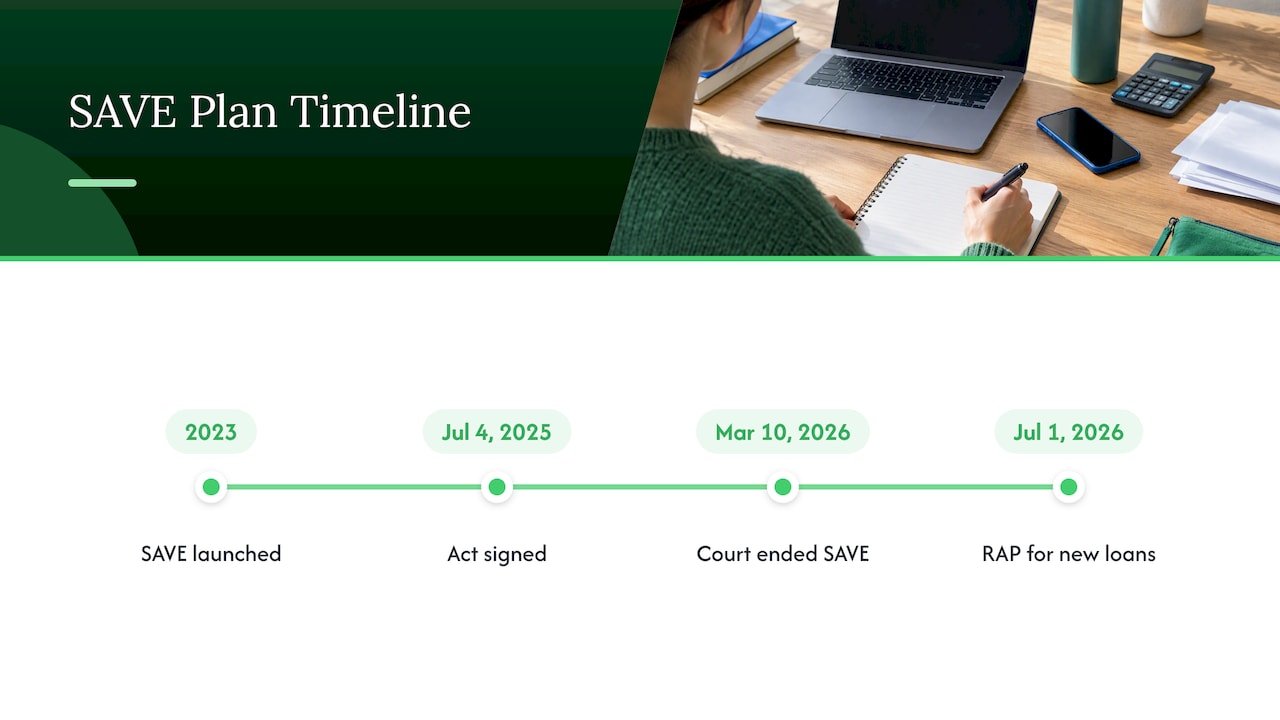
SAVE stood for Saving on a Valuable Education. It was an income-driven repayment (IDR) plan, which means your monthly bill was based on your income and household size rather than only on how much you owed. It launched in 2023 and became the most affordable option for many borrowers, sometimes producing a $0 monthly payment.
The plan was challenged in court. According to Student Loan Borrower Assistance, a nonprofit that advises borrowers, the Department of Education agreed to eliminate the plan to settle a lawsuit brought by Missouri and several other states, and a federal court entered judgment on March 10, 2026. The same source puts enrollment at about 7 million people.
Separately, the One Big Beautiful Bill Act, signed July 4, 2025, rewrites parts of the federal loan system. It creates a new Repayment Assistance Plan for loans made on or after July 1, 2026, according to the Department of Education’s discussion paper on the new rules. You may see articles saying SAVE would sunset in 2028. The court order moved that date up: the plan is already closed.
Who qualified for SAVE
If you’re searching for who qualifies for the SAVE plan, the answer is now historical, but it still matters because it tells you which borrowers are affected.
SAVE was open to people with federal Direct Loans, including consolidated loans, who enrolled and recertified their income. Parent PLUS loans were not eligible unless they had been through the consolidation route that other plans use. Private student loans were never part of it. If you’re unsure whether your loans are federal or private, our guide on deciding between federal and private loans walks through the differences, and your StudentAid.gov dashboard lists every federal loan you hold.
The practical test today is simple: if your servicer put you in SAVE, whether you were making payments or sitting in the related forbearance, you received or will receive a notice to choose again.
What happens if you haven’t switched
The timeline matters, so here it is in plain terms:
- March 10, 2026: A court order ended SAVE.
- Around July 1, 2026: Servicers started sending notices. One loan servicer, Edfinancial, said it would notify SAVE borrowers between July 1 and August 15 and that borrowers would have 90 days from the notice date to choose.
- Late September 2026: The first 90-day windows closed, since notices went out over several weeks.
Today is October 18, 2026, so your window may already have closed or may close soon depending on the date on your notice. Don’t wait for a phone call. The Department of Education says notices have already gone out by mail and electronically, so check your StudentAid.gov account first.
If you missed your window, you can generally still apply for a different plan through StudentAid.gov or your servicer. Contact your servicer to confirm what plan you’re in now and what it will cost. A fixed payment plan bases the bill on your balance, not your income, so the jump can be large for borrowers with modest pay.
SAVE vs PAYE and the other income-driven plans
Borrowers keep asking how SAVE compared with PAYE (Pay As You Earn). The comparison is useful because PAYE was the main alternative, and its own future is limited. The table below summarizes what’s available based on the sources we reviewed. Plan details change, so confirm your specific terms on StudentAid.gov before you apply.
| Plan | Status in October 2026 | Who it is for | Key point |
|---|---|---|---|
| SAVE | Ended March 10, 2026 | Former enrollees | Must choose a new plan |
| PAYE | Scheduled to sunset by July 1, 2028 | Existing borrowers | Reported as closing to new use as the law phases in |
| ICR | Scheduled to sunset by July 1, 2028 | Includes consolidated Parent PLUS loans | Same phase-out timing as PAYE |
| IBR | Remains available for loans disbursed before July 2026 | Many existing borrowers | Often the practical IDR landing spot |
| RAP | New from July 1, 2026 | New borrowers and, per reports, existing borrowers | Payments run 1% to 10% of adjusted gross income |
The phase-out dates for PAYE, ICR and IBR, and the RAP payment range, come from a college financial aid office summary of the new law. It also notes that RAP charges a flat $10 a month if income is under $10,000 a year. That page says borrowers on PAYE, ICR or the defunct SAVE plan will need to move to IBR or RAP by July 1, 2028, and that servicers will auto-enroll those who don’t.
How the plans differ in practice
SAVE protected a larger slice of income from payment calculations than older plans, which is why its bills were lower. One analysis of the plan in the research set concerns the IBR forgiveness rules, which give forgiveness after 25 years under certain conditions. Because that protection is gone, expect most former SAVE borrowers to see higher bills on whatever they pick next, even on IDR plans.
That doesn’t mean every plan is a bad deal. Income-driven plans still tie the bill to what you earn, and that’s the main protection if your pay is low or uneven.
How to choose your next plan
You don’t need to be a loan expert. You need four numbers and one tool.
Step 1: Gather your facts
Write down your adjusted gross income from your latest tax return, your household size, your total federal balance, and whether any loans are Parent PLUS or were taken out before or after July 1, 2026. These drive eligibility and the payment amount.
Step 2: Run the official calculator
The Department of Education urges borrowers to use the Repayment Calculator on StudentAid.gov to compare the remaining plans rather than waiting for automatic placement. Our own loan simulator guide shows how to read the output and compare total cost against monthly cost.
Step 3: Compare monthly payment and total cost
The lowest monthly bill is not always the cheapest plan. A longer plan lowers your payment but can raise the total interest you pay. Compare both numbers side by side.
Step 4: Apply and put recertification on your calendar
Once you apply, income-driven plans require you to recertify income and family size each year. According to a loan servicer’s eligibility page, missing those deadlines can cause interest to capitalize and payments to rise. Set a reminder two months before your date.
A worked example
Here is an illustration, not a quote. Say you have $40,000 in federal loans, earn a modest salary and support a household of two. On a fixed payment plan, your servicer calculates the bill from the $40,000 balance and the term. On an income-driven plan, the bill comes from your income minus a protected amount. If your income dips, an IDR bill falls with it. A fixed bill doesn’t.
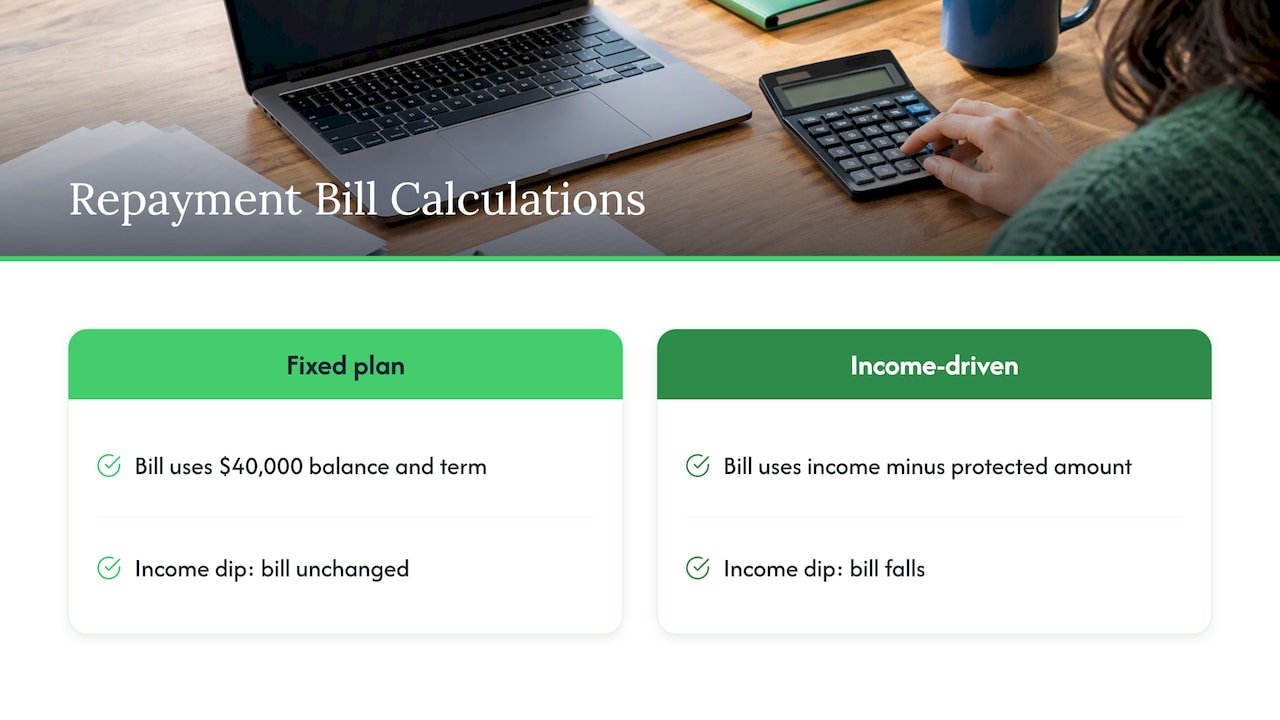
That difference is why an unplanned move into a fixed plan is the outcome to avoid. The servicer FAQ notes that borrowers who do nothing end up in a standard type plan that can cost significantly more each month than an IDR choice. Plug your own numbers into the calculator to see the real gap.
Forgiveness, PSLF and the forbearance trap
Income-driven plans still lead to forgiveness. Edfinancial’s list of discharge options says Public Service Loan Forgiveness needs 120 qualifying payments, and IDR discharge comes after 20 to 30 years of eligible repayment depending on the plan. It also points borrowers to the PSLF Help Tool on StudentAid.gov to verify employer eligibility and track progress.
Here is the catch for former SAVE borrowers. Many were placed in a special forbearance while the plan was in legal limbo. The Department of Education says that time doesn’t automatically count toward PSLF, though you may be able to buy back certain months of ineligible deferment or forbearance. If you work for a government agency or nonprofit, check your count now and ask your servicer about buyback before you pick a plan.
Our perspective
We’ve watched borrowers lose weeks to confusion about SAVE, and the pattern is consistent: people wait for a call that never comes, then discover the default plan costs more. Our view is that the best response is boring and fast. Log in, run the calculator, choose, and calendar your recertification date.
We also think borrowers should stop treating the lowest monthly payment as the goal. The goal is a payment you can sustain while your budget still covers emergency savings and retirement contributions. Student debt competes with everything else in your finances, and a plan you can’t afford leads to missed payments, which hurt more than a slightly higher bill on the right plan.
Finally, we’re an educational resource, not a licensed planner or your loan servicer. For complex cases such as Parent PLUS loans, private loans mixed with federal, or large balances, talk to your servicer or a nonprofit student loan counselor before you submit an application.
— Win Personal Finance
Fitting the new payment into your budget
A changed student loan bill ripples through the rest of your month. Rebuild your budget the day you know the new amount. Our guide to seven budgeting habits that work is a good place to start, and our roundup of free financial wellness tools lists no-cost apps for tracking the new payment alongside your other bills.
If the new bill leaves you short, work on the income side too. Our 30 day side hustle plan and the raise scripts can help you raise the number you earn rather than only cutting spending.
Where Win Personal Finance fits
We publish step-by-step guides on debt, budgeting and income so you can make these decisions in plain language. Start with our personal finance guides for debt reduction, saving habits and money management, and use the loan simulator walkthrough above to size up your options before you apply.
FAQ
Is the SAVE plan still available?
No. A court order ended SAVE on March 10, 2026, and no one can enroll or stay in it. If you were enrolled, you must choose a different repayment plan through StudentAid.gov or your servicer.
What happens if I don’t choose a new plan?
The Department of Education says you’ll be enrolled in a fixed payment plan. The bill is based on your balance rather than your income, so it can be much higher than an income-driven payment. Check your account to see where you’ve been placed.
Can I still switch plans after my 90 days?
In most cases you can apply for a different plan at any time through StudentAid.gov, though the details depend on your loans and servicer. Call your servicer to confirm your options and any effect on interest.
Does SAVE forbearance count toward PSLF?
Not automatically. The Department of Education says you may be able to buy back certain months of ineligible forbearance. Use the PSLF Help Tool and ask your servicer to check your count.
Sources
- SAVE Plan Borrowers: FAQs About Choosing a Different Repayment Plan, Federal Student Aid
- The SAVE Plan is Ending, Student Loan Borrower Assistance
- Update on Federal Loan Changes Beginning in 2026, TCNJ Financial Aid
- Fixed Loan Repayment Plans discussion paper, U.S. Department of Education
- Income-driven repayment discussion paper, U.S. Department of Education
- Complete List of Discharge Options, Edfinancial Services
- SAVE Plan FAQ, MOHELA
- IDR Eligibility Requirements, MOHELA