
A high-yield savings account (HYSA) works best when you need your money within reach, like for an emergency fund or a goal you might hit within months. A certificate of deposit (CD) works best when you can commit funds for a set term in exchange for a locked, usually higher, rate. For many savers, the strongest approach combines both: an HYSA for liquidity and a CD ladder for expenses you can already see coming. So let’s talk HYSA vs CD.
TL;DR:
- Keep three to six months of expenses in an HYSA before buying CDs; emergencies can trigger penalties that consume interest and, after early withdrawals, principal.
- A three rung ladder with six, twelve, and eighteen month terms staggers access roughly every six months; check each bank’s short renewal window.
- FDIC coverage caps at $250,000 per depositor, insured bank, and ownership category, so an HYSA and CD at the same bank share one limit.
- Interest from both accounts is taxable in the year credited, even when you do not withdraw it, so include accrued CD interest in tax planning.
Table of Contents
- Key Takeaways at a Glance
- What a High-Yield Savings Account Is and How It Works
- What a Certificate of Deposit Is and How It Works
- Head-to-Head: Rates, Liquidity, Penalties, Insurance, and Taxes
- When to Choose a HYSA, When to Choose a CD
- How to Build a CD Ladder
- Example Math: How Much a CD vs HYSA Pays
- Step-by-Step Checklist for Opening a HYSA or CD
- Win Personal Finance Perspective and Research-Backed Tips
- A Practical Recommendation for U.S. Savers
- Where to Go From Here
- FAQ
- Sources
Key Takeaways at a Glance
Before we get into the mechanics, here’s what matters most if you’re deciding where to park your cash this year.
- An HYSA pays a variable APY and gives you instant access to your money, which makes it the better home for an emergency fund.
- A CD pays a fixed APY for a fixed term, which makes it a better fit for money you’ve already earmarked and won’t need to touch.
- The FDIC insures deposits up to $250,000 per depositor, per insured bank, per ownership category, and that protection covers both savings accounts and CDs.
- A laddered CD strategy spreads your money across several maturity dates, which smooths out your access to cash and reduces the risk of reinvesting everything at a bad rate at once.
We’ll walk through how each account actually works, then get into the numbers so you can see what a real dollar difference looks like.
What a High-Yield Savings Account Is and How It Works
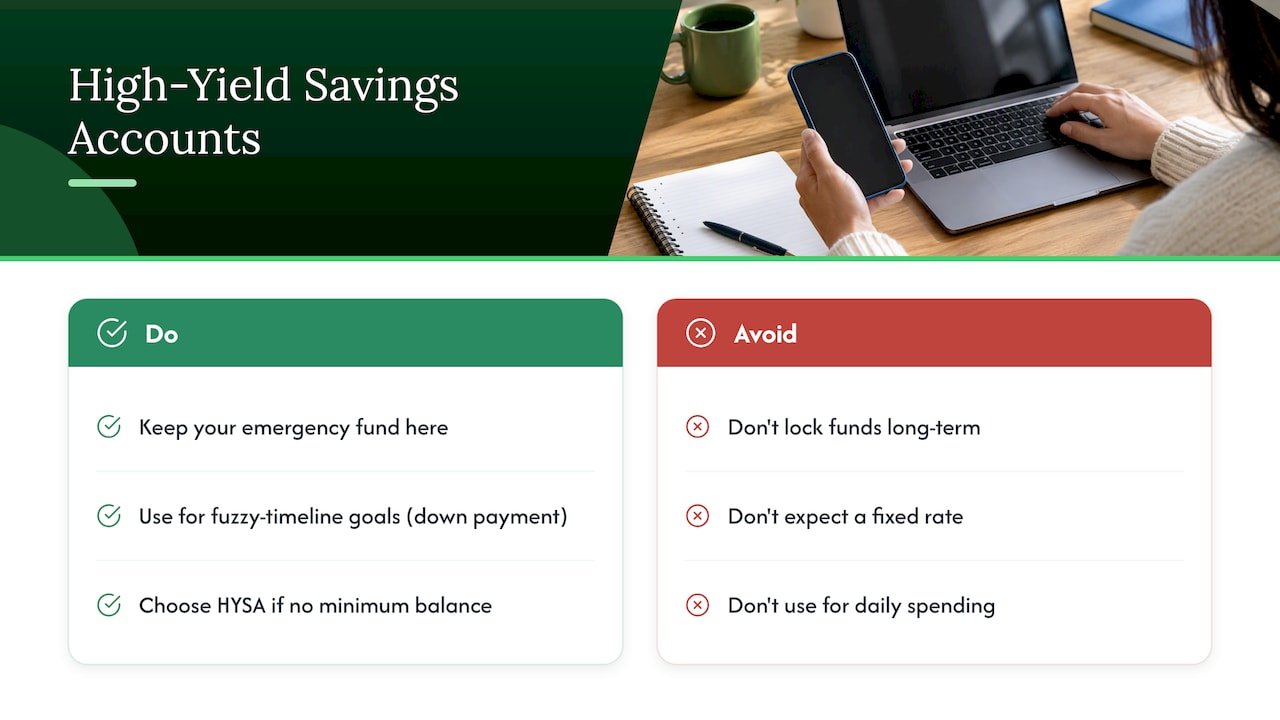
A high-yield savings account functions like a traditional savings account, but it pays a meaningfully higher annual percentage yield, and it usually comes from an online bank rather than a brick-and-mortar branch. You deposit money, it earns interest, and you can withdraw it whenever you need to, though some banks cap the number of free transfers per month.
The “high-yield” part comes down to overhead. Online banks skip the cost of physical branches, and the Consumer Financial Protection Bureau notes that this lower overhead is a major reason online banks can offer higher HYSA rates than many traditional banks offer on standard savings accounts.
The rate itself is variable, meaning it moves with broader market conditions and Federal Reserve policy. When the Fed raises its benchmark rate, HYSA yields tend to climb within weeks. When the Fed cuts rates, your HYSA yield can drop just as quickly, sometimes with little warning beyond an email from your bank.
Most HYSAs have no minimum balance requirement, though a handful set a low minimum to open. Some offer debit cards or ATM access, but many are transfer-only, meaning you move money to a linked checking account before you spend it. That small friction is actually a feature for some savers: it keeps emergency funds from doubling as everyday spending money.
Because the rate floats and the money stays liquid, an HYSA fits best as the home for your emergency fund, a house down payment you’re still saving toward, or any goal where the timeline is fuzzy enough that locking up the cash would be risky.
What a Certificate of Deposit Is and How It Works
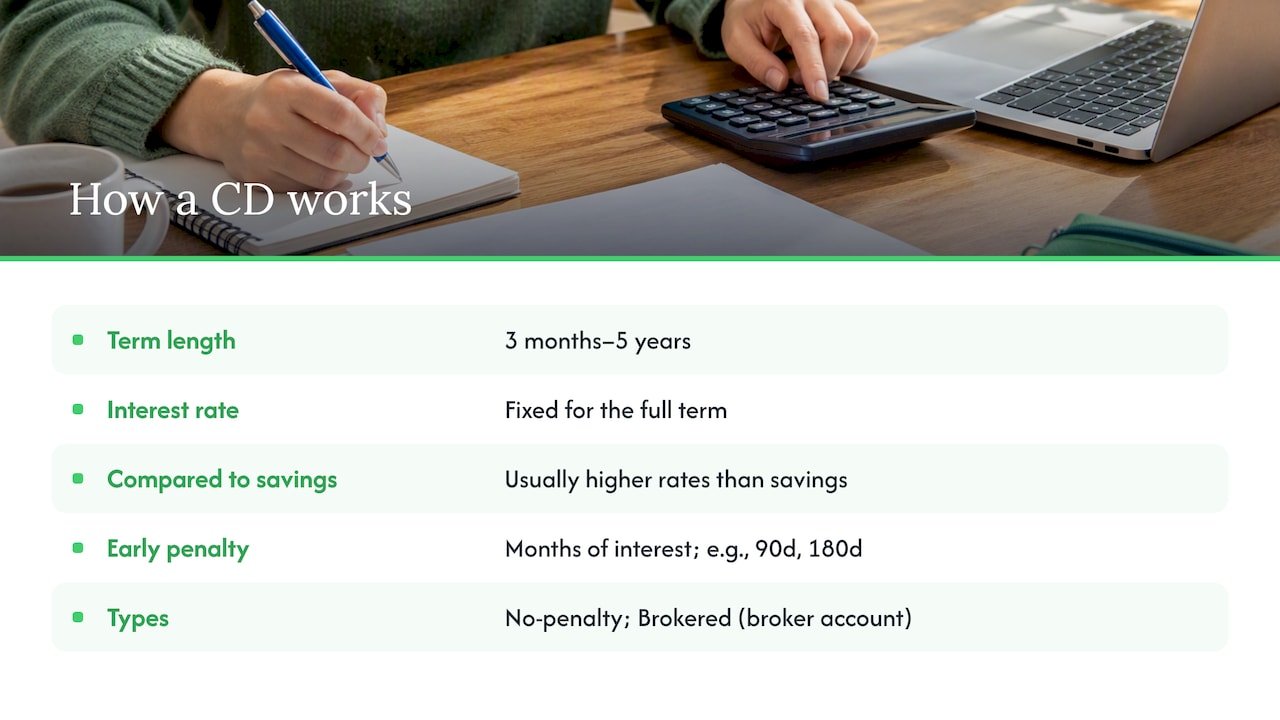
A certificate of deposit asks you to commit a lump sum for a fixed term, usually ranging from three months to five years, in exchange for a fixed interest rate that doesn’t move for the life of the term. Investopedia’s comparison of CDs and savings accounts notes that CDs typically offer higher rates than savings accounts for comparable balances and terms, and that longer terms often pay more than shorter ones.
That higher rate comes with a tradeoff: if you pull your money out before the term ends, you’ll usually pay an early withdrawal penalty. Penalties are typically calculated as a number of months’ worth of interest, for example 90 days of interest on a one-year CD or 180 days on a longer term. If you withdraw early enough, that penalty can eat into your principal, not just your earned interest.
Not every CD works the same way. No-penalty CDs let you withdraw early without a fee, usually in exchange for a slightly lower rate. Brokered CDs, sold through a brokerage account rather than directly from a bank, can offer competitive rates but come with their own fine print. The Investor that product features and penalty schedules vary by issuer, so reading the disclosure before you open an account matters more with CDs than with most savings products.
CDs make the most sense when you already know your timeline: a wedding in 18 months, a tax bill due next spring, a home renovation planned for next year.
Head-to-Head: Rates, Liquidity, Penalties, Insurance, and Taxes
Once you line up an HYSA and a CD side by side, the differences come down to five practical factors.
Rates. HYSA rates float with the market, while CD rates lock in on day one. Investopedia notes that a CD’s rate advantage depends on the term and market conditions at the time of purchase, so a CD opened today might look better or worse than one opened six months from now, depending on where rates have moved.
Liquidity. An HYSA lets you transfer money out within a day or two, with no penalty. A CD locks your funds until maturity, and breaking that commitment early costs you in lost interest, sometimes a chunk of your principal if you withdraw very early in the term.
FDIC insurance. Both products carry the same protection. The FDIC insures deposits up to $250,000 per depositor, per insured bank, per ownership category, and that coverage includes principal plus any accrued interest through the date of default. One detail trips up savers with larger balances: the FDIC’s general principles of insurance coverage confirm that balances aggregate across products in the same ownership category at the same bank, so a savings account and a CD held in your name at the same institution count toward the same $250,000 limit, not separate limits.
Taxes. Interest from both HYSAs and CDs is taxable income. The IRS explains that interest becomes taxable in the year it’s credited to your account, even if you don’t withdraw it, and banks typically report $10 or more in interest on a Form 1099-INT. That rule applies the same way whether the interest came from a savings account or a CD.
Here’s how those factors stack up:
- HYSA rates move with the market, so your yield today may not match your yield in six months.
- CD rates stay fixed for the full term, so you know exactly what you’ll earn when you open the account.
- Early CD withdrawals typically cost you several months of interest, while HYSA withdrawals cost nothing.
- Both account types report interest on a 1099-INT, and you owe tax on that interest in the year you earned it.
A significant portion of U.S. adults report having three months of emergency savings, according to Federal Reserve survey data tracking household financial well-being. That gap is part of why keeping an accessible HYSA balance matters before locking money into CDs at all.
When to Choose a HYSA, When to Choose a CD
The decision usually comes down to two questions: when will you need the money, and how much does a higher fixed rate matter to you compared with staying flexible?
- Building an emergency fund? Keep it in an HYSA. You don’t know when a car repair or medical bill will hit, and a CD’s early withdrawal penalty is the last thing you want to deal with during a crisis.
- Saving for a goal with a known date, like a wedding or a move? A CD or a short CD ladder timed to that date can lock in a better rate than a savings account while still getting your cash back when you need it.
- Not sure which way rates are headed? The Investopedia comparison suggests that when rates are rising, shorter CDs or an HYSA let you reinvest at higher rates later, while locking a CD rate works to your advantage when rates look likely to fall.
- Struggle with the temptation to dip into savings? A CD’s penalty can work in your favor here. Fortune reports that the penalty structure itself acts as a commitment device, discouraging impulsive withdrawals for savers who find a liquid account too easy to raid.
Pro Tip: Keep three to six months of expenses in an HYSA before you commit a single dollar to a CD. Liquidity comes first, yield comes second.
How to Build a CD Ladder
A CD ladder spreads your money across several CDs with staggered maturity dates instead of locking it all into one term. That structure means part of your money becomes available every few months, so you’re never stuck waiting a full year (or five) to access any of it, and you get the chance to reinvest at current rates as each rung matures.
Here’s how a simple ladder works in practice:
- 3-rung ladder: Split your total savings into three equal parts and open CDs with terms of 6 months, 12 months, and 18 months, so one matures roughly every six months.
- 5-rung ladder: Split your total into five parts and open terms of 1, 2, 3, 4, and 5 years, giving you a maturity every year and exposure to typically higher long-term rates.
- At each maturity, decide whether to reinvest into a new long-term rung (keeping the ladder going) or move the funds to your HYSA if you need the cash.
- Watch the renewal window. Most banks auto-renew a CD into the same term at the current rate unless you act within a short grace period after maturity, often just a week or two.
Laddering beats a single long-term CD whenever you want some predictable access to cash without giving up the higher rates that longer terms tend to pay.
Example Math: How Much a CD vs HYSA Pays
Numbers make this easier to picture, so let’s use a simple, illustrative example to show how the math actually plays out. Say you have $100,000 to save for one year.
- At a hypothetical 4.00% APY in an HYSA, your balance would grow over the year, assuming the rate holds steady the entire time, which it may not since HYSA rates are variable.
- At a hypothetical 4.50% APY in a one-year CD, your balance would grow by a fixed and guaranteed amount over the same year, as long as you don’t touch the funds early.
- If you withdrew that CD early and faced a penalty equal to 180 days of interest, you’d give back a portion of those earnings, cutting your net gain for the year accordingly.
CDs typically pay higher rates than savings accounts for comparable terms, though the gap narrows or reverses depending on where the Federal Reserve has set its benchmark rate at any given time. When you compare real offers, look at compounding frequency too: a rate compounded daily will earn slightly more than the same stated rate compounded monthly, since interest starts earning its own interest sooner. If your balance tops $250,000, run it through the FDIC’s EDIE tool before you commit, so you know exactly what’s covered.
Step-by-Step Checklist for Opening a HYSA or CD
Before you open either account, work through this short checklist so you’re not caught off guard later.
- Confirm the bank or credit union carries FDIC or NCUA insurance, and check which ownership category your deposit falls under.
- Compare the APY, minimum deposit, early withdrawal penalty schedule, and compounding frequency across at least two or three offers.
- Have your government-issued ID, Social Security number, and funding account details (routing and account number) ready before you start the application.
- Expect ACH transfers to take one to three business days to clear, so time your funding transfer if you’re working against a rate-lock deadline or a CD promotion.
Our financial management plan guide walks through how to decide what portion of your savings should stay liquid versus locked into a CD, which is worth reading before you commit any large sum.
Win Personal Finance Perspective and Research-Backed Tips
A hybrid approach can be effective: keep your emergency fund and near-term goals in an HYSA, then ladder CDs for expenses you can already see on the calendar. Setting up automatic transfers into your HYSA keeps the habit consistent, and using a CD’s penalty as a built-in commitment device can help if impulse withdrawals have derailed your savings before. Before opening either account, confirm FDIC coverage, understand that interest gets reported on a 1099-INT, and double-check the math on any advertised APY against the actual compounding terms.
A Practical Recommendation for U.S. Savers
We keep coming back to the same conclusion: don’t treat this as an either-or decision. Build your emergency cushion in an HYSA first, then let a CD ladder handle the savings goals you can already date on a calendar. Run the FDIC check on your total balances, work through the math with your own numbers rather than ours, and adjust the ladder’s rungs as your goals shift.
— Win Personal Finance
Where to Go From Here
If you’re ready to put this into action, a few of our guides can help you get the structure right. Our financial management plan walks you through deciding how much to keep liquid versus locked away, and our roundup of free financial wellness tools can help you track balances and automate transfers between accounts.

If building up enough to save in the first place is the real challenge, our guide to smart budgeting habits can help you free up the cash to put toward either option. Start on our homepage for the full library of guides we’ve built to help you make these calls with confidence.
This article is general information, not a substitute for advice from a qualified financial advisor. Consult a qualified financial professional about your own circumstances before acting on anything here.
FAQ
Is it better to put my money in a CD or an HYSA?
It depends on your timeline: an HYSA is better for money you might need on short notice, like an emergency fund, while a CD is better for money you can commit for a known term in exchange for a fixed, often higher, rate. Many savers use both at once, splitting funds between the two based on when they’ll need the cash.
How much interest will a $100,000 CD earn in a year?
Using a hypothetical 4.50% APY as an illustrative example, a $100,000 one-year CD would earn about $4,500 in interest over the year, assuming you hold it to maturity. Actual CD rates vary by bank, term length, and the broader rate environment, so compare current offers before assuming any specific rate applies to you.
How many Americans have $20,000 in savings?
Federal Reserve survey visualizations don’t break out savings balances at the $20,000 threshold specifically, but they do show that roughly half of U.S. adults report having three months of emergency savings in recent survey years. That figure gives a better sense of emergency-fund readiness than any single dollar threshold would.
What’s a typical CD APY range right now?
CD rates vary by term, bank, and the current interest rate environment, with longer terms often paying more than shorter ones when rates are stable or falling. Always compare the specific rate and term offered by a bank rather than relying on a general figure, since advertised rates change frequently.
Does FDIC insurance cover both my HYSA and my CD at the same bank?
Yes, FDIC insurance covers both account types, but coverage aggregates across products held in the same ownership category at the same institution. The FDIC’s general principles of coverage confirm that a savings account and a CD under your name at one bank share the same $250,000 limit, so spreading large balances across different banks or ownership categories keeps everything insured.
Sources
- Fdic
- Certificates of Deposit (CDs) vs. Savings Accounts: Which Is Better for You? — Investopedia
- Interest Income — IRS Topic No. 403
- Report on the Economic Well-Being of U.S. Households — Federal Reserve data visualizations