
Smart financial goals follow a simple framework: Specific, Measurable, Achievable, Relevant, and Time-bound. The fastest way to put this to work is to pick one priority right now and write it down using those five criteria, because CFPB worksheets and Investor both point to writing and automating goals as the most reliable path to follow through.
TL;DR:
- Give every goal a dollar target and deadline, verify the contribution fits income and expenses, and break larger amounts into dated milestones.
- Schedule an automatic transfer for the day after payday, sized to reach the next milestone, so bank processing delays do not trigger a failed payment.
- Check transfers and balances weekly, compare progress with milestones monthly, and revise the amount or deadline after three consecutive missed targets rather than quitting.
- Limit active priorities to one or two, fund them before moving on, and roll the freed cash into the next goal.
- A $2,500 credit card payoff over six months requires $420 monthly above the minimum; prioritize high interest debt before aggressive investing.
Table of Contents
- What each letter of SMART means in practice
- SMART financial goal examples you can copy and adjust
- Turning a goal into weekly and monthly tasks
- Tracking progress without losing steam
- Templates and tools that make this easier
- Why we recommend staging just one or two goals
- Get the templates and start your first goal today
- FAQ
- Sources
What each letter of SMART means in practice
Breaking the acronym into questions makes it usable instead of abstract. Each letter for smart financial goals forces a decision you might otherwise skip, and skipping any one of them is usually why a goal stalls out.
- Specific: name the exact outcome and who it affects, such as “I will pay off my $3,200 credit card balance” instead of “pay off debt.”
- Measurable: attach a number or a clear signal of progress, like a dollar balance, a percentage paid down, or a monthly savings total.
- Achievable: check your current income and expenses, then break a large goal into smaller milestones you can actually reach.
- Relevant: connect the goal to something you already care about, whether that is reducing stress, buying a home, or retiring earlier.
- Time-bound: set a real deadline and add sub-deadlines along the way, since a goal with no end date tends to drift.
Working through these five questions turns a vague wish into a plan you can act on this week. The CFPB’s SMART goals tool includes fillable worksheets built around this exact structure, with space to write out steps, resources, and dates for any goal you’re working toward. Using it as a starting template can be helpful rather than building one from scratch.
SMART financial goals examples you can copy and adjust
Seeing a goal written out fully makes the framework click faster than reading definitions. Adjust the dollar amounts and timelines below to match your own numbers, but keep the structure intact.
- Short-term, emergency fund: save $1,000 in a separate savings account within 90 days by automating a $112 weekly transfer.
- Short-term, debt payoff: pay off a $2,500 credit card balance in six months by paying $420 monthly above the minimum.
- Short-term, holiday fund: set aside $600 for holiday spending by November 1 through $100 monthly transfers.
- Mid-term, down payment: save $10,000 for a car down payment in 18 months by setting aside $556 per month.
- Mid-term, certification: fund a $1,500 professional certification within 12 months by saving $125 monthly.
- Long-term, retirement: increase retirement contributions by 2% of income this year, then review and raise it again annually.
- Long-term, education: build a $20,000 college fund over 10 years through $167 monthly contributions to a dedicated account.
Each example hits every SMART financial goals element: a specific dollar figure, a measurable target, a monthly amount that fits a realistic budget, a reason tied to your priorities, and a clear deadline. That one-to-one mapping is what separates a SMART goal from a general intention.
Turning a goal into weekly and monthly tasks
A written goal only moves forward once it becomes a routine. Breaking it into dated milestones and recurring actions is what makes the difference between a goal on paper and money actually moving.
- Split your smart financial goals into four to six dated milestones, each with its own mini-target (for example, $250 saved by week four).
- Review your spending in the categories that tend to dominate a budget, since BLS data shows housing, transportation, food, personal insurance and pensions, and healthcare made up roughly 83.7% of household spending in 2024, which is where most reallocation opportunity lives.
- Automate a recurring transfer sized to hit your next milestone, scheduled for the day after payday so the money moves before it gets spent.
- Set a calendar reminder or use a bill and goal tracking app so transfers and due dates don’t slip through the cracks. Our budgeting habits guide walks through several ways to free up cash for this step.
- Choose one tracking method, whether a spreadsheet or a free app, and check it weekly for five minutes and monthly for a fuller reconciliation.
- Direct at least half of any raise, bonus, or tax refund toward your current goal before it gets absorbed into regular spending.
Pro Tip: Schedule automatic transfers for the day after your paycheck lands, not the day of, since bank processing delays can bounce an early transfer.
Missed due dates derail momentum faster than almost anything else. A partner resource on avoiding missed bills covers reminder tactics that work well alongside automated transfers.
Tracking progress without losing steam
Checking in regularly keeps a goal visible instead of forgotten. Three numbers matter most: your current balance, your percentage complete, and your rate of progress compared to your plan.
- Do a two-minute weekly check of your transfer and balance, just to confirm nothing bounced.
- Pull a fuller account snapshot once a month and compare it against your milestone schedule.
- Review the whole goal quarterly and decide whether the amount or the timeline needs adjusting.
Regular, automated contributions are consistently cited as one of the most reliable ways to build savings over time, according to Investor.gov, which frames the combination of regular investing and time as the core driver of long-term wealth.
If you miss a milestone once, keep going. If you miss three in a row, that’s the signal to revise the amount or stretch the deadline rather than abandon the goal. Telling a friend or family member about your goal, or stacking your new savings habit onto an existing routine like paying rent, both help keep it top of mind.
Templates and tools that make this easier
You don’t need to build a tracking system from scratch. A few public and site resources cover most of what’s needed to plan, automate, and monitor a SMART goal.
- The CFPB’s SMART goals worksheet and its companion “putting goals into action” module walk through writing a goal, listing the steps, and assigning resources and dates.
- The broader CFPB Your Money, Your Goals toolkit includes worksheets for staging multiple goals and revising them as life changes.
- Investor.gov’s saving and investing guidance explains why automated, regular contributions compound into meaningful savings over years.
- Our own financial management plan lays out a step-by-step framework with downloadable templates that pair well with the worksheets above.
- Our roundup of free financial wellness tools covers apps for tracking budgets and automating transfers toward your goals.
Why we recommend staging just one or two goals
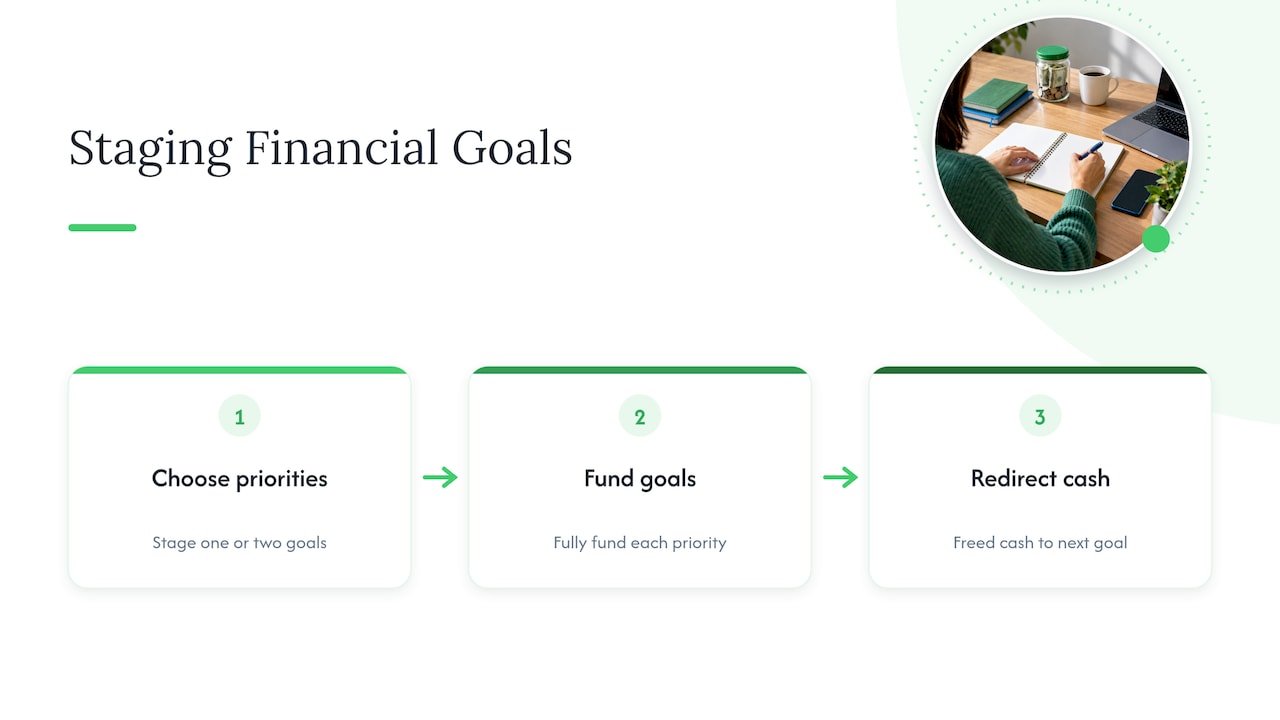
Trying to chase five financial goals at once is one of the fastest ways to abandon all of them. We’ve found that staging one or two priorities, funding them fully, then rolling the freed-up cash into the next goal, keeps momentum intact in a way that spreading thin rarely does.
Automation does the heavy lifting once a goal is set. The habit that matters most isn’t willpower, it’s building a system where the transfer happens whether or not you remembered to think about it that week.
Pick one goal from the examples above, write it out using the SMART framework, and set up the automation this month.
— Win Personal Finance
Get the templates and start your first goal today
We built our financial management plan to take the guesswork out of this process, with copy-ready templates that walk you from a written SMART goal straight into a working budget and automated transfer schedule.

If you’re saving alongside a partner, roommates, or family toward a shared target, a workspace like PoolCash can help split contributions and track who’s paid what without the spreadsheet headache. Pair either approach with our list of free financial wellness tools to automate the transfers and track your progress in one place. Visit our financial management plan now to download the templates and set your first goal before the month ends.
FAQ
What are 5 SMART financial goals examples?
Five common examples include saving $1,000 for an emergency fund in 90 days, paying off a $2,500 credit card in six months, saving $10,000 for a car down payment in 18 months, funding a $1,500 certification in a year, and building a $20,000 college fund over 10 years. Each one names a dollar amount, a deadline, and a monthly contribution, which is what makes it measurable and time-bound rather than a vague intention.
What are 5 good SMART financial goals?
Strong financial goals typically cover building an emergency fund, paying down high-interest debt, saving for a major purchase like a car or home, increasing retirement contributions, and setting aside money for education or certifications. Investor.gov suggests tackling high-interest debt before aggressive investing, since the interest owed often outweighs expected investment returns.
What are examples of SMART financial goals?
Financial goals range from short-term targets like building a $1,000 starter emergency fund to long-term goals like retirement savings or a child’s college fund. The key is writing each one with a specific number, a deadline, and a plan for how the money gets there, using the SMART framework to keep it concrete.
What is the 70/20/10 rule money?
The 70/20/10 rule is a budgeting approach where 70% of income covers living expenses, 20% goes toward savings or debt payoff, and 10% goes to giving or discretionary spending. It’s one of several simple budgeting splits people use to direct money toward SMART goals without tracking every category in detail.