
Aim to save enough to cover your upfront move-in costs plus at least one month of essential expenses, and ideally a few months if your timeline allows. The Federal Reserve tracks how young adults’ spending shifts once they leave a parent’s home, and BLS data confirm housing is the largest line in most budgets. We built this guide to help you turn those numbers into a real savings plan and understanding your moving out budget.
TL;DR:
- Saving at least three to six months of essential living expenses is crucial to withstand unexpected costs during the first year of independence.
- Move-in costs often exceed first and last month’s rent, including deposits, application fees, pet fees, insurance, and utility setup charges.
- A typical move can range from a few hundred dollars locally to several thousand dollars for long-distance relocation, so obtaining multiple quotes is recommended.
- Building a savings plan with automatic transfers and tracking monthly milestones helps ensure you reach your target before moving day.
- In high-cost cities, a $10,000 savings might only cover move-in costs and a small cushion, making delayed moves or reduced expenses advisable.
Table of Contents
- Calculate Your Upfront Move-In Costs
- Estimate the Cost of the Move Itself
- Build a Monthly Budget for Your New Place
- Why You Need an Emergency Fund Before You Move
- What $1,000, $5,000, and $10,000 Actually Cover
- How to Save Faster and Cut Your Move-In Costs
- Costs People Forget and a Move-In Checklist
- How Our Guides Help You Build This Budget
- A Few Honest Thoughts on Saving for Your First Place
- Put This Plan to Work With Our Free Tools
- FAQ
- Sources
Calculate Your Upfront Move-In Costs
Before you sign anything, you need a single number: the total cash required to get keys in hand. This figure almost always surprises first-time renters because it is rarely just “first month’s rent.”
Start by pulling every charge mentioned in the listing, then confirm each one in writing. The FTC’s guidance on rental housing fees warns that advertised base rent often leaves out amenity, parking, and trash charges, so treat your lease like a financial contract rather than a one-line price tag. Ask the property manager for a written cost summary before you commit. A sample lease from Consumer shows the clauses you should expect: rent due dates, security deposit terms, and who pays for utilities.
Your upfront total typically includes:
- First month’s rent, due at signing in most leases.
- Security deposit, often equal to one month’s rent but sometimes higher for pets or lower credit scores.
- Last month’s rent, which some landlords require upfront as a second deposit.
- Application and administrative fees, usually $30 to $75 per applicant.
- Pet deposits or monthly pet rent, plus parking fees in many urban buildings.
- A renters insurance policy, frequently mandatory before you get keys.
Here’s a quick worked example. Say a one-bedroom apartment lists for $1,400 a month. You might owe $1,400 for first month’s rent, $1,400 for a security deposit, $50 for an application fee, $300 for a pet deposit, and $15 a month for renters insurance. That puts your move-in total near $3,165 before you’ve rented a single truck. Running this math against your own lease terms is the single most useful thing you can do before you start packing boxes.
Estimate the Cost of the Move Itself
Once you know your move-in total, add the cost of actually getting your belongings from point A to point B. This number swings widely based on distance, volume, and whether you hire help.
A local move with a rented truck and a few friends might run $150 to $400 once you account for a truck rental, gas, and packing supplies like boxes and tape. Hiring professional movers for the same local move typically runs $800 to $2,500, depending on crew size and hours. Long-distance moves climb fast: a cross-country haul through a moving company can run several thousand dollars once you factor in fuel, tolls, and sometimes a night or two in a hotel along the way. A long-distance moving resource like All In Moving can give you a sense of how quotes vary by distance and load size before you commit to a date.
Your moving line item usually includes:
- Truck rental or professional mover fees, the single biggest swing factor.
- Fuel and tolls, especially for long-distance routes.
- Packing supplies: boxes, tape, bubble wrap, and furniture blankets.
- Short-term storage if your move-in date doesn’t line up with your move-out date.
- Travel costs like gas, flights, or a hotel stay for longer relocations.
Pro Tip: Get at least three moving quotes and ask about off-peak pricing. Movers often charge less for weekday moves and for dates outside the first and last weekends of the month.
Build a Monthly Budget for Your New Place
Your move-in costs get you through the door, but your monthly budget determines whether you can actually stay. This is where a lot of first-time renters underestimate what it takes to sustain a household.
Start by listing every recurring expense you’ll owe once you’re settled:
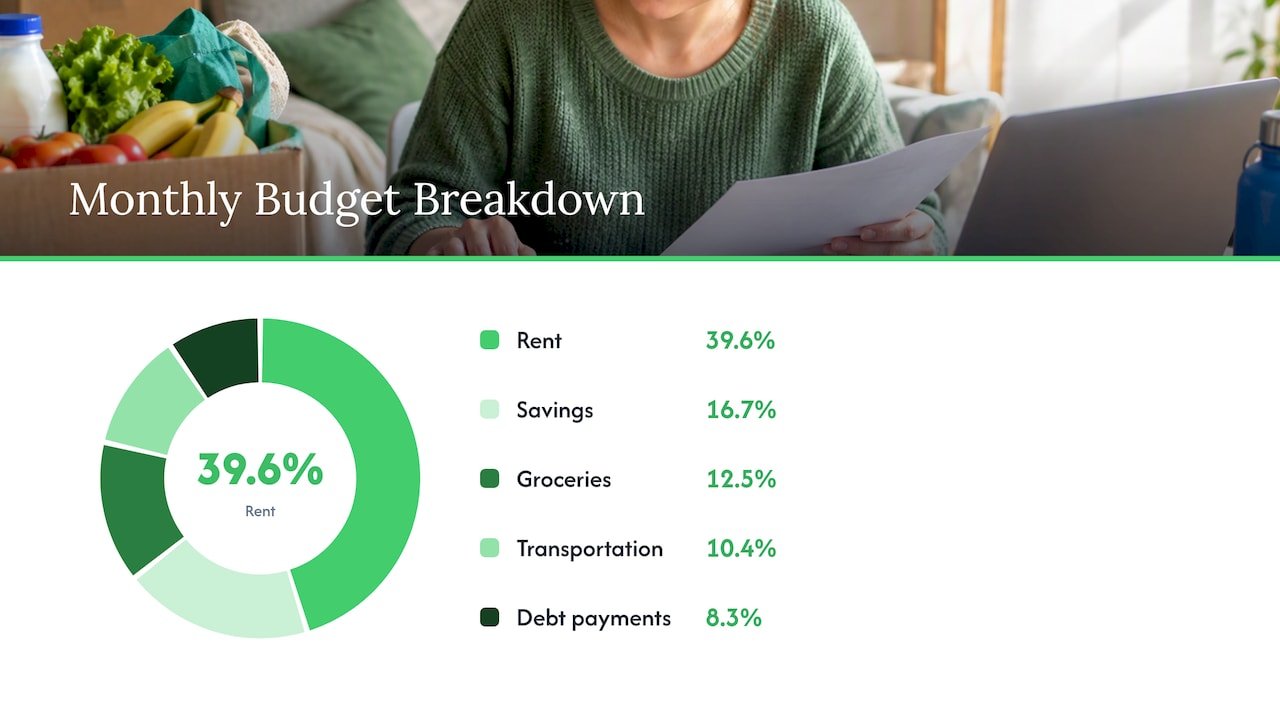
- Rent, your largest fixed cost.
- Utilities, including electricity, gas, and water.
- Internet and phone service.
- Groceries and household supplies.
- Transportation, whether that’s a car payment, gas, or transit passes.
- Renters insurance, typically a modest monthly premium.
- Any existing debt payments, like student loans or a credit card balance.
- Subscriptions, from streaming services to a gym membership.
- Savings, treated as a required line item rather than an afterthought.
A common starting point is the 30% rule, which suggests keeping rent at or below 30% of your gross income. Another is the 50/30/20 framework, which splits income into needs, wants, and savings. Use these guidelines as a baseline, then adjust based on your actual numbers.
Housing is the largest category in most household budgets, and BLS data show it has been a primary driver of rising consumer expenditures in recent years. That makes it worth prioritizing over nearly every other line item when you’re deciding what you can afford.
Here’s a worked example for someone earning $3,200 a month after taxes: rent at $950, utilities at $150, internet and phone at $90, groceries at $300, transportation at $250, insurance at $20, debt payments at $200, subscriptions at $40, and savings at $400. That totals $2,400, leaving a $800 buffer for discretionary spending or extra savings.
Before you sign a lease, stress-test that budget.
Why You Need an Emergency Fund Before You Move
A monthly budget covers predictable expenses, but it won’t help you when your car breaks down or your hours get cut. That’s what a separate emergency fund is for, and it matters more in the first year on your own than at almost any other point in your financial life.
The Federal Reserve and related household well-being research point to a common guideline: build a cushion covering three to six months of essential living expenses, which often lands somewhere between $6,000 and $18,000 depending on your regional cost of living and income level.
To calculate your own target, total your true essentials, meaning rent, utilities, groceries, insurance, transportation, and minimum debt payments, then multiply by the number of months of coverage you’re aiming for.
- Identify your essential monthly costs only, leaving out discretionary spending like subscriptions or dining out.
- Multiply that figure by three for a baseline cushion.
- Multiply by six if your income is irregular, such as freelance or commission-based work.
- Round up slightly to account for the credit-card float trap, where covering unexpected costs with a credit card creates high-interest debt that’s hard to shake in your first months on your own.
If a full three-to-six month fund feels out of reach before your move date, a smaller one-month cushion is a reasonable fallback. The goal is to avoid relying on credit for basic survival expenses while you build toward a fuller reserve over your first year.
What $1,000, $5,000, and $10,000 Actually Cover
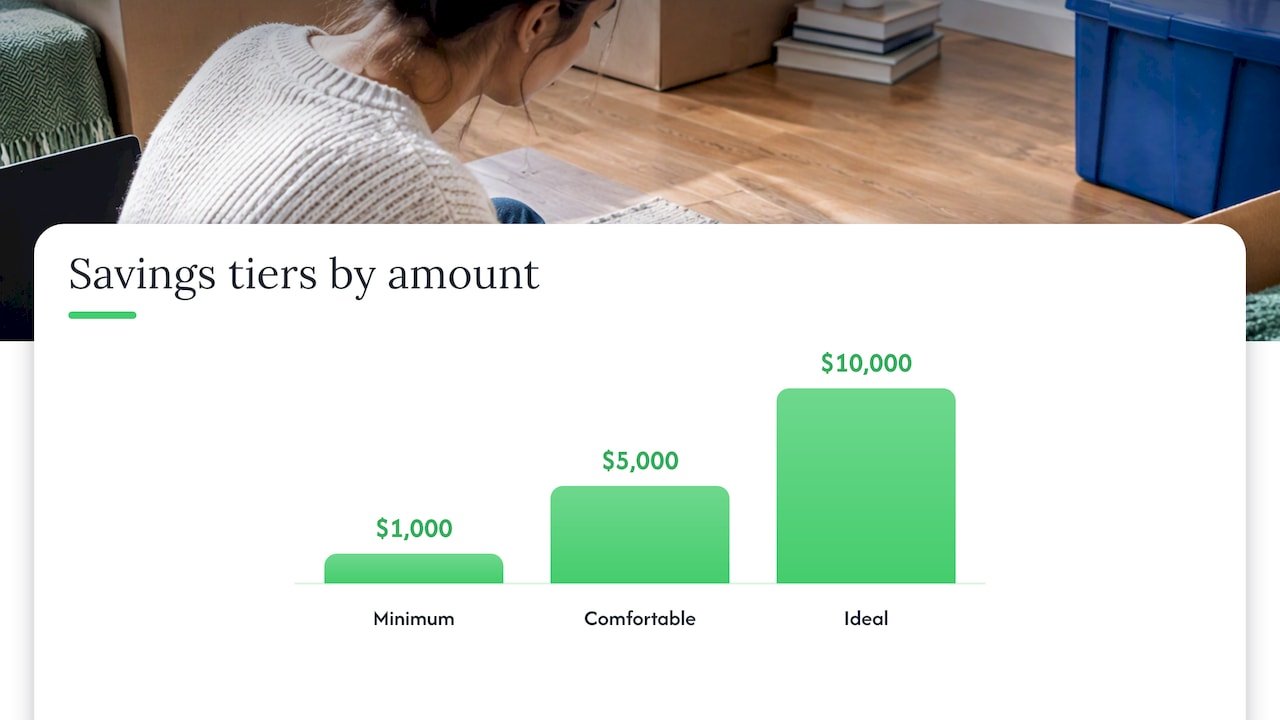
Not every mover starts with the same amount saved, and the outcome looks very different depending on where you land. Three tiers help frame the decision: minimum, comfortable, and ideal.
A minimum target covers your move-in costs and little else: first month’s rent, deposit, and basic moving expenses, with no cushion for emergencies. A comfortable target adds essentials and a one-month buffer on top of move-in costs. An ideal target adds a full three-to-six month emergency fund, built using the Federal Reserve-based calculation above.
- With $1,000, you can likely cover move-in costs on a modest apartment with a roommate, but you’ll have no cushion and should expect to live paycheck to paycheck for several months.
- With $5,000, you can typically cover move-in costs, basic furnishing, and a one-month essentials cushion for a modest one-bedroom in most mid-cost areas.
- With $10,000, you’re likely positioned for move-in costs, furnishing, and a meaningful head start on a three-month emergency fund, especially outside high-cost metro areas.
| Savings level | What it typically covers | Main gap |
|---|---|---|
| $1,000 | Move-in costs with a roommate, minimal furnishing | No emergency cushion |
| $5,000 | Move-in costs, basic furniture, one month of essentials | Limited room for a larger emergency fund |
| $10,000 | Move-in costs, furnishing, partial to full emergency fund | May still fall short in high-cost metro areas |
If your current savings sit well below the minimum tier for your target rent, that’s a signal to delay your move date, add a roommate to cut your per-person move-in costs, or look at a lower cost-of-living area before signing anything.
How to Save Faster and Cut Your Move-In Costs
The gap between where you are and your savings target shrinks fastest when you work both sides: saving more and spending less on the move itself.
- Set a specific monthly savings target and automate a transfer the day you get paid.
- Pick up extra shifts or a short-term side gig specifically earmarked for your moving fund.
- Buy used furniture from marketplace listings or thrift stores instead of new.
- Stagger non-essential purchases across your first few paychecks rather than buying everything at once.
- Negotiate your move-in date to avoid rushed, premium-priced moving services.
- Recruit friends for a DIY move and compare at least three mover quotes if you go professional.
Start this process four to six months before your target move date if you can. Break your total savings goal into monthly milestones by dividing your total target by the number of months you have. For a $6,000 goal over five months, that’s $1,200 a month, a number you can track weekly to stay on pace. Our budgeting habits guide walks through practical ways to hit a target like this without feeling like you’re sacrificing everything along the way.
Pro Tip: Open a separate savings account just for your moving fund so the money is out of sight and harder to spend on everyday purchases.
Costs People Forget and a Move-In Checklist
Even a careful budget tends to miss a handful of smaller costs that add up fast once you’re actually moving in.
- Utility deposits, which some providers require from renters with no prior account history.
- Internet installation or equipment fees, often charged separately from the monthly rate.
- Renters insurance, sometimes required by the lease and easy to overlook in early planning.
- Small household basics: shower curtain, trash cans, cleaning supplies, and a toolkit.
- Local taxes or municipal fees tied to utility setup in some cities.
- Parking permits, HOA fees, or pet fees not listed in the original rent quote.
Call your utility providers directly to confirm deposit requirements, and check your city or county website for any local setup fees before move-in day. A simple checklist you can copy into your budget spreadsheet: rent, deposit, application fee, movers, utility deposits, internet setup, renters insurance, cleaning supplies, and a small contingency line for whatever you forgot the first time.
How Our Guides Help You Build This Budget
We built our resources around the same categories covered in this guide, because a savings target only matters if you actually hit it. Our financial management plan guide walks through turning a lump-sum target, like the $1,000, $5,000, or $10,000 scenarios above, into a month-by-month savings timeline.
- Our budgeting habits guide covers the specific habits that keep a moving fund on track once you’ve set it.
- Our step-by-step financial management plan helps you convert your move-in total into a realistic savings schedule.
- We focus on practical, beginner-friendly steps rather than jargon, so you can apply these tools the same week you read them.
Setting a target is the easy part. Automating your savings and checking your progress monthly is what actually gets you to move-in day with the cushion you planned for.
A Few Honest Thoughts on Saving for Your First Place
The biggest mistake we see first-time movers make isn’t underestimating rent, it’s underestimating everything around it: the pet deposit, the utility setup fee, the inevitable trip to the store for a shower curtain and a broom. Those small costs rarely feel significant on their own, but they stack up fast in your first month.
If you can only hit one of the three savings tiers before you move, we’d rather you lean conservative. A thinner furniture budget is an inconvenience. An empty emergency fund during your first car repair or reduced-hours week is a real problem. Prioritize the cushion over the nonessential purchases every time.
Put This Plan to Work With Our Free Tools
Once you know your number, the next step is making it automatic instead of relying on willpower every payday. Win Personal Finance is where we keep our full library of guides built for exactly this stage of your financial life.

Our financial management plan guide walks you through turning your move-in total and emergency fund target into a simple savings timeline with monthly milestones. If you want help choosing the right accounts and apps to automate the process, our list of free financial wellness tools covers options for tracking spending and setting up automatic transfers without paying for premium software.
- Use the financial management plan to turn your savings target into monthly milestones.
- Pair it with our budgeting habits guide to keep spending in check once you’ve moved.
- Check our free tools list for ways to automate transfers into your moving fund.
Start with the financial management plan guide this week and set your first automatic transfer before your next paycheck lands.
This article is general information, not a substitute for advice from a qualified financial advisor. Consult a qualified financial professional about your own circumstances before acting on anything here.
FAQ
Is $10,000 enough to move out?
For most renters, $10,000 comfortably covers move-in costs, basic furnishing, and a meaningful start on an emergency fund, especially outside high-cost metro areas. In expensive cities, it may cover move-in costs and essentials but fall short of a full three-to-six month cushion as recommended by Federal Reserve guidance.
What is the $27.40 rule?
This isn’t a standard or widely recognized financial guideline, so we won’t assign it a definition here. If you’ve seen it referenced elsewhere, it likely refers to a specific daily savings calculation tied to a particular savings goal and timeline rather than an established budgeting rule.
Is $8,000 enough to move out?
A budget around $5,000 typically covers move-in costs, basic furnishing, and a one-month essentials cushion, corresponding to the comfortable tier. Whether it stretches to a larger emergency cushion depends heavily on your local rent and the move-in fees in your specific lease.
Is $5,000 enough to move out?
For many renters in mid-cost areas, $5,000 covers move-in costs, basic furnishing, and roughly one month of essential expenses as a cushion. In higher-cost metro areas, that same amount may only stretch to cover move-in costs with little left over for a buffer.
Sources
- Federal Reserve: Young adults’ spending in and out of their parents’ home
- BLS Consumer Expenditures news release (2024/2025 results)